Updating your news feed...

NEWS EXPRESS is Nigeria’s leading online newspaper. Published by Africa’s international award-winning journalist, Mr. Isaac Umunna, NEWS EXPRESS is Nigeria’s first truly professional online daily newspaper. It is published from Lagos, Nigeria’s economic and media hub, and has a provision for occasional special print editions. Thanks to our vast network of sources and dedicated team of professional journalists and contributors spread across Nigeria and overseas, NEWS EXPRESS has become synonymous with newsbreaks and exclusive stories from around the world.




Loading banners
Loading banners...

Nigeria has produced several sporting prodigies who announced themselves early but failed to sustain the promise that surrounded their careers.
From FIFA youth World Cup winners and Golden Ball recipients to Olympic medallists and world champions, many appeared destined for long and successful careers at the highest level.
Some were affected by injuries or illness, while others struggled after early moves to Europe. Poor career decisions, lack of opportunities, disciplinary issues, personal tragedy and doping sanctions also played a role.
Here are 15 Nigerian sports stars whose bright starts did not last.
Etim Esin was one of Nigeria’s most celebrated football talents of the 1980s. Born in Oron, Akwa Ibom State, in 1966, he rose through Iwuanyanwu Nationale, Flash Flamingoes and Calabar Rovers before breaking into the national junior team.
His skills earned him the nickname “African Maradona” and he featured at the 1987 FIFA World Youth Championship in Chile.
Esin later moved to Belgium, where he played for Lokeren and Lierse. His career, however, was disrupted by an allegation of rape. Although he was reportedly cleared, the controversy contributed to his departure from Europe.
Esin never played at a World Cup, which he later described as one of his biggest regrets.
Philip Osondu was the outstanding player at the 1987 FIFA U-16 World Championship in Canada.
He scored four goals as Nigeria reached the final and won the Golden Ball as the tournament’s best player.
Anderlecht signed him in 1988 when he was only 17, but he struggled to secure regular first-team football in Belgium.
He subsequently moved through several Belgian clubs but never earned a senior Nigeria cap.
Osondu died in Belgium in 2019 at the age of 48 after falling ill at work.
Dimeji Lawal was part of Nigeria’s successful youth teams at the 1987 U-16 World Championship and 1989 World Youth Championship.
His performances earned him a move to Real Madrid, where he joined the club’s reserve side alongside fellow Nigerians Mutiu Adepoju and Chris Ohenhen.
However, he couldn’t break into the first team.
Lawal later returned to Nigeria before playing in Belgium and South Africa. He scored on his senior international debut against Togo but earned only three caps.
The emergence of players such as Finidi George further limited his opportunities with the Super Eagles.
Goalkeeper Ambrose Vanzekin progressed through Nigeria’s youth teams alongside players such as John Obi Mikel and Chinedu Obasi.
He was part of the Flying Eagles side that won the 2005 African Youth Championship and reached the FIFA World Youth Championship final.
Three years later, he was in goal as Nigeria won silver at the 2008 Beijing Olympics.
Despite his achievements at youth and Olympic levels, Vanzekin never earned a senior Super Eagles cap.
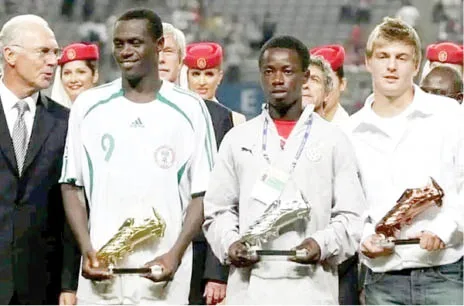
Macauley Chrisantus was the leading scorer at the 2007 FIFA U-17 World Cup in South Korea.
He scored seven goals as Nigeria won the title and collected the Golden Shoe.
Several European clubs reportedly showed interest before he joined Hamburg in Germany at 17.
The move failed to produce the expected breakthrough. Chrisantus played for Hamburg’s reserve side but never appeared for the club in the Bundesliga.
He was subsequently loaned out before spells in Spain, Turkey, Greece, Finland and Italy.
Rabiu Ibrahim was once regarded as one of Nigeria’s brightest midfield prospects.
His technical ability and passing range led to comparisons with former Super Eagles captain Jay-Jay Okocha.
Ibrahim represented Nigeria at youth level and later earned senior opportunities, but he failed to establish himself as a regular international midfielder.
Sani Emmanuel was named the best player at the 2009 FIFA U-17 World Cup hosted by Nigeria.
He scored five goals and won the Golden Ball as the Golden Eaglets finished runners-up to Switzerland.
The performance attracted interest from leading European clubs, but Emmanuel eventually joined Lazio.
He failed to break into the Italian club’s first team and was sent on loan to Salernitana and Swiss side Biel-Bienne.
Injuries, particularly foot and Achilles problems, repeatedly disrupted his career.
He eventually quit professional football at 22. In 2019, former Super Eagles midfielder Ogenyi Onazi helped fund surgery for him.
Sunday Mba became one of the heroes of Nigeria’s 2013 Africa Cup of Nations triumph.
He scored the winning goal against Ivory Coast in the quarter-final before netting the decisive goal against Burkina Faso in the final.
The midfielder appeared destined for a major European move, but instead joined French lower-division club CA Bastia in 2014.
He missed the 2014 World Cup and later moved to Turkey.
Oluyemi Kayode was one of Nigeria’s leading sprinters in the early 1990s.
He won silver in the 4x100m relay at the 1992 Barcelona Olympics alongside Chidi Imoh, Olapade Adeniken and Davidson Ezinwa.
He also reached the Olympic 200m final and won silver in the event at the 1993 African Championships.
Kayode was regarded as a potential medal contender for the 1996 Atlanta Olympics.
However, his career and life were cut short when he died in a car accident in Arizona on October 1, 1994. He was only 26.
Seun Ogunkoya emerged as one of Africa’s fastest sprinters in the late 1990s.
At 19, he became one of the youngest athletes to break the 10-second barrier in the 100m, running 9.97 seconds in 1997.
He won the African title the following year and set an African record of 9.92 seconds in Johannesburg.
Ogunkoya also won silver in the 4x100m relay at the 1997 World Championships.
His career subsequently declined. He later cited personal problems, poor management and inadequate support among the factors that affected his progress. He eventually moved into coaching.
Divine Oduduru rose to prominence in American collegiate athletics, winning two NCAA titles at Texas Tech.
He recorded a Nigerian record of 19.73 seconds in the 200m and a personal best of 9.86 seconds in the 100m.
He competed at the Tokyo Olympics, reaching the 200m semi-finals.
His career was later derailed by a doping case linked to the Eric Lira investigation involving performance-enhancing substances.
The Athletics Integrity Unit subsequently imposed a six-year ban on Oduduru.
He has maintained his innocence, but the sanction effectively ended his immediate prospects of competing at the highest level.
Samuel Peter is the only boxer on the list and one of its biggest success stories.
Born in Akwa Ibom, Peter represented Nigeria at the 2000 Sydney Olympics before turning professional.
He won his first 24 professional fights and established himself as one of the division’s most feared punchers.
In March 2008, he stopped Oleg Maskaev to win the WBC heavyweight title, becoming Nigeria’s first world heavyweight champion.
However, his reign lasted only one fight.
Peter lost the title to Vitali Klitschko in his first defence and later suffered defeats against Wladimir Klitschko and Eddie Chambers.
He retired with 34 wins, including 27 knockouts, and five defeats. (Daily Trust)