Updating your news feed...

NEWS EXPRESS is Nigeria’s leading online newspaper. Published by Africa’s international award-winning journalist, Mr. Isaac Umunna, NEWS EXPRESS is Nigeria’s first truly professional online daily newspaper. It is published from Lagos, Nigeria’s economic and media hub, and has a provision for occasional special print editions. Thanks to our vast network of sources and dedicated team of professional journalists and contributors spread across Nigeria and overseas, NEWS EXPRESS has become synonymous with newsbreaks and exclusive stories from around the world.














.webp)







Loading banners
Loading banners...

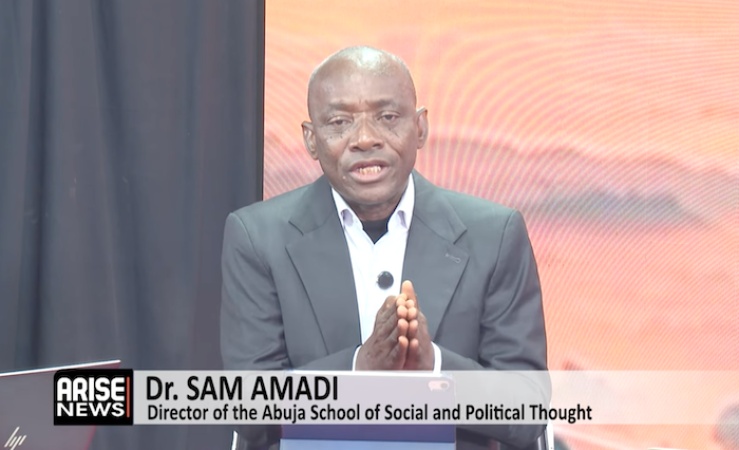
The Director, Abuja School of Social and Political Thoughts, Dr. Sam Amadi, has called on the Federal Government to tell Nigerians the truth about the release of kidnapped corps members, questioning claims of a successful rescue amid reports that families paid ransom.
Following reports of the rescue of 20 NYSC corps members who were reportedly kidnapped by gunmen in Imo State on October 1, Amadi, while speaking with ARISE NEWS on Friday in an interview, has questioned the circumstances of their release, urging the Federal Government to tell Nigerians the truth amid claims that families paid ransom.
“The question is: do we have any rescue, or do we have release after ransom? The ransom industry is such a big economy. The problem is when the government lies and tries to pass itself off as effective or efficient, when evidence shows otherwise. How will you challenge the testimony of families who paid ₦6 million or who paid in US dollars, which is the normal currency of black market business?
“These things are clear; the government couldn’t rescue them. It doesn’t even have extraordinary prowess.
“This is shameful. We require truth. Tell us the truth; don’t just talk about failure. Tell the truth, because governance is about telling the people the truth.”
Amadi described the incident as evidence of the Nigerian state’s inability to tackle even low-level criminal activities, arguing that the failure to secure the corps members from what he called “ragtag kidnappers” reflected deeper institutional weaknesses.
He also questioned the government’s operational capacity, drawing parallels with concerns over military aircraft maintenance and the police’s inability to effectively respond to security threats.
“Every time they’re ready to strike, they do. It shows the state’s incapacity—a Nigerian phenomenon. It is now clear that the Nigerian state lacks the capacity to deal with low-tech robbery and kidnapping. These guys are not using the most sophisticated equipment. They’re not like non-state actors in Colombia with sophisticated networks and technology; they’re ragtag guys. And each time, the Nigerian state cannot defeat them; it can’t do the basics.
“There’s a story of a state that has collapsed in technical capability to get things done. We can’t get our fleet all okay to fly without washing with water and cleaning before takeoff; we can’t get our police to act. Meanwhile, in Imo State, they have a notorious group focused on extortion and arresting political opponents. They just can’t extricate corps members from ragtag kidnappers.”
Acknowledging that security forces may have made efforts to locate the kidnapped corps members, Amadi insisted that success, rather than effort, should determine their performance, arguing that repeated failures to secure victims exposed gaps in the country’s security capabilities.
“It’s true efforts are made, but my point is that there’s something wrong with our capability to deal with these threats, and they are recurrent.
“There’s nowhere in Imo State that is extremely difficult. The point I’m raising is that if each time people are kidnapped we can’t get them out, even though we make good efforts, it speaks about our incapacity. The benchmark should always remain success, performance, and effectiveness, not necessarily effort.”
He added that ransom payments were placing severe financial pressure on families, forcing many to borrow money from relatives and neighbours.
“The story is the same: it ends up with parents under pressure to part with borrowed money. This industry of kidnapping is wrecking the economy of homes. People are borrowing massively and getting neighbors to pay for them. The essence of economic growth is savings and investment. If families are pulling together money from several relatives to pay someone who will spend it on consumption, you’re wrecking the economy.
“Whether they made their best effort or not, we should now be measuring success by results, not by effort, because too many times we’ve not gotten any results.”
Dr Amadi warned that conflicting accounts of the corps members’ release could undermine public trust, insisting that the government must be honest about the circumstances surrounding their freedom. He said authorities should acknowledge security challenges rather than claim a successful rescue if families paid ransom, adding that such payments could force children out of school as households struggle with debt.
He maintained that admitting the country’s security shortcomings would be a necessary step towards rebuilding public confidence and strengthening institutional capacity.
“It goes to the heart of public trust. There’s something wrong with saying the place is lined with IEDs and we couldn’t penetrate, but the kidnappers, after collecting money, released them. That’s undignified.
“There’s something dangerous when government begins to tell lies. Governance is the art of telling the people the truth. Truth should be the form of governance. If you fabricate a story that you rescued them when families paid money because nobody gave them assurances.
“So let’s admit our crisis. Let’s not paper over it; let’s not politicize it. Tell the truth: ‘We tried, but there are crises, and we couldn’t get there because of X, Y, Z.’ Then people can begin to re-invest trust and rebuild capacity because they did the best they could.”
Questioning the safety of prospective corps members, Amadi cited the ADC’s call for a one-year suspension of the NYSC scheme if their movement cannot be guaranteed.
“Why not stop NYSC if you can’t guarantee movement? The ADC has raised that issue about suspending it for one year.” (Arise News)