Updating your news feed...

NEWS EXPRESS is Nigeria’s leading online newspaper. Published by Africa’s international award-winning journalist, Mr. Isaac Umunna, NEWS EXPRESS is Nigeria’s first truly professional online daily newspaper. It is published from Lagos, Nigeria’s economic and media hub, and has a provision for occasional special print editions. Thanks to our vast network of sources and dedicated team of professional journalists and contributors spread across Nigeria and overseas, NEWS EXPRESS has become synonymous with newsbreaks and exclusive stories from around the world.



Loading banners
Loading banners...

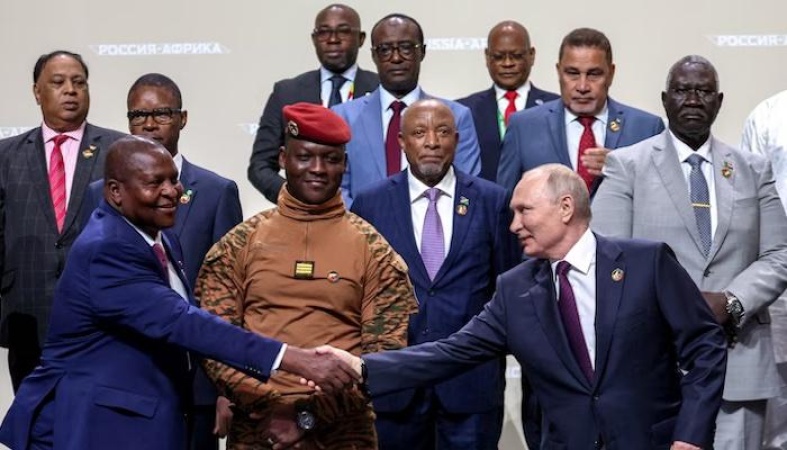
With barely a month to go before the Third Russia-Africa Summit, scheduled for 28–29 October in Moscow, African delegations face a question that has nothing to do with diplomacy and everything to do with arithmetic: is it worth the risk of flying into a capital that Ukrainian drones now reach with uncomfortable regularity, and what, precisely, does Africa get for making the trip at all?
The security question answers itself first. On 6 October, roughly 650 drones struck the Moscow region in one of the largest such attacks of the war, killing two people and setting a warehouse ablaze; it followed a 20 September assault in which some 450 drones were aimed at the capital specifically, part of a wider barrage of 1,600 launched across Russia that day. These are not isolated incidents but a pattern, and one that has already reached African carriers directly. In early September, Air Tanzania suspended its Dar es Salaam-Moscow route following a risk assessment, resuming it only days later under commercial and diplomatic pressure. “If Air Tanzania judged it necessary to temporarily suspend flights, it was not without reason,” a Tanzanian official close to the matter is reported to have said. “But what happens if Moscow is struck again during the summit, or if air defences are activated while we are there?”
That question deserves more than Moscow’s choreography will allow. The danger is not that Ukraine would deliberately target an African delegation; it is that civilian aviation and live air defence operations now share the same airspace over the same city, with precedents that should concentrate minds. In 2014, flight MH17 was shot down over eastern Ukraine, killing all 298 people aboard. In December 2024, Azerbaijan Airlines flight J2-8243 crashed after apparently being struck during Russian air defence operations against drones, killing 38. Neither involved an African carrier, but both show what happens when commercial aircraft fly through contested skies.
“If Russia cannot secure its own capital, what exactly is it offering the African governments that have come to treat it as a security guarantor?”
Moscow’s pitch to Africa rests on a narrower premise than its rhetoric suggests, not development, not shared prosperity, but protection, delivered through private military contractors and now the state-run Africa Corps in Mali, the Central African Republic and beyond. Putin said in 2023 that Russia had military-technical cooperation agreements with more than 40 African states; US congressional research has identified regime protection, not institution-building, as the principal attraction. That comparative advantage is strongest precisely where African institutions are weakest, which is a different business from development entirely.
The economic case is no sturdier. At the inaugural Sochi summit in 2019, Putin set a target of roughly doubling Russia-Africa trade within four to five years, implying a figure near $40bn. By Lavrov’s own account, 2025 turnover came in at just over $27bn, and Russia still accounts for less than 1% of foreign direct investment into Africa. That gap has not gone unnoticed inside the delegations themselves. “It would be interesting to discuss the ‘win-win’ aspect of this partnership. For now, that is not the case,” a source close to Ghana’s delegation said, adding pointedly: “AI can wait, political stability cannot,” a rejoinder aimed squarely at Lavrov’s own list of summit priorities, artificial intelligence, digital payments, alternative currencies, which reads less like an African agenda than one exported wholesale from Moscow. Gabon has reportedly settled the matter outright, declining to send its president or his inner circle to a summit held far from its borders and further still from its citizens’ concerns.
More troubling than the shortfall is what increasingly fills it. A US Congressional Research Service assessment notes reports that African gold and other resources have helped Russia cushion sanctions pressure. Now another resource appears increasingly relevant: people. Amnesty International’s September investigation documented deceptive and coercive recruitment of foreign nationals, disproportionately from poorer Global South countries, into Russia’s armed forces, concluding that in many cases the practices amounted to human trafficking. A partnership cannot credibly be called mutually beneficial if Africans searching for ordinary jobs end up supplying manpower for someone else’s war.
This is also why the summit’s location deserves scrutiny, not just its agenda. Russia has now held three summits with Africa, Sochi in 2019, St Petersburg in 2023, Moscow in 2026, and has never once brought the gathering to African soil. Compare that with France’s Africa Forward Summit, held in Nairobi on 11–12 May 2026 and co-chaired jointly by Macron and Kenya’s president, the first such summit in Africa, with African hosts, African protocol and African convening power. Whatever one thinks of France’s own record on the continent, the choice of venue signalled something Moscow has never offered: treating African leaders as co-chairs of their own partnership rather than invitees to someone else’s capital. If Russia’s engagement with Africa is genuinely a partnership of equals rather than a demonstration of whose capital commands the guest list, there is no structural reason the next summit could not be held in Addis Ababa, Nairobi or Abuja, co-chaired by an African head of state. That it has not been, after three editions, says as much about the relationship as any communiqué will.
None of this argues for severing ties with Moscow. Russia remains a significant arms supplier and a useful counterweight for states diversifying away from former colonial patrons, and strategic autonomy means keeping options open, not foreclosing them. But engagement is not deference, and a summit is not evidence that a partnership is working. As one official close to the preparations put it: “For three years now we have been discussing a summit held in Africa; it remains a dead letter. But on top of that, we now run the risk of being bombed.” Before African leaders sign on to another round of declarations in a city that cannot fully guarantee their physical safety, the least they owe their own citizens is an honest answer: if Russia cannot protect itself, and will not even meet Africa halfway on its own soil, what exactly is this partnership protecting?
•Oumarou Sanou is a social critic, Pan-African observer and researcher focusing on governance, security and political transitions in the Sahel. He writes on geopolitics, regional stability and African leadership dynamics. Contact: sanououmarou386@gmail.com