Updating your news feed...

NEWS EXPRESS is Nigeria’s leading online newspaper. Published by Africa’s international award-winning journalist, Mr. Isaac Umunna, NEWS EXPRESS is Nigeria’s first truly professional online daily newspaper. It is published from Lagos, Nigeria’s economic and media hub, and has a provision for occasional special print editions. Thanks to our vast network of sources and dedicated team of professional journalists and contributors spread across Nigeria and overseas, NEWS EXPRESS has become synonymous with newsbreaks and exclusive stories from around the world.

















Loading banners
Loading banners...

A growing number of Republican candidates in competitive US congressional races are distancing themselves from President Donald Trump ahead of the November 3 midterm elections, a Reuters review has found.
Two-thirds of Republican candidates in closely contested House and Senate races have either broken with Trump on policy issues or sought to play down their association with him.
The Reuters review of voting records, public statements and campaign materials found candidates in 41 of 62 competitive congressional races seeking some distance from the president.
Rather than rejecting Trump’s wider political agenda, most of the candidates have instead separated themselves from him on individual issues, apparently seeking to appeal to independent voters while avoiding a direct confrontation with the Republican leader.
Policy disagreements were the most common form of divergence, appearing in 23 of the 62 races reviewed by Reuters.
The war with Iran was a major source of disagreement in 12 contests. Some vulnerable Republicans voted to limit Trump’s war powers, while others publicly called for an end to the conflict, which has contributed to higher gas prices and increased pressure on household budgets.
Data centres have also emerged as an issue dividing Trump from some Republican candidates. Reuters identified three candidates in competitive races who criticised or sought to slow down such projects despite Trump’s support for faster development.
The development is significant because Trump has reshaped the Republican Party around his political agenda and has previously responded strongly to lawmakers and candidates who oppose him.
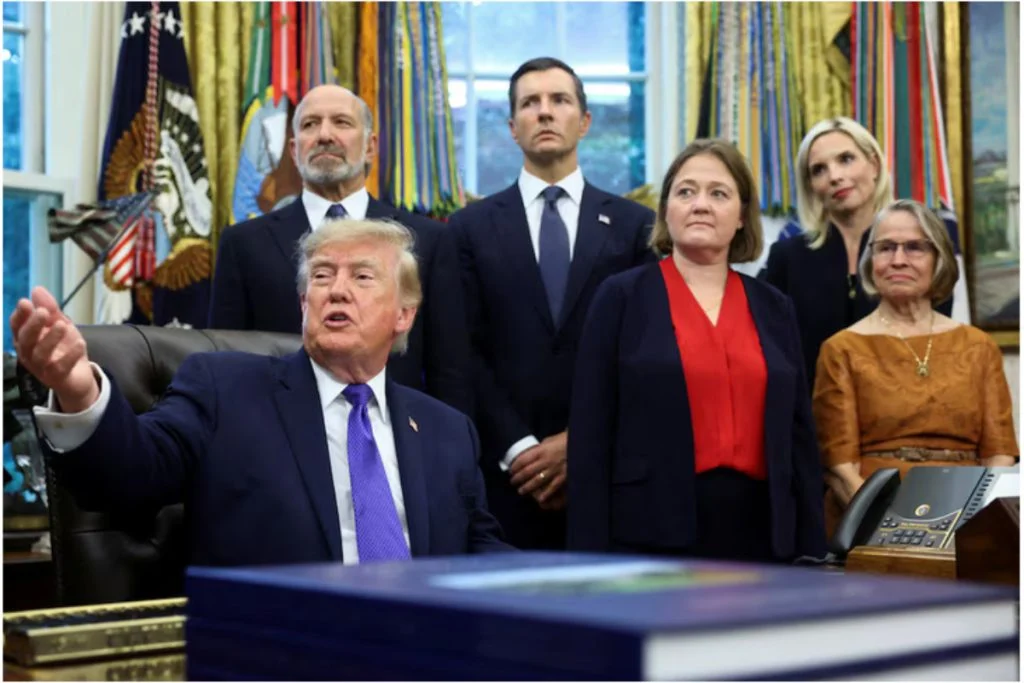
White House spokesman Davis Ingle defended the president when asked about the Reuters findings, describing Trump as “the unequivocal leader, best messenger and unmatched motivator” for the Republican Party.
The review also found that some Republicans are reducing visible associations with Trump. Twelve candidates removed his name, image or endorsements from their campaign websites, with most doing so after securing their party’s nomination.
Others have taken less direct steps, including skipping Trump’s campaign events or refusing to say whether they want him to campaign for them.
Direct criticism of Trump remains relatively uncommon, reflecting the risks Republican candidates face in openly challenging a president who retains strong support among many members of the party.
Republican strategist Ron Bonjean said the candidates were responding to voters in their respective races.
“(Candidates) are reflecting voter attitudes in these races,” Bonjean said. “If (voters) are not with Trump, then they need to show a break.”
One example is Republican Senator Pete Ricketts of Nebraska, who is facing a tough challenge from independent candidate Dan Osborn. Ricketts has criticised Trump’s plan to expand beef imports while continuing to support the president on other issues.
He nevertheless appeared alongside Trump at a Nebraska rally this week.
“President Trump, I have been fighting for you in Washington,” Ricketts told the crowd.
Republican Representative Mariannette Miller-Meeks of Iowa has also broken with Trump on several issues, including his beef-import policy and the war in Iran.
Despite voting to limit Trump’s war powers, she later joined the president at the White House for the announcement of a major steel plant investment in Iowa.
Republican consultant Jeanette Hoffman described the strategy as “a balancing act”, saying candidates were attempting to benefit from the administration’s achievements while creating distance because of “how toxic the Trump brand is at the moment.”
The political repositioning comes as Trump faces weak approval ratings. A Reuters/Ipsos poll found his approval rating at a career-low 32%, while registered voters preferred Democrats over Republicans by 44% to 37%. Among independent voters, Democrats held a 37% to 21% advantage.
With control of Congress at stake, Republican candidates are therefore attempting to balance loyalty to Trump with the need to appeal to voters who may be uncomfortable with the president. (Reuters)