Updating your news feed...

NEWS EXPRESS is Nigeria’s leading online newspaper. Published by Africa’s international award-winning journalist, Mr. Isaac Umunna, NEWS EXPRESS is Nigeria’s first truly professional online daily newspaper. It is published from Lagos, Nigeria’s economic and media hub, and has a provision for occasional special print editions. Thanks to our vast network of sources and dedicated team of professional journalists and contributors spread across Nigeria and overseas, NEWS EXPRESS has become synonymous with newsbreaks and exclusive stories from around the world.














Loading banners
Loading banners...

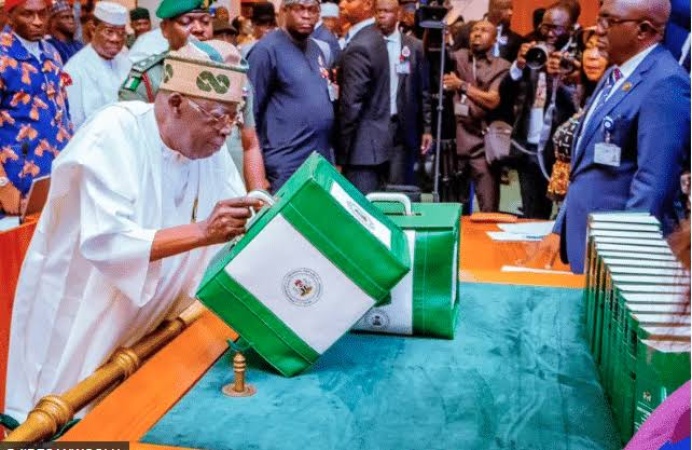
President Bola Ahmed Tinubu presenting the 2026 budget before the joint sitting of the National Ass
There are legal concerns over President Bola Tinubu’s signing of the law extending the implementation of the 2025 budget from September 30, 2026, to December 31, 2026.
The President assented to the bill on Wednesday, September 30, a day after the Senate and House of Representatives approved the fourth extension of the 2025 budget.
The Presidency said the extension would give Ministries, Departments and Agencies (MDAs) more time to complete ongoing capital projects and ensure that funds already appropriated are fully put to work without disrupting critical programmes.
Daily Trust had previously reported that lawyers and civil society organisations raised legal and accountability concerns over the repeated extension of the 2025 budget, particularly the implications of allowing the appropriation to run alongside the 2026 budget.
The concerns centred on the constitutional requirement for annual budgeting, the tracking of expenditure under overlapping appropriations and the ability of oversight institutions to determine which budget authorises projects executed during the extended period.
The latest extension has now moved the debate from whether the 2025 appropriation should be extended to the legal and accountability implications of keeping it in force while the 2026 budget is already being implemented.
What The Constitution Says
Lawyer Victoria Adaji said the legal implications of the extension should be considered against the provisions of the 1999 Constitution governing Nigeria’s budgeting and financial year.
She referred to Section 81(1), which provides that the President shall cause to be prepared and laid before each House of the National Assembly, in each financial year, estimates of the revenues and expenditure of the Federation for the “next following financial year.”
Adaji also cited Section 318 of the Constitution, which defines a financial year as 12 months beginning on January 1 and ending on December 31.
“The legal implications of the National Assembly extending the 2025 budget’s capital component for a fourth time to December 31, 2026, while overlapping with a signed 2026 budget and staring down 2027 fiscal discussions, represent a structural breakdown in Nigeria’s public finance management,” Adaji said.
She said the overlap could create difficulties in tracking public expenditure.
“This poses a tracking nightmare as this violates basic public accounting laws,” she said.
Adaji specifically raised concerns about the ability of the Auditor-General of the Federation to determine which appropriation funded projects executed during the extended period.
“The Auditor-General of the Federation faces a legal gridlock trying to track whether a contract executed in October 2026 was funded by the 2025 extension or the 2026 main allocation,” she said.
According to her, repeated extensions could gradually alter the character of Nigeria’s annual budgeting system.
“By this four-time extension, Nigeria is effectively transforming its budgetary framework into a rolling three-year cycle managed through ad-hoc amendments, eroding the rule of law in public finance management,” Adaji said.
She also noted that the Constitution does not provide a statutory deadline for the presentation of the budget.
“It’s quite unfortunate that our constitution poses no statutory deadline which is the driving force. It only defined financial year unlike Ghana,” she said.
Adaji cited Ghana and Kenya as examples of countries with statutory timelines for presenting budget documents.
“Ghana section 179(1) requires presentation of budget document not later than one month before the end of the financial year or Kenya, section 221(1) requiring submission at least two months before the end of each financial year,” she added.
Human rights lawyer Udochukwu Onoh said the repeated extension exposed longstanding problems in Nigeria’s budget approval and implementation process.
“Every budget is intended to be expended within the same year. Unfortunately, in Nigeria, it takes us longer to deliberate on budget approval and presidential assent,” Onoh said.
He said delays in budget passage and presidential assent had caused implementation to spill into subsequent years.
“Even when it has been passed, the signing by the President takes time to the extent that it has to spill over to the next year. This is a serious problem and citizens should hold the office holders accountable,” he said.
Onoh also raised concerns about the failure to properly retire unspent funds and account for expenditure before another budget takes effect.
“The fact that whatever is not expended is not retired is another problem. Even CSOs that should hold power to account are gradually losing their voices,” he said.
He urged government agencies to complete the necessary retirement and accounting processes.
“If the budget is yet to be implemented, by virtue of the fact that the existing one is in use, then the agencies should make necessary retirement before the next one. Every penny should be accounted for,” Onoh said.
While acknowledging that circumstances beyond government’s control could necessitate an extension, he warned that such circumstances should not undermine accountability.
“The extension could be for reasons beyond their control, but the money involved should not develop wings and fly; otherwise, there is a serious problem and the citizens must stand up to their responsibility to hold power to account,” he said.
Country Director of Accountability Lab Nigeria, Friday Odeh, also raised concerns about the implications of the fourth extension for Nigeria’s appropriation system.
“The fourth extension of the 2025 capital budget destroys the legal sanctity of the Appropriation Act, reducing a statutory law into a flexible administrative suggestion or political convenience,” Odeh said.
He argued that overlapping spending periods could make expenditure tracking and legislative oversight more difficult.
“Operating overlapping spending windows across multiple years creates an unmonitored dual fiscal regime that dismantles expenditure tracking, obscures rollover funds, and severely cripples the oversight capacity of the Office of the Auditor General for the Federation,” he said.
Odeh also argued that repeated extensions could conceal broader weaknesses in revenue generation and capital budget implementation.
“Repeated extensions disguise chronic revenue deficits and poor capital absorptive capacity as mere procurement delays,” he said.
He argued that prolonged implementation periods could affect government’s financial management.
“By continuously stretching execution timelines to cover unfunded budget lines, the executive branch distorts cash flow management, inflates debt service costs through late borrowing, and triggers inflationary pressures when pent up liquidity is suddenly released into the economy,” Odeh said.
He also criticised the legislature’s role in approving repeated extensions.
“The legislature has abdicated its constitutional power of the purse by granting continuous lifelines instead of enforcing fiscal realism,” he said.
Odeh called for stronger scrutiny of projects covered by the extension.
“Restoring accountability requires an immediate project by project audit of extended items, a strict single extension limit tied to performance conditions, and the systematic re-appropriation of unfinished capital works into subsequent annual budgets rather than legalizing indefinite extensions,” he said.
NESG Warns Of Fiscal Improvisation
The Nigerian Economic Summit Group (NESG) said Nigeria’s public finance system is based on annual budgeting and anchored in Chapter V, Part I of the 1999 Constitution.
According to the group, the President prepares and presents the Appropriation Bill, while the Appropriation Act authorises expenditure from the Consolidated Revenue Fund for a specific financial year.
It also said the Financial Year Act standardises the financial year from January 1 to December 31.
The NESG said persistent delays in budget preparation, passage and implementation had necessitated legislative extensions beyond statutory timelines, raising questions around constitutional validity, fiscal discipline and governance implications.
The group described the development as a pattern of “fiscal improvisation” and said concurrent budgetary operations could weaken legislative oversight and create blurred audit trails.
It acknowledged that extensions could prevent disruptions to essential services and allow government to complete delayed projects.
However, it warned that frequent rollovers could weaken legislative oversight and create blurred audit trails.
The NESG also said repeated extensions could disincentivise timely budgeting and diminish parliamentary control over public expenditure.
It argued that extensions diminish parliamentary power over the purse, transforming the legislature from appropriation authority to retrospective validator.
The group further warned that normalising repeated extensions could create a moral hazard by reducing incentives for timely budget preparation, passage and implementation.
The Legal Question
At the centre of the controversy is the relationship between Nigeria’s annual budget system and the power of the National Assembly to amend an existing appropriation.
The Presidency said the latest extension is intended to give MDAs more time to complete ongoing capital projects and ensure that already appropriated funds are put to work.
The lawyers and civil society actors, however, have focused on what the extension means for the constitutional and accountability framework governing public expenditure.
Their concerns include whether expenditure under the extended 2025 appropriation can be clearly distinguished from spending under the 2026 budget, whether unspent funds are properly retired and whether overlapping appropriations could complicate the work of oversight institutions.
With the President’s assent, the 2025 budget will remain in operation until December 31, 2026. (Daily Trust)





