ADAD
ADADUpdating your news feed...

NEWS EXPRESS is Nigeria’s leading online newspaper. Published by Africa’s international award-winning journalist, Mr. Isaac Umunna, NEWS EXPRESS is Nigeria’s first truly professional online daily newspaper. It is published from Lagos, Nigeria’s economic and media hub, and has a provision for occasional special print editions. Thanks to our vast network of sources and dedicated team of professional journalists and contributors spread across Nigeria and overseas, NEWS EXPRESS has become synonymous with newsbreaks and exclusive stories from around the world.
.webp)
.webp)










Loading banners
Loading banners...

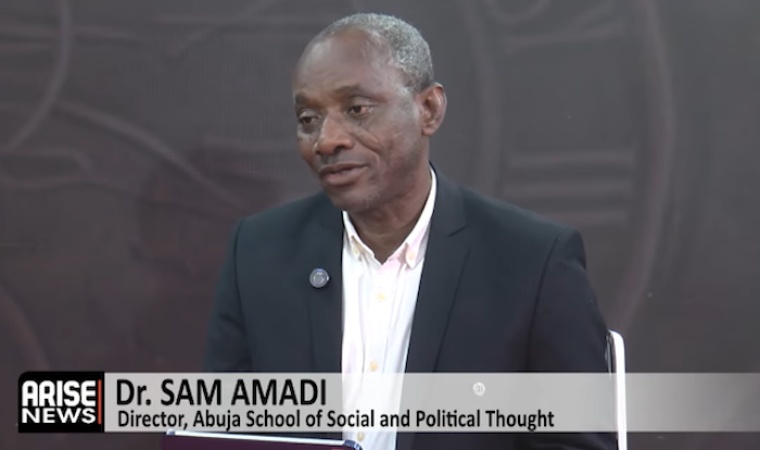
The director, Abuja School of Social and Political Thought, Dr Sam Amadi, has commented on the recent exchange between Arise TV presenter, Rufai Oseni, and Lere Olayinka, media aide to the Minister of the Federal Capital Territory, Nyesom Wike, stressing the need for public officials to engage constructively with journalists, whom he said must maintain professionalism during interviews.
Recall that the exchange occurred during an interview on the Morning Show programme on Arise News on Friday morning, when Rufai Oseni’s question drew a sharp response from Lere Olayinka, who indicated that he would not answer questions from the presenter, before the interview was abruptly brought to an end.
The exchange has since sparked reactions among netizens, with Dr Amadi offering his perspective on the responsibilities of both public officials and journalists in such encounters.
“Hosts should serve as conduits for public understanding, helping to expose weaknesses or false claims tactfully rather than joining the fight directly.
“If Lere was invited, he is still expected to address the questions. Refusing to do so sets a poor precedent. However, their relationship has a history that tends to get personalized and combative. While one can argue that you cannot pick who interviews you, an official who attends an interview should engage constructively.”
Amadi said the media’s constitutional responsibility requires professionalism, stressing that anchors and show hosts should respect the dignity of their guests and avoid approaching interviews with an intention to “get” the person being interviewed.
“The press has a social responsibility anchored in the constitution under freedom of the press and expression. That responsibility requires professionalism. Media anchors and show hosts should respect the dignity of the person being interviewed. Walking in with an attitude of ‘I’m going to get him’ leads to lost opportunities to engage a public official on substantive principles. The media’s role is to inform and communicate with the audience, not to engage in shouting matches.”
Turning to the 2027 elections and the nature of political debates, Amadi acknowledged that politicians are driven to outsmart one another, often through name-calling and mudslinging, but said the political discourse must be elevated to focus more on issues affecting Nigerians.
“Realism dictates that the main aim of politicians is to outsmart one another, which can include name-calling and mutual mudslinging. However, there is a need to elevate politics. This depends on the political market and demand and supply. If political constituencies mobilize attention around policy issues, politicians will have an incentive to focus on them. They look at what works. If the media, political centers, and intellectual class shape the agenda to address real issues, politicians will adjust their approach.
“Currently, the framing leans toward personality, conspiracies, and drama. While we can encourage politicians to elevate the discourse, the media and think tanks must shape that agenda. Issues like the economy, hunger, security, health insurance, and the rule of law should be the focus. The present struggles strengthen the case for issue-based politics.”
On the character of candidates ahead of the 2027 elections, Amadi said effective governance depends not only on policy but also on personality, urging voters to scrutinise candidates’ integrity, credibility and past conduct before making their electoral choices.
“Effective governance is about policy and personality. So we want to hear more about people and their misdeeds and their non-candor and corruption because it helps us make the right choice. The right choice is not just a choice of policy—subsidy, no subsidy—it’s also about personality. Can we trust you to deliver what you promise? Yes, we should be less smearing, but we should bring up everything that shows that a candidate is good or not good.” (Arise News)