ADAD
ADAD
Updating your news feed...
NEWS EXPRESS is Nigeria’s leading online newspaper. Published by Africa’s international award-winning journalist, Mr. Isaac Umunna, NEWS EXPRESS is Nigeria’s first truly professional online daily newspaper. It is published from Lagos, Nigeria’s economic and media hub, and has a provision for occasional special print editions. Thanks to our vast network of sources and dedicated team of professional journalists and contributors spread across Nigeria and overseas, NEWS EXPRESS has become synonymous with newsbreaks and exclusive stories from around the world.






.webp)


Loading banners
Loading banners...

As Nigeria moves towards the 2027 general elections, a small but notable group of women are seeking a place on the country’s highest political stage, bringing backgrounds that range from grassroots mobilisation and party administration to public health, humanitarian work, entertainment and entrepreneurship.
But while their emergence offers a glimpse of women increasingly seeking space at the highest level of politics, the substitution of Anita Zugwai-Chukwu by the Young Progressives Party (YPP) means that only two women now remain in the presidential race, according to the latest development.
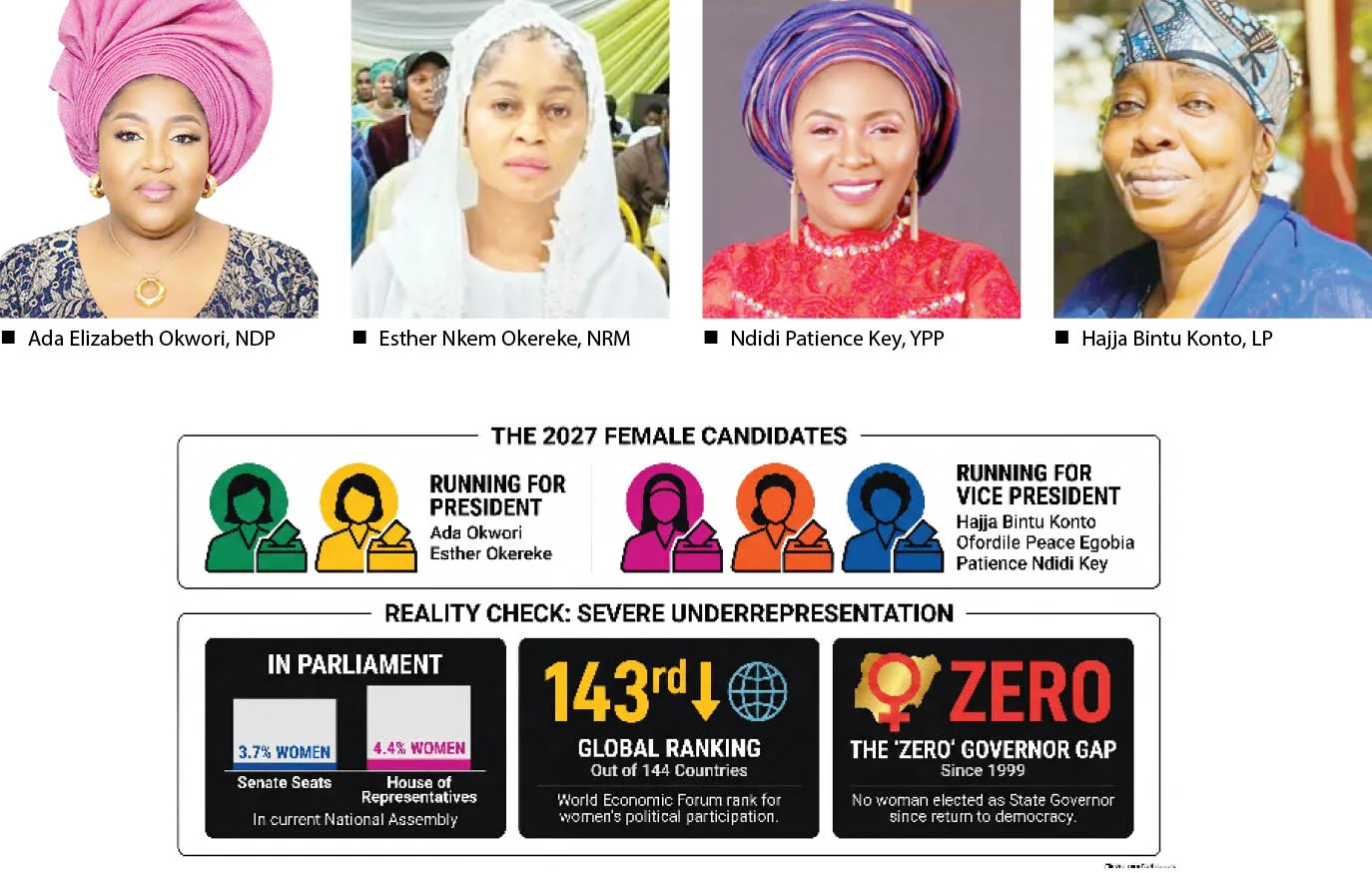
The women featured in the emerging 2027 contest include Ada Elizabeth Fredrick Okwori of the National Democratic Party (NDP), Esther Nkem Okereke of the National Rescue Movement (NRM), Hajja Bintu Konto of the Labour Party (LP) and Ofordile Peace Egobia of the Action Peoples Party (APP). Okwori and Okereke are presidential candidates, while Konto and Egobia are on vice-presidential tickets. Ndidi Patience Key was also nominated as running mate to the new presidential candidate that replaced Zugwai-Chukwu on the YPP platform.
Zugwai-Chukwu had earlier made history as the YPP’s first female presidential standard-bearer after being adopted unopposed at the party’s national convention in Abuja on May 30, 2026. However, the party has since substituted her with Peter Agada as its presidential candidate.
The development further highlights the fragile nature of women’s representation at the highest level of Nigerian politics.
The women seeking to lead
Ada Okwori, the NDP national chairman, emerged as the party’s presidential candidate after a consensus process involving its structures across the country.
An Idoma from Benue State, with roots in Otukpo, Okwori has been involved in politics through the Peoples Democratic Party and grassroots mobilisation. She founded the Ward2Ward initiative, which promotes political participation at the community level.
Her political message centres on grassroots participation, the inclusion of women and young people, social welfare and infrastructure development. She has also spoken against the influence of money politics and political godfathers.
Her immediate challenge is to turn that grassroots identity into nationwide visibility and organisation in an increasingly crowded presidential field.
Esther Nkem Okereke has perhaps the most unconventional profile among the presidential candidates.
A Nollywood actress and film producer, she has also worked in entrepreneurship, philanthropy and investment. She emerged as the NRM’s presidential candidate at the party’s convention in Abuja on May 29, 2026, after competing with other aspirants.
Her “ESTHER Agenda” focuses on Education, Security, Technology, Housing, Entrepreneurship and Restitution. She has identified insecurity, poverty, unemployment, corruption and institutional weaknesses as some of the country’s major challenges.
On the vice-presidential tickets are women with equally varied backgrounds.
Hajja Bintu Konto, the Labour Party’s running mate to Dr Chibuzo Sunday Okereke, is a veteran public health and humanitarian practitioner with more than three decades of experience in healthcare, community development and humanitarian intervention.
She worked with Catholic Relief Services, including assignments in Borno, Adamawa and Yobe states, where she participated in programmes serving vulnerable communities and internally displaced persons.
Her professional interests have included public health, nutrition, water, sanitation and hygiene, humanitarian response and community development. She holds a master’s degree in public health and has experience in community health education.
Ofordile Peace Egobia is the APP’s vice-presidential candidate and running mate to Kabiru Yusuf. Compared with the other women, publicly available information about her professional and political background remains limited.
Patience Ndidi Key (PNK), the running mate to Peter Agada of the YPP, is a US-based Nigerian healthcare professional, entrepreneur and politician. She replaced Anita Zugwai-Chukwu, who was initially named as Agada’s running mate.
Key is the President and CEO of the Nigerians in Diaspora Chamber of Commerce (NiDCC) and is active in Nigerian politics. She previously contested the presidential ticket of the Peoples Redemption Party (PRP) ahead of the 2023 election.
A mixed picture of progress
The presence of women on presidential and vice-presidential tickets is significant. But measured against Nigeria’s political history, it also tells a story of how little has changed.
Before the YPP substitution, three of the 19 presidential candidates identified for the 2027 contest were women, representing about 16 per cent of the field. With Zugwai-Chukwu’s replacement, only two women remain among the presidential candidates in the latest development.
The figures from previous elections show an uneven pattern.
In 2015, only one woman contested the presidency, while four women were listed as vice-presidential candidates. By 2019, female participation increased to five presidential candidates and 23 vice-presidential candidates.
But in 2023, only one woman contested the presidency, while no woman was on a vice-presidential ticket.
The picture is even less encouraging when attention shifts from candidates to elected office.
Since the return to democratic rule in 1999, women have remained significantly underrepresented in the National Assembly. Although with about 20 female deputy governors since 1999, no woman is yet elected as a governor of any state. In the 10th National Assembly, they account for only about 3.7 per cent of senators and 4.4 per cent of members of the House of Representatives. Fourteen state assemblies have no woman at all.
The imbalance has also attracted international attention. Data from the Inter-Parliamentary Union in 2023 placed Nigeria among the 10 countries with the lowest levels of women’s representation in national parliaments worldwide. The World Economic Forum’s 2025 Global Gender Gap Report ranked Nigeria 143rd out of 144 countries for women’s political participation.
This is despite the Revised National Gender Policy 2021-2026, which adopted a 35 percent affirmative-action target for women’s participation in political and public decision-making.
Why the gap persists
For women seeking political office, the problem goes beyond simply finding the courage to contest.
Party gatekeeping, the high cost of elections, political violence, patronage networks and social expectations around women’s roles continue to shape who gets access to political power.
Nigeria’s political system relies heavily on money and networks built over years. Women who lack comparable access to financial resources and political structures often struggle to compete even when they have the qualifications and ambition.
They also face forms of scrutiny that can be less prominent for male politicians. Marital status, appearance, family responsibilities, age and personal lives can become subjects of political attacks, while harassment and gender-based abuse, particularly online, have often discouraged women from seeking office.
Irene Awunah-Ikyegh, president of the League of Women Voters of Nigeria, told Daily Trust that women remained central to elections as voters, grassroots mobilisers, campaign organisers and supporters, but that their contribution had not translated into commensurate representation in party leadership, candidate selection or elected office.
She said political parties must move beyond promises and adopt measurable strategies for women’s inclusion ahead of 2027, including clear targets at presidential, governorship, National Assembly and state assembly levels.
Maryam Baba Mohammed, chairperson and founder of the Women in Leadership Initiative, also raised concerns about the visibility of female candidates.
“Sadly, the media are saying little or nothing about them and what they stand for,” she said, arguing that women often compete at a disadvantage because of disparities in campaign financing and access to political resources.
She called for the implementation of the proposed 35 per cent affirmative-action policy and urged the media to give female candidates fair and sustained coverage so voters can understand their backgrounds, policies and leadership visions.
Faiz Mohammed, an advocate for women’s advancement in finance, digital innovation, entrepreneurship and political participation, similarly warned that simply putting women on electoral tickets should not be mistaken for meaningful inclusion.
Women, he argued, need access to political power, campaign finance, party structures and grassroots networks if they are to have a realistic chance of winning. (Daily Trust)