ADAD
ADAD
Updating your news feed...
NEWS EXPRESS is Nigeria’s leading online newspaper. Published by Africa’s international award-winning journalist, Mr. Isaac Umunna, NEWS EXPRESS is Nigeria’s first truly professional online daily newspaper. It is published from Lagos, Nigeria’s economic and media hub, and has a provision for occasional special print editions. Thanks to our vast network of sources and dedicated team of professional journalists and contributors spread across Nigeria and overseas, NEWS EXPRESS has become synonymous with newsbreaks and exclusive stories from around the world.






















Loading banners
Loading banners...

By SARAFINA CHRISTOPHER
Nigeria has deployed its first standardised justice sector platform for tracking cases of violence against women aimed at closing long-standing gaps in Sexual and Gender-Based Violence (SGBV) data and accountability.
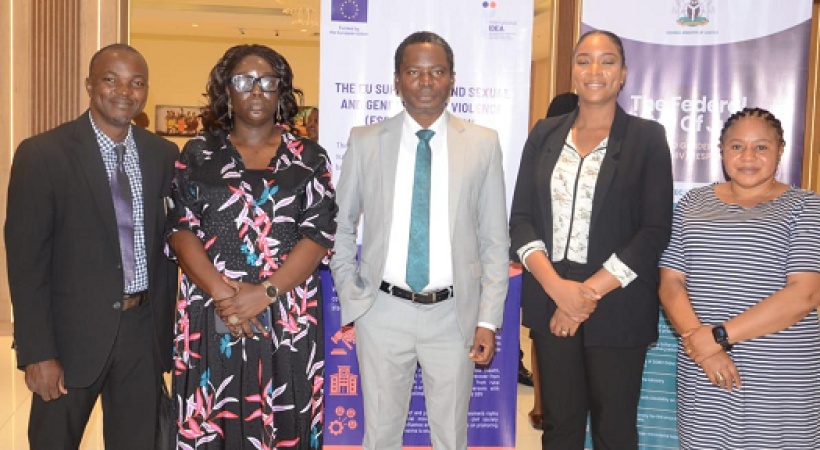
The platform was unveiled during a five-day national validation and capacity-building workshop to review and validate the reporting tools, strengthening reporting standards and building the technical capacity of SGBV desk officers.
Developed by the Federal Ministry of Justice, it is being deployed and operationalised to report cases from the point of reporting to resolution,
The platform is a European Union-funded support project to End Sexual and Gender-Based Violence (ESGBV) Programme in Nigeria, implemented by the International Institute for Democracy and Electoral Assistance (International IDEA).
Mrs Melissa Omene, GBV Policy and Strategy Development Specialist, ESGBV Programme, International IDEA, said that the platform is expected to provide justice institutions across the country with a single system for tracking reported cases.
She added it would also help in the prosecutions, convictions and pending matters, while generating reliable data for policy and accountability.
Omene noted that Nigeria had made significant progress in establishing laws, policies and institutions to address violence against women and girls, but the major challenge remained implementation, accountability and monitoring.
She said an assessment of the implementation, enforcement and operationalisation of SGBV frameworks in the FCT, Benue, Kaduna and Oyo States, involving 112 respondents across 32 institutions, identified fragmented data systems.
According to her, the absence of a coordinated justice-sector reporting mechanism are significant weaknesses.
“Institutions continue to collect data using different tools, methodologies and reporting standards, which make it difficult to generate a comprehensive picture of what is happening in Nigeria.
“What happens to cases after they are reported?” she asked.
Omene said the National GBV Dashboard recorded 4,449 cases of gender-based violence in the first half of 2023, while more than 19,000 reported cases had been documented since its launch in 2020.
She said only a fraction of the cases resulted in convictions, while hundreds were closed without resolution and many remained pending or stalled within the justice system.
Omene said the new reporting system would enable the ministries of justice at federal and state levels to generate standardised and comparable data, monitor implementation of the Violence Against Persons Prohibition (VAPP) Act and relevant laws.
She added that this also strengthen national accountability processes.
“Reporting violence is only the beginning of a survivor’s journey. What happens after reporting matters just as much as the reporting itself.
“Survivors need investigations, they need prosecutions, they need protection mechanisms, and justice outcomes that are visible, measurable and accountable,” she said.
Mr Agharinma Ehiedu, National Consultant, VAW Reporting System, International IDEA, said the platform was designed to address the absence of a central ecosystem for violence-against-women data in Nigeria.
Ehiedu said states currently have different methods of gathering VAW-related information, resulting in scattered data and limited visibility of the national situation.
“The platform is aimed at centralising them, for uniformity’s sake, standardising, and then, from a single point, anyone in the justice system can have full visibility of what is happening around any reported cases,” he said.
He said the platform would allow justice institutions to access information on the number of reported cases, offenders, convictions and cases pending trial across the country without having to contact individual states for statistics.
According to him, the system will also provide members of the public with an avenue to report cases, with the information routed to the appropriate state desk officer for follow-up.
Earlier, Mrs Yewande Gbola-Awopetu, Head of the SGBV Unit at the Federal Ministry of Justice, said the platform would only achieve its purpose if desk officers maintained accurate, complete and timely records.
Gbola-Awopetu said the National Human Rights Commission had recorded more than 33,000 SGBV cases between January and May of the reporting year.
She said the National Agency for the Prohibition of Trafficking in Persons had documented more than 3,000 cases of violence against women in the FCT.
She said inadequate evidence documentation and inconsistent case tracking had continued to undermine successful prosecution of SGBV cases.
Gbola-Awopetu urged participants to regard the training as an investment in the integrity of Nigeria’s national data on violence against women and children and in the coordination required to translate reporting into justice.
Also speaking, Ms Shirley Atane, Special Assistant, Gender and Vulnerable Persons, Office of the Attorney-General of Ekiti State, said political will and strong legal and policy frameworks had contributed to Ekiti’s progress in responding to gender-based violence.
Atane, who also serves as Legal Adviser to the First Lady of Ekiti, said the state has established a referral pathway, standard operating procedure for GBV intervention and other policies aimed at protecting survivors.
Atane, however, identified funding as a major challenge to sustaining and expanding interventions, saying implementation of existing laws and policies required adequate resources.
She called for increased budgetary allocation and funding support to ensure that existing laws and policies translated into practical interventions for survivors. (NAN)
•PHOTO: Participants at the national validation and capacity-building workshop on the Violence Against Women (VAW) Reporting System. (NAN)