Updating your news feed...
NEWS EXPRESS is Nigeria’s leading online newspaper. Published by Africa’s international award-winning journalist, Mr. Isaac Umunna, NEWS EXPRESS is Nigeria’s first truly professional online daily newspaper. It is published from Lagos, Nigeria’s economic and media hub, and has a provision for occasional special print editions. Thanks to our vast network of sources and dedicated team of professional journalists and contributors spread across Nigeria and overseas, NEWS EXPRESS has become synonymous with newsbreaks and exclusive stories from around the world.











.webp)













Loading banners
Loading banners...

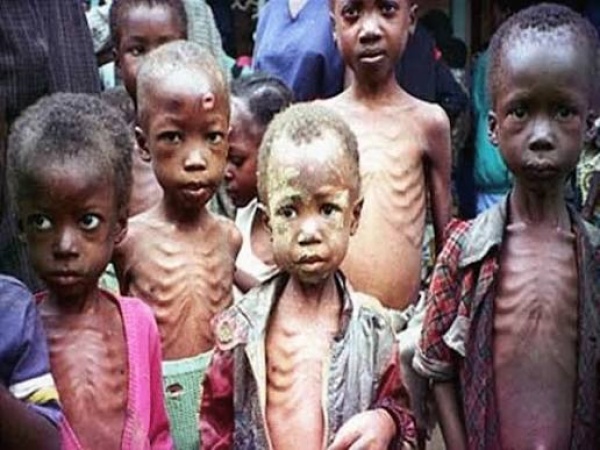
Malnourished children from northern Nigeria
About 40 per cent of Nigerian children under the age of five are suffering from stunted growth, while eight per cent are wasted and 27 per cent are underweight, with the highest burden concentrated in the North-West and North-East regions, a new policy report has revealed.
The report, titled, “Why malnutrition persists in northern Nigeria: Strengthening nutrition governance, financing and primary healthcare,” blamed weak governance structures, poor accountability and institutional failures for the continued child nutrition crisis despite years of government interventions and policy initiatives.
Released by the Athena Centre for Policy and Leadership, yesterday, the report warned that Nigeria’s malnutrition challenge was no longer due to lack of policies but failure to effectively implement programmes and ensure accountability in nutrition spending.
It said children in several northern states remained the most affected, citing stunting rates of 46.3 per cent in Katsina, 43.8 per cent in Sokoto and 42.6 per cent in Zamfara.
The report also highlighted severe child food poverty in conflict-affected states, noting that 67 per cent of children in Borno, 66 per cent in Yobe and 60 per cent in Adamawa are affected.
According to the report, more than 17 million people across nine conflict-affected northern states are currently facing crisis, emergency or catastrophic levels of hunger, based on World Food Programme data.
The authors, Dr. Suleiman Bello and Joshua Abah, said Nigeria had made progress in developing nutrition policies but had struggled to establish effective delivery systems capable of reaching vulnerable children and households.
“The absence of clear institutional ownership and an accountable delivery chain linking nutrition financing, primary healthcare, social protection, agriculture and local implementation structures continues to undermine progress,” the report stated.
The report argued that government responses had remained largely reactive, with interventions often introduced after children had already developed severe malnutrition rather than focusing on prevention during pregnancy and the first 1,000 days of a child’s life.
It called for stronger accountability mechanisms, including making verified nutrition readiness a condition for accessing performance financing under the Basic Health Care Provision Fund in high-burden states.
The think tank also recommended the publication of quarterly nutrition compliance reports detailing budget releases, procurement of nutrition commodities, health facilities supplied, wards reached and outstanding obligations.
It further urged northern states to establish lead nutrition accountability institutions to coordinate interventions across health, agriculture, water, sanitation, social protection and humanitarian sectors.
The report stressed the need to strengthen Ward Development Committees to enable early identification of vulnerable mothers and children before malnutrition becomes severe.
It maintained that tackling child malnutrition requires treating nutrition as a measurable responsibility of government rather than an emergency response activated only during humanitarian crises.
“A child should not have to become visibly wasted before the state becomes visible,” the report concluded. (The Sun)