
Updating your news feed...
NEWS EXPRESS is Nigeria’s leading online newspaper. Published by Africa’s international award-winning journalist, Mr. Isaac Umunna, NEWS EXPRESS is Nigeria’s first truly professional online daily newspaper. It is published from Lagos, Nigeria’s economic and media hub, and has a provision for occasional special print editions. Thanks to our vast network of sources and dedicated team of professional journalists and contributors spread across Nigeria and overseas, NEWS EXPRESS has become synonymous with newsbreaks and exclusive stories from around the world.


















.webp)







Loading banners
Loading banners...

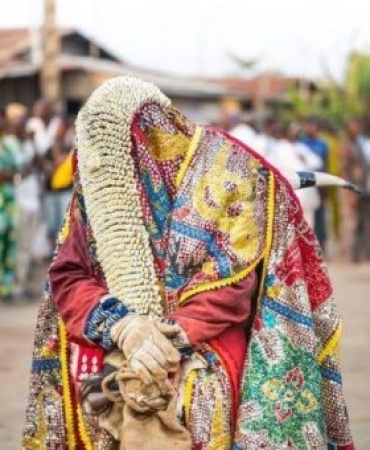
Masquerades, also known as “Egungun” or “Ará Ọ̀run” in Yorubaland, are masked/costumed figures honouring their ancestors.
Egungun masquerades are male-dominated within the performance aspect, and only men are allowed to connect with the spirits in Egungun by transforming into the masked figure.
The high-energy celebrations are a vibrant sight to behold, constantly sparking awe, wonder and mystery among onlookers and participants.
Important Egungun include the Oloolu and Alapansanpa, both of Ibadanland. Alamudu and Aladoko in Akure, Egemurege in Ado Ekiti, Omormo in Akokoland, Gbegbe in Iragbiji. Elewe of the Ìgbómìnà Yoruba clan, which is common in the towns of Òkè-Ìlá Òràngún, Ìlá Òràngún, and Arandun, is also of particular prominence.
Oloolu is a very powerful masquerade, regarded as the father of all masquerades in the Yoruba city of Ibadan, and one of the most revered in the entire Yorubaland and Africa for its powers and sacredness.
The name ‘Oloolu’ means ‘you will put your life in peril.’ Every July in Ibadan, the Oloolu masquerade celebrates the Oloolu festival, which is said to bring favours to the region.
A recent action by a female TikTok content creator, Wasilat Olalere who reportedly filmed the Oloolu masquerade procession linked to the annual festival has sparked widespread debate after videos showed the woman undergoing traditional cleansing rites at the Oloolu compound.
Oloolu masquerade wears a distinctive outfit which is fascinating and resembles an elongated pyramid comprised of various pieces of clothing. They are made up of layers of fabric of different kinds.
The Olubadan of Ibadanland, Oba Rashidi Adewolu Ladoja, had issued public warnings reminding residents and visitors that women are traditionally forbidden from seeing the sacred Oloolu masquerade and that no individual should photograph, record, or broadcast its movement.
The palace explained that these restrictions form part of the ancient customs surrounding one of Ibadan’s most revered ancestral institutions.
Oloolu is not regarded merely as a cultural spectacle or tourist attraction but as a sacred ancestral institution whose taboos, rituals, and restrictions have been observed for generations.
The annual Oloolu Festival is celebrated by descendants of the Oloolu lineage and attracts thousands of devotees, traditional chiefs, cultural enthusiasts, and visitors from across Yorùbáland and beyond.
Governed by the Aje family in the Ode Aje compound, the custodian of Oloolu holds significant ceremonial authority and social status in Ibadan.
The festival is marked by prayers, rituals, drumming, dancing, sacrifices, and processions that honor the ancestors while seeking peace, protection, fertility, prosperity, and communal well-being.
Related News
In times past, during the Oloolu festival, a public service announcement is made on radio and television of his scheduled route (which is always in Old Ibadan neighbourhoods like Yemetu, Oluyoro, Itu Taba, and Oja Oba), as it is an “ewo” (forbidden) for women to see him. This is a tradition Ibadan residents are well aware of and follow.
Oral history passed down from generations says Oloolu used to wear a mask and that this mask possesses mystical powers that help Oloolu detect the presence of women nearby and will warn accordingly. It was said that his mask was sold long ago to European explorers and was never replaced
The masquerade is bound by strict taboos: The bearer must abstain from his wife for 30 days before the festival. He must remain barefoot and carry no loads except his costume, which includes a female skull and human thigh bone.
It is forbidden to challenge Oloolu. An attempt by another masquerade, Iponri-Iku, led to its demise when it bent to pick up a mystical cowry dropped by Oloolu, broke its spine, and died, reinforcing Oloolu’s dominance.
Women are strictly forbidden from seeing Oloolu. It is thought that any woman who glimpses it will lose her menstrual cycle, and in extreme cases, face death or paralysis.
In Ibadan’s folklore, Oloolu emerges as a saviour during times of crisis, bringing rain and prosperity. “Oloolu is more than a cultural icon; it’s a symbol of hope for our community.”
According to a research by Steve James Itsewah & Oluwatoyin Olokodana J.Y titled: “The Evolvement, Myth and Mystery of Oloolu as a Facekuerade”, oral history has it that the emergence of Oloolu was as a result of the Kiriji war fought by some powerful warlords of Ibadan; warriors like Iba, Bashorun Ogunmola, Ogbori-Efon, Ayorinde Aje, Balogun Ibikule and some other unmentioned warlords at Ogbagi in Oka-Akoko of Ekiti (which was then located in Ondo State but is now in Ekiti State, Nigeria).
The war was fierce to the extent that the character Oloolu resorted to disappearing acts; he was said to turn into different animals, such as lions, crocodiles, etc. While he was displaying all these feats, Ayorinde was transforming into the same motif until he finally transmuted into an ‘Ogan’ (anthill); Ayorinde did the same and followed him; that was how and where he was captured, but it was only his cloth that was recovered.
It was however not only Oloolu’s costume that was brought from the warfront; slaves, clothing and war gadgets were inclusive. It was assumed that the costume refused to enter Ibadan until it had been appeased, which they did before they were able to take it into the city of Ibadan and since then it has been a denizen in the home of Ayorinde Aje and it has been placed in a special apartment built for it alone.
It’s germane to know that Oloolu’s costume was not sewn, nor was it bought, but brought to Ibadan as many presume; but with time, Oloolu has stopped putting on the apparel; he now wears anything. Women who symbolise his essence are forbidden from seeing him; in fact, a kind of curfew is imposed on all women. The mystery behind him (Oloolu) is that even if he does not see a woman but the said woman sees him secretly, it is said that the woman’s menstrual flow will dry up and she would not bear children till the end of her life except some divine intervention mercifully occurs.
It is worthy to note that Oloolu does not move with the crowd; the followers and acolytes might be hundreds of meters away from him. As for Oloolu, he passes through Agbole (short cuts between houses), and that is the more reason it is compulsory for women to stay indoors during the festival because one does not know where he might burst out from at any given time. Oloolu does not cavalcade in the metropolis but concentrates on the core and major Ibadan areas. (The Nation)