
Updating your news feed...
NEWS EXPRESS is Nigeria’s leading online newspaper. Published by Africa’s international award-winning journalist, Mr. Isaac Umunna, NEWS EXPRESS is Nigeria’s first truly professional online daily newspaper. It is published from Lagos, Nigeria’s economic and media hub, and has a provision for occasional special print editions. Thanks to our vast network of sources and dedicated team of professional journalists and contributors spread across Nigeria and overseas, NEWS EXPRESS has become synonymous with newsbreaks and exclusive stories from around the world.














Loading banners
Loading banners...

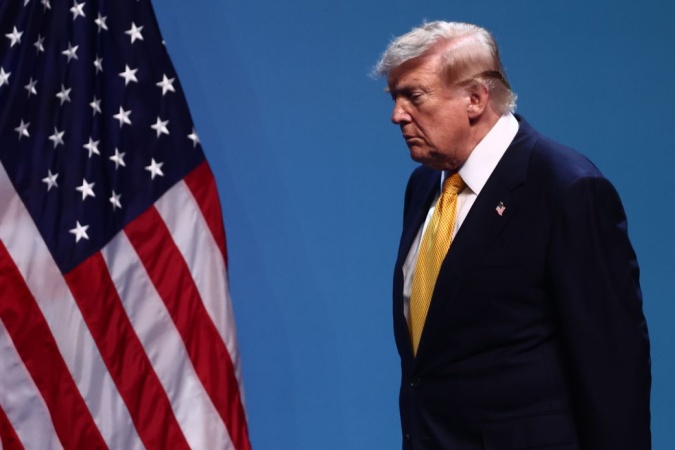
President Donald Trump has passed up multiple chances to explain to Americans how his latest escalation will win the war in Iran or how he’ll alleviate their perpetually high costs for groceries, housing and fuel.
Now he’s planning to anchor a national address Thursday evening on a personal fixation about the past — his false claim that he won the 2020 election.
Critics fear this is all part of a quickening effort to buckle trust in voting systems and to create a pretext to use federal powers to sway November’s midterm elections. It would not be the first time that this president — who convention states should seek to bolster American democracy — has instead undermined it.
“It doesn’t get bigger, because without free and fair elections, you don’t have a country,” the president said Wednesday as he previewed his speech. “We’ll be discussing other things too, but it’s going to be a very big announcement.”
Trump’s rising drumbeat of warnings is broadening unease that he’s not just recycling claims about the 2020 election that were debunked by multiple courts, state Republicans and even his first-term administration. Trump, as he has in the past, seems to be building a fallback narrative if the Republican Party fares poorly in November and to portray any election that he doesn’t win, as, by definition, unfair.
No one outside the White House knows what the president will say on Thursday. But there’s no credible sign yet that he has compelling new evidence of voter fraud that would contradict an overwhelming body of evidence that the 2020 election was fair or countless academic studies finding that major irregularities are very rare in US elections.
But Trump’s speech may confirm a familiar pattern. In 2016, 2020, and 2024, as voting neared, he stepped up efforts to cast doubt on the fairness of elections. In 2020, this morphed into active election interference after he refused to concede to Joe Biden and sought to overturn the result without evidence. His campaign culminated in a riot by his supporters intended to thwart the certification of the president-elect’s win, during which police officers were beaten and the US Capitol was desecrated.
In one of the first acts of his second term, Trump pardoned or commuted sentences for hundreds convicted in connection with January 6, 2021, sending a message that election violence or attempts to subvert democracy on his behalf were acceptable and above the law.
Alarm bells are ringing again, partly because of the role of Trump’s interim director of national intelligence, Bill Pulte, whom the president implied was sent to the top spy agency to find evidence about “rigged elections.” The FBI has meanwhile been investigating 2020 elections in Georgia, a state Trump lost, after seizing boxes of election materials. That election was deemed free and fair multiple times by GOP state officials following forensic audits.
Nationwide, the administration has been demanding voter rolls, raising fears it intends to infringe the constitutional mandate that states, not the federal government, oversee elections. Trump is also making every domestic priority subordinate to his pressure on Republicans to pass the “SAVE America Act,” which, while containing reforms on requiring voter ID — which many citizens support — also threatens to make voting harder, curtail registration and narrow the franchise for minority voters. It could also give Trump more power to interfere in national elections.
In the past, US intelligence agencies have concluded that foreign states and actors have tried to influence US elections. But pro-democracy groups fear that Trump’s team will use such evidence out of context to suggest there was active and successful interference to hurt Trump.
Ben Berwick, who leads the Election Law and Litigation Team for Protect Democracy, a nonpartisan group, expects the president to recycle his repeatedly debunked claims about the 2020 election on Wednesday evening. “I think there’s no doubt that a major piece of what is happening is really an intent to sow doubt about the 2026 election,” he said.
Administration officials insist their only goal is to secure elections. “The work that we’re doing is to make sure that we have fair and honest elections,” Trump’s nominee for attorney general, Todd Blanche, said in his confirmation hearing Wednesday. Blanche said the goal is to ensure “that the only people voting are the people who are eligible to vote and that they’re only voting once.” Still, one reason some voters may be having doubts about the integrity of US democracy is that Trump and his supporters have spent so much time trashing it.
Trump officials know the price for entry to his inner circle — accepting the false orthodoxy that he won in 2020. The latest official to dodge an unequivocal statement that Biden was rightfully elected was Jay Clayton, during his confirmation hearing Wednesday to be director of national intelligence. “I believe he had the most electoral votes,” Clayton said of Biden.
When officials adopt such formulations they are ignoring facts and evidence, which raises questions about how they’d act if the president seeks again to overturn the result of a democratic election.
The US government’s own election security agencies under the Election Infrastructure Government Coordinating Council concluded during Trump’s first administration that the 2020 election was “the most secure in American history” and that “there is no evidence that any voting system deleted or lost votes, changed votes, or was in any way compromised.”
Trump’s refusal to move on infuriates many Republicans, even if most are loath to speak out publicly against a president who still commands the grassroots MAGA base. Republican Sen. John Cornyn, however, has a measure of freedom after losing his primary in Texas to a Trump-endorsed rival. “I, frankly, am more concerned about the upcoming midterm elections than I am … what happened in 2020, and obviously election integrity is very important. But I personally don’t see any point in relitigating an election that occurred six years ago,” Cornyn said.
But Trump finds it impossible to drive a consistent electoral message. He rarely mounts an effective campaign around a domestic policy bill that handed many Americans higher tax refunds and temporarily reduced taxes on tips and overtime. Nor does he spend much time touting efforts to make prescription drugs more affordable through his TrumpRX website. When the White House schedules a trip to discuss affordability — the key 2026 election issue — Trump often deliberately ditches the script. He’d rather talk about his construction of an architectural legacy in the White House complex and around DC.
Concern that he may seek an illegitimate way to boost Republicans in the midterms is also rising because a clutch of gathering political crises threaten to dampen Republicans’ prospects. The stakes are huge: If Democrats win back one chamber of Congress, they will have the power to subject the president’s second term and personal financial arrangements to unprecedented oversight.
The unpopular Iran war is raging again, confounding Trump’s claims that he won it within days of its February launch and renewing the risk of soaring gasoline prices that anger voters. Several recent deaths linked to immigration raids by federal agents are reminding the country how much it dislikes one of Trump’s cornerstone policies. And while he mocks the idea that millions of Americans are struggling to afford the basics of daily life, he’s added $2 billion in personal wealth since returning to office.
The latest polling reflects Trump’s worsening political position. A Reuters/Ipsos poll completed Sunday found 79% of respondents think US military involvement in the war will “go on for an extended period of time,” up from 65% in late March. A PBS/NPR/Marist poll in June found only 33% of Americans approve of Trump’s handling of the economy. If immigration recaptures the headlines, that might also be bad news for Trump. A Marquette Law School poll in May showed voters had an unfavorable view of the US Immigration and Customs Enforcement agency by 61%-36%.
Trump has made no secret of his admiration for strongman leaders. His opponents fear he may take a page from the playbook of authoritarians who erode democratic societies when their popularity wanes.
Sen. Jon Ossoff, a Georgia Democrat whose 2020 election has been the source of rumors on conservative media sites in relation to Trump’s speech, hit on this potential political motivation for Trump’s speech this week. “Privately, most elected Republicans in this building think the president has lost it and is dooming them to dismal losses this fall,” Ossoff told reporters Tuesday.
Ossoff also had a heated exchange with Clayton over the administration’s new election probe in the hearing on Wednesday. His keenness to engage on this issue implies that he sees it as a losing one for his Trump-backed opponent. “Mike Collins launched his general election campaign doubling down on his 2020 election denials. Now he not only has to defend doubling health insurance premiums for more than a million Georgians, he has to defend these conspiracy theories about the 2020 election that Georgia voters have rejected time and time again,” Ossoff said.
On one level, Trump’s address may come to be seen as symptomatic of his tendency to pursue his own narrow interests in a second term that appears rather remote from the concerns of millions of voters.
On another, it is likely to fuel fresh questions about how Trump would respond to another GOP electoral loss after spending years arguing his last defeat was illegitimate. (CNN)




