Updating your news feed...

NEWS EXPRESS is Nigeria’s leading online newspaper. Published by Africa’s international award-winning journalist, Mr. Isaac Umunna, NEWS EXPRESS is Nigeria’s first truly professional online daily newspaper. It is published from Lagos, Nigeria’s economic and media hub, and has a provision for occasional special print editions. Thanks to our vast network of sources and dedicated team of professional journalists and contributors spread across Nigeria and overseas, NEWS EXPRESS has become synonymous with newsbreaks and exclusive stories from around the world.























Loading banners
Loading banners...


President Bola Ahmed Tinubu
The Federation Account Allocation Committee (FAAC) shared a total of N10.456 trillion among the federal, state and local governments as well as oil producing states during its first five meetings of 2026, despite fluctuations in Value Added Tax (VAT) and customs receipts, it has been learnt.
An analysis of official documents issued after the January to May 2026 FAAC meetings showed that the distributable revenue rose steadily after a temporary dip in February, reaching a record N2.30 trillion in the June meeting where May earnings were disbursed.
The five monthly allocations comprised N1.969 trillion distributed at the January meeting from December 2025 revenue, N1.894 trillion from February 2026 revenue, N2.036 trillion from March revenue, N2.257 trillion from April revenue and N2.30 trillion from May revenue.
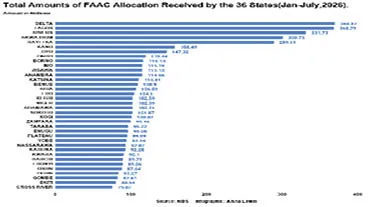
A breakdown of the cumulative allocations showed that the federal government received N3.724 trillion of the total distributable revenue, while the 36 states received N3.547 trillion and the 774 local government councils received N2.513 trillion.
Besides, oil producing states shared N673.177 billion as 13 per cent derivation revenue from mineral proceeds, representing about 6.4 per cent of the total allocation. These cumulative figures were calculated from the official monthly allocation breakdowns.
In practice, FAAC allocations constitute the main source of income for most states and local governments, making the monthly meetings a critical fiscal event. It comprises the ministry of finance; Office of the Accountant General of the Federation; Commissioners of Finance from the 36 states; The Nigeria Revenue Service (NRS); Nigeria Customs Service (NCS), among others.
THISDAY analysis showed that January comprised distributable earnings of N1.084 trillion statutory revenue, N846.507 billion from VAT and N38.110 billion from Electronic Money Transfer Levy (EMTL). The federal government received N653.500 billion, states N706.469 billion, local governments N513.272 billion, while oil producing states received N96.083 billion as derivation.
During the month, gross revenue stood at N2.585 trillion, from which N104.697 billion was deducted as cost of collection and N511.585 billion for transfers, refunds and savings.
But revenue declined in the February allocation as FAAC distributed N1.894 trillion from a gross revenue of N2.230 trillion. The federal government received N675.086 billion, states N651.525 billion, local governments N456.467 billion, while derivation stood at N110.949 billion. The decline was attributable mainly to lower VAT, Companies Income Tax (CIT), Petroleum Profit Tax (PPT) and Hydrocarbon Tax receipts, although oil and gas royalty and excise duty improved.
However, allocations rebounded in April when N2.036 trillion generated in March was shared. Of the amount, the federal government received N789.159 billion, states N657.596 billion, local governments N468.826 billion, while oil producing states received N120.759 billion.
The distributable revenue comprised N1.32 trillion statutory revenue, N515.391 billion VAT and N200 billion augmentation. Gross statutory revenue increased by 8.8 per cent to N1.699 trillion, while VAT collections declined marginally by 0.6 per cent.
The upward trend continued in the May FAAC meeting, where N2.257 trillion generated in April was shared among the beneficiaries, before rising further to N2.30 trillion at the June meeting. The May allocation represented a 1.9 per cent increase over the previous month and was driven largely by improved statutory revenue collections despite weaker VAT, import duty and excise duty receipts.
According to the data, gross statutory revenue increased from N2.378 trillion in April to N2.652 trillion in May, an increase of N273.623 billion or approximately 11.5 per cent. However, gross VAT revenue declined by 7.8 per cent, falling from N806.617 billion to N743.668 billion.
Higher collections from companies income tax, capital gains tax, stamp duties, petroleum profit tax, hydrocarbon tax and oil and gas royalties offset the weakness in VAT and customs related revenues.
The trend over the five meetings underscored the growing importance of statutory revenue in supporting federation allocations amid mixed tax performance. While VAT receipts were volatile, stronger inflows from petroleum related taxes and royalties helped sustain monthly distributions above N2 trillion from March onwards.
In all, the combined allocations to the federal government, states and local governments accounted for more than 93 per cent of the distributable revenue during the period, with derivation payments accounting for the balance and reflecting improved federation revenues. (THISDAY)