ADAD
ADAD
Updating your news feed...
NEWS EXPRESS is Nigeria’s leading online newspaper. Published by Africa’s international award-winning journalist, Mr. Isaac Umunna, NEWS EXPRESS is Nigeria’s first truly professional online daily newspaper. It is published from Lagos, Nigeria’s economic and media hub, and has a provision for occasional special print editions. Thanks to our vast network of sources and dedicated team of professional journalists and contributors spread across Nigeria and overseas, NEWS EXPRESS has become synonymous with newsbreaks and exclusive stories from around the world.




Loading banners
Loading banners...

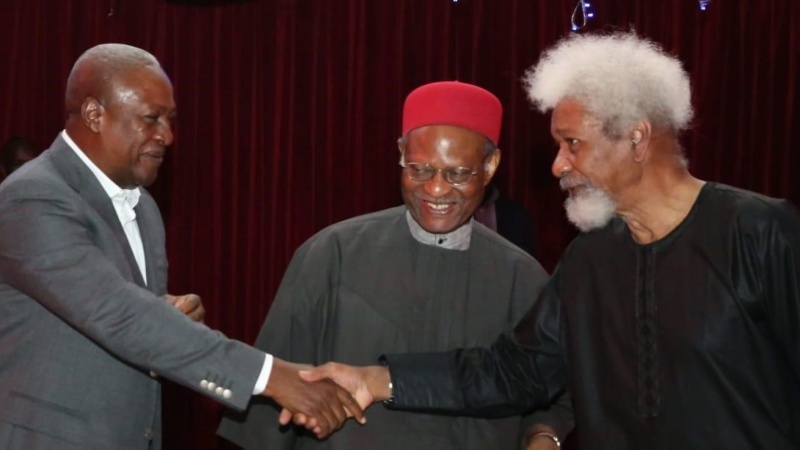
Young members of the African diaspora, alongside students, academics, artists and the wider public will once again have the rare privilege of engaging directly with the Nobel Laureate in another mentorship conversation and interactive question and answer session.
This man, Akinwande Oluwole Babatunde Soyinka, Africa’s first Nobel prize winner in literature, for decades, has quietly resisted the temptation of making his birthday the centrepiece of public celebration. Rather than bask in accolades, he has preferred reflection, retreat and, perhaps most importantly, a return to what has defined much of his life’s work: engaging minds. Except when he turned 90, when the Federal Government named the National Theatre after him and elaborate ceremony was organised on October 1 , 2024. He always avoided loud celebration on his birthday.
Those close to him speak of his eagerness to once again welcome the young participants and continue a dialogue that has endured for nearly two decades.
From Ijegba to London, the message remains the same: culture transcends geography; ideas know no borders; and dialogue remains one of humanity’s greatest instruments of progress.
Celebrations span Lagos, Abuja, and London. The events centre around literary exhibitions, a major book launch, and a global cultural exchange.
On July 13, 2026, friends, admirers, scholars, and lovers of literature will gather in Abuja to celebrate the remarkable life and enduring legacy of Professor Wole Soyinka, Africa’s first Nobel Laureate in
Literature, as he marks his 92nd Birthday.
As part of this celebration, Prof Adesoji Adesugba’s new book, Ideas Do Not Die: Prof. Wole Soyinka and the Philosophy of Moral Rebellion, will be launched.
This book explores the ideas, convictions, courage, and moral vision that have shaped Professor Soyinka’s extraordinary journey as a writer, activist, public intellectual, and defender of human freedom.
Built around extensive conversations with Professor Soyinka and enriched by historical, philosophical, and political reflections, the book examines the themes that have defined his life and work: rebellion against injustice, the defense of truth, the power of memory, the importance of conscience, and the responsibility of leadership.
Historical conversations will unfold — first in the quiet surroundings of the Autonomous Republic of Ijegba (ARI) and days later in London — where one man, whose words have travelled the world, will once again sit among the young, answer their questions, challenge their thinking, and remind them that the future belongs to those prepared to imagine it, question it and build it.
Organisers of the 17th Wole Soyinka International Cultural Exchange (WSICE @92) have announced that Soyinka has confirmed that he will once again receive young people for his yearly mentorship and interactive question and answer session at his residence, the Autonomous Republic of Ijegba (ARI), Abeokuta, on Wednesday, July 15, 2026.
“For 17 years, this has become one of the most distinctive intellectual traditions in Nigeria. What began as a modest engagement has grown into a pilgrimage for students, young writers, scholars, artists, teachers and cultural enthusiasts from across the country. They come not simply to see a global literary icon, but to ask questions that matter. Questions about literature. About Africa. About freedom. About identity. About courage. About leadership. About truth. About the responsibilities that accompany education and privilege,” said Alhaji Teju Kareem, co-founder of the culture platform, Wole Soyinka International Cultural Exchange.
He said the children come “because Professor Soyinka listens before he answers. They come because every conversation is unscripted. They come because every year history quietly unfolds in a courtyard in Ijegba.”
According to Kareem, “preparations are now in their final stages. Organisers are coordinating logistics, hospitality, security and media coverage for what promises to be another memorable encounter between one of the world’s most celebrated intellectuals and the generation that will inherit the future. Its impact extends well beyond the annual gathering.”
More than 10,000 essays have been received from students over the life of the project. Outstanding entries have been curated into published volumes, each preserving the voices, hopes and imagination of young Africans. Notably, two of these publications carry forewords personally written by Professor Soyinka himself—further testament to his enduring investment in the intellectual development of younger generations.
The programme has equally become a meeting point for writers, academics, diplomats, theatre practitioners, policymakers and cultural leaders who recognise that meaningful nation-building begins with informed and engaged young citizens.
This year’s theme, “Culture Beyond Borders,” speaks directly to a world increasingly defined by migration, interconnectedness and cultural exchange. It asks how societies can remain rooted in their histories while embracing global citizenship, and how culture can serve as a bridge rather than a barrier.
He noted, the conversation will not end in Abeokuta. Professor Soyinka will participate in the United Kingdom leg of the programme on Saturday, July 18, 2026, at The Africa Centre.
The yearly mentorship remains the emotional heart of the Wole Soyinka International Cultural Exchange, an initiative that has, over seventeen editions, grown into one of Africa’s foremost youth-centred literary and cultural advocacy platforms.
“In an age increasingly shaped by fleeting digital interactions, Professor Soyinka continues to demonstrate the enduring value of face-to-face conversation—of listening deeply, questioning honestly and challenging young minds to think independently. That may well be one of his greatest legacies. Not merely the Nobel Prize. Not merely the plays, essays and novels. Not merely the decades of public advocacy,” said Kareem. “But the quiet consistency with which he has continued to make himself available to young people, year after year, generation after generation.”
That tradition continues in 2026. “It is of a living tradition. It is of ideas. It is of mentorship. It is of a lifelong commitment to nurturing minds,” he mused.
At 92, Professor Soyinka remains as intellectually restless as ever. The national treasure, Soyinka, is everything Nigeria is not: Focused, consistent and inspiring. Nigeria is not. The country Soyinka and his co-travellers in the 50s and 60s idealised has sunk into an abysmal quandary. His generation had deployed both ethical and empirical arguments to buttress the way forward for the nation.
Born July 13,1934, Soyinka, one of 1930s generation most accomplished writers, was awarded the 1986 Nobel Prize in Literature for what has been described”as a wide cultural perspective and with poetic overtones fashioning the drama of existence.”
His 1986 success has gone on to open the floodgates in the continent with four other writers following in his stead: Naguib Mahfouz, Nadine Gordimer, John Maxwell Coetzee and Abdulrazak Gournah.
Soyinka is perhaps the most versatile of African writers, equally at home in all genres; his dramatic masterpieces, such as Kongi’s Harvest and Death and the King’s Horseman have been produced all over the world.
His poetry anthology, Poems of Black Africa (1975), remains the most authoritative showcase of the writings of the first generation of postcolonial African poets, from Agostinho Neto to Léopold Senghor to Dennis Brutus – a generation that is fast dwindling.
The playwright, poet, novelist, essayist is among a rare crop of African intellectuals who contribute immensely to the economic and political debate in their countries.
He is unquestionably a man of action and ideas; an embodiment of benevolence, who helps nurture young minds while supporting the less privileged, and intervening in crisis situation to prevent conflict.
He makes the perfect poster figure: imprisoned, exiled, perpetually seeking to reform his country by turning out books critical of the corrupt rulers who, after the euphoria of independence from the colonial Europeans, have continued exactly where they left off, using the same playbook of divide and rule.
Born into a Yoruba family in Abeokuta. In 1954, he attended Government College in Ibadan, and subsequently University College Ibadan and the University of Leeds in England.
After studying in Nigeria and the UK, he worked with the Royal Court Theatre in London. He went on to write plays that were produced in both countries, in theatres and on radio. He took an active role in Nigeria’s political history and its campaign for independence from British colonial rule. In 1965, he seized the Western Nigeria Broadcasting Service studio and broadcast a demand for the cancellation of the Western Nigeria Regional Elections.
In 1967, Soyinka was appointed Director, School of Drama, and later, Head of Drama at the University of Ibadan, but he could not assume that position as a result of the Nigerian Civil War, when he was arrested by the Federal Government of General Yakubu Gowon and put in solitary confinement for two years, for volunteering to be a non-government mediating actor.
After his release, he moved to the University of Ife, now Obafemi Awolowo University, Ife, where he was Professor of Comparative Literature (1975 to 1984, when he voluntarily retired). With civilian rule restored to Nigeria in 1999, he was made professor emeritus.
While in the United States, he first taught at Cornell University as Goldwin Smith professor for African Studies and Theatre Arts from 1988 to 1991and then at Emory University, where in 1996 he was appointed Robert W. Woodruff Professor of the Arts.
Soyinka has been a Professor of Creative Writing at the University of Nevada, Las Vegas, and has served as scholar-in-residence at New York University’s Institute of African American Affairs and at Loyola Marymount University in Los Angeles, California. He has also taught at the universities of Cambridge, Oxford, Harvard and Yale, and was also a Distinguished Scholar in Residence at Duke University in 2008.
Soyinka is a strong critic of successive Nigerian (and African at large) governments, especially the country’s many military dictators, as well as other political tyrannies, including the Mugabe regime in Zimbabwe in works such as The Open Sore of a Continent: A Personal Narrative of the Nigerian Crisis, A Play of Giants, Opera Wonyonsi, The Man Died and others.
Much of his writing has been concerned with “the oppressive boot and the irrelevance of the colour of the foot that wears it.”
During the regime of General Sani Abacha (1993–98), Soyinka escaped from Nigeria on a motorcycle via the “NADECO Route.” Abacha later proclaimed a death sentence against him “in absentia.” With civilian rule restored to Nigeria in 1999, Soyinka returned to his nation.
In December 2017, Soyinka was awarded the Europe Theatre Prize in the “Special Prize” category, awarded to someone who has “contributed to the realization of cultural events that promote understanding and the exchange of knowledge between peoples”.
Soyinka is a pragmatic writer and views the new Information and Communication Technology (ICT) era with realism, underscoring the role of new media and their influence on the public and users. For him, new media users should use it to enhance good governance and the continent’s development.
“Sometimes I think the inventor of the Internet should be decorated, given the key to the city, put on a white horse, and then…hung from the nearest lamppost,” he joked; “it’s amazing how technology has been used for libel, ignorance, and the abuse of the notion of freedom. That’s why I stopped at email”. But “in more atavistic zones,” he said, “expressing the hope that the Internet will contribute to the exposure of corruption and violence.”
With his interventions as a polemics, he has given the community of readers and those committed to a life of the mind another somewhat meaty matter to engage in such essays as – InterInventions: Between Defective Memory and the Public Lie – A Personal Odyssey in the Republic of Liars, Isese Festival: An Open Letter to Sulu Gambari, A Putrid Presidential Easter Egg and Fascism On Course.
As one of Nigeria’s most celebrated playwrights, poets, and political activists, Prof. Soyinka’s contributions to the world of literature and his tireless commitment to social justice have made an indelible impact on the global stage.
Though, Ugoji Egbujo, in a recent article, titled, Has the man died?, feels Wole Soyinka has slowed down in his activism, because he has continue to look away from some of the things happening in the country, at 92, he “remains strong and razor-sharp.”
He has picked up slave trade and reparation as pertinent issues that will shape his conversations in years to come.
For Soyinka, the deepest damage of the slave trade was the stripping of identity and humanity. He argues that true reparations must elevate the descendants of the enslaved by addressing the enduring psychological and social scars left by the legacy of enslavement. In his UN address, he detailed why he believes reparations cannot be quantified. “Reparations can’t be quantified,” he said.
He believes reparations must restore humanity, not just provide compensation. The Nobel laureate called for reparatory justice efforts to move beyond financial compensation and symbolic gestures.
He argued that the deeper challenge is the restoration of humanity, dignity, and identity damaged by slavery.
Speaking at the opening of the Next Steps Conference on Reparatory Justice in Accra on Thursday, June 18, 2026, Prof. Soyinka said the legacy of the transatlantic slave trade continues to affect the psychological and cultural well-being of people of African descent and must be addressed as part of any meaningful reparations agenda.
“As that any means that enable us to recover the re-humanization collectively, even of memory, not just of the present, but even of memory is essential to the development, collective development of those who’ve been traumatized as a people by this iniquitous commodity in human beings,” he said.
Prof. Soyinka urged governments, institutions, and advocates to pursue a more dynamic approach to reparatory justice, one that extends beyond commemorative events and economic discussions.
“Let us move mentally and practically towards the dynamizing of the commemoratives which exist,” he said. “We have to move now beyond just the performances, the discussions, the rhetoric, even the economic aspects of a retrieval of an egalitarian relationship between them and us.”
The Nobel laureate argued that slavery’s impact was not limited to economic exploitation but also altered how affected communities perceive themselves and their place in the world.
“We have to recognize the fact that even our mental conditioning is involved and in the diaspora in particular,” he said.
Prof. Soyinka described the African diaspora as a critical component of the reparatory justice movement, stressing that efforts to reconnect descendants of enslaved Africans with the continent carry significance beyond symbolism.
Nobel Laureate Prof. Wole Soyinka is spearheading the Heritage Voyage of Discovery, a global initiative aimed at reuniting the African diaspora with their ancestral roots. Supported by the Nigerians in Diaspora Commission (NIDCOM), the commitment centres around the iconic Door of Return ceremony in Badagry.
According to him, initiatives such as the Door of Return represent opportunities to reclaim values and identities that were distorted or erased by the experience of slavery.
“It is a return to certain values, certain human values, which were distorted or simply totally wiped out of our collective appreciation of a reality of the world we inhabit,” he said.
Soyinka champions this spiritual and historical pilgrimage in Badagry, Lagos. It serves as the symbolic inverse of the historical “Point of No Return”, aiming to heal the generational wounds of the transatlantic slave trade. The Heritage Return Journey: He promotes this reverse route as a global tool to reunite Africans in Europe and the Americas with their lost heritage.
Prof. Soyinka works closely with NIDCOM and its Chairman/CEO, Abike Dabiri-Erewa, integrating the “Door of Return” into Nigeria’s official cultural diplomacy and diaspora engagement agenda.
Soyinka uses high-profile platforms, including the United Nations and UNESCO, to advocate for the reclamation of history and the cultural reintegration of the global African diaspora. (Guardian)