ADAD
ADADUpdating your news feed...

NEWS EXPRESS is Nigeria’s leading online newspaper. Published by Africa’s international award-winning journalist, Mr. Isaac Umunna, NEWS EXPRESS is Nigeria’s first truly professional online daily newspaper. It is published from Lagos, Nigeria’s economic and media hub, and has a provision for occasional special print editions. Thanks to our vast network of sources and dedicated team of professional journalists and contributors spread across Nigeria and overseas, NEWS EXPRESS has become synonymous with newsbreaks and exclusive stories from around the world.



















Loading banners
Loading banners...

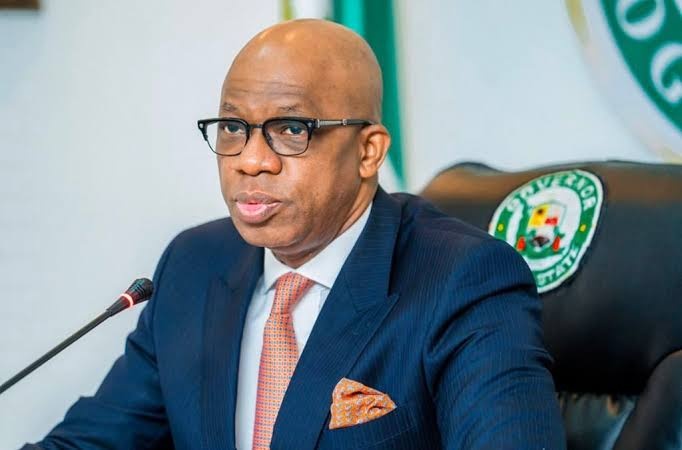
Ogun State Gov Dapo Abiodun
Houses of Assembly in the 36 states will pass the State police Bill simultaneously when it is transmitted to them by the National Assembly, Ogun State Governor Dapo Abiodun said yesterday.
According to him, the governors had agreed on this course of action to quicken the phase of the establishment of State police.
He acknowledged that decentralising policing would bring law enforcement closer to communities, strengthen intelligence gathering and significantly improve response to insecurity across the country.
He spoke at the ARISE NEWS Town Hall Meeting in Abuja, with the theme: “Building a national consensus for state police and national security.”
Stakeholders agreed that Nigeria had reached a defining moment in its quest to reform the country’s policing architecture, with many describing the debate over state police as largely settled.
Leading the campaign, Deputy Speaker of the House of Representatives, Benjamin Kalu, said the proposed constitutional amendment establishing state police would enable quicker responses to crime while addressing longstanding structural deficiencies in Nigeria’s centralised policing system.
Kalu argued that giving states operational control over policing would improve intelligence gathering, deepen community policing and ensure security agencies respond more effectively to emerging threats.
Abiodun described June 24, 2026, when President Bola Tinubu transmitted the Executive Bill on state police to the National Assembly, as a watershed in Nigeria’s democratic evolution.
“What we aim to do is to ensure that all our Houses of Assembly pass this bill on the same day. What we see here is a dream that we’ve had for so many years unfolding,” he said.
The governor commended President Tinubu for accomplishing what previous administrations had been unable to achieve despite years of advocacy for decentralised policing.
He said the proposal had attained broad national acceptance following extensive consultations involving the Nigeria Governors’ Forum (NGF), state attorneys-general and other stakeholders before the Executive Bill was forwarded to the National Assembly.
Abiodun explained that although governors are constitutionally designated as chief security officers of their states, they possess little operational authority over the police despite providing vehicles, logistics, accommodation and funding for security operations.
He said the NGF constituted a committee comprising governors and state attorneys-general to review the proposal and make recommendations, many of which were incorporated into the bill.
According to him, the proposed state police system validates years of advocacy for community policing and builds on the successes recorded by regional security outfits such as the South-West Security Network, codenamed Amotekun.
He added that decentralised policing would immediately improve Nigeria’s police-to-population ratio by creating between 300,000 and 400,000 additional personnel nationwide.
Using Ogun State as an example, Abiodun said the state already has about 6,000 personnel spread across Amotekun, the So-Safe Corps, vigilante groups and other security outfits, noting that similar arrangements exist across the federation.
He explained that the constitutional amendment seeks to move policing from the Exclusive Legislative List to the Concurrent Legislative List, empowering states to establish their own police services.
However, the governor stressed that a constitutional amendment would only be the first step.
He said consequential amendments to the Police Act and other legislation would be required to define recruitment, funding, oversight mechanisms, training standards, operational structures, police councils, service commissions and the relationship between state police and the federal police.
Abiodun, who is a member of a Federal Government committee on the operational framework, said the panel had been given seven weeks to produce guidelines for implementing the new policing arrangement.
He added that while the federal police would retain responsibility for terrorism, interstate crimes and other federal offences, state police would focus on local crimes, community policing and intelligence gathering, with recruitment largely based on local residency and language proficiency.
Enugu State Governor Peter Mbah said discussions should now shift from whether Nigeria needs state police to how the system should be implemented.
“I think that’s a settled debate. What we really should be talking about is how we implement it,” he said.
Mbah argued that the country’s centralised policing model had failed to keep pace with evolving security challenges, insisting that constitutional responsibility for security must be matched with operational authority.
He said insecurity was the greatest challenge his administration inherited and disclosed that Enugu State had invested heavily in surveillance technology, artificial intelligence-driven monitoring systems and a Distress Response Squad working alongside conventional police formations.
According to him, the integrated security strategy has reduced violent crime in the state by more than 90 per cent.
“There should be a national standard. There should be local capability. There should be national support. There should be local decision-making,” Mbah said.
He advocated flexibility in the proposed constitutional amendment to allow future reforms without requiring another constitutional review.
National Assembly will amend Police Act, says Bamidele
Senate Leader Opeyemi Bamidele said the Police Act would be amended after the Constitution review to permit the operation of the state police.
He hailed President Bola Ahmed Tinubu for encouraging the Federal Government to shed weight by transferring some items from the Exclusive List to the Concurrent List.
He said much work needed to be accomplished by the National Assembly and other stakeholders to make the initiative become a reality.
Bamidele said: “After the constitution amendment, the Police Act should also be amended, supported by additional Acts of Parliament.”
He assured that state police would not be abused because of the inherent safeguards.
Bamidele said although some people fear that governors can abuse the state police, there is also the possibility of abuse by the business class, criminals and cabals.
He said the solution is to allow state police to benefit from the first line item in the constitution, adding that he who pays the piper dictates the tune.
Bamidele also emphasised that while the state authorities control the state police, the state police service commission should have financial autonomy.
The Senate Leader said all the aspects of management relating to state police should be spelt out in the Constitution, adding that non-state actors should not be allowed to hijack the structures.
Bamidele said that in the overall conception, Nigeria cannot go beyond the minimum global standards.
He said the final goal is community policing, which would make the grassroots feel the impact of the proposed security architecture.
Bamidele stressed: “We want community policing. This is the first step we need to take. We should address the issue of local government autonomy for community policing to operate.”
Urging the public to sustain the discussion, he said stakeholders should continue to work together before the country can get to El Dorado.
‘Governors need powers to secure domains’
Former Edo State Governor and Senator representing Edo North, Adams Oshiomhole, also renewed his call for state police, describing the existing arrangement as a constitutional contradiction.
“The Constitution calls the governor the chief security officer, yet he cannot recruit, deploy, promote or discipline police officers. It is like calling someone a husband when he has no wife,” he said.
Oshiomhole argued that governors cannot be held accountable for insecurity while lacking the authority to direct police operations.
Responding to concerns over funding, he maintained that government expenditure reflects priorities rather than scarcity of resources.
Drawing from his experience as governor, he recalled investing heavily in police logistics without having the power to determine how those resources were deployed or to discipline officers who misused them.
He dismissed fears that governors would weaponise state police for political purposes, arguing that abuse already exists under the current centralised policing system.
“If a governor mistakes state police for his personal police and misuses them, then vote him out at the next election,” he said.
The senator said Nigeria’s federal structure should naturally be reflected in its policing system. (The Nation)