

ADVERTISEMENT

ADVERTISEMENT
Updating your news feed...

NEWS EXPRESS is Nigeria’s leading online newspaper. Published by Africa’s international award-winning journalist, Mr. Isaac Umunna, NEWS EXPRESS is Nigeria’s first truly professional online daily newspaper. It is published from Lagos, Nigeria’s economic and media hub, and has a provision for occasional special print editions. Thanks to our vast network of sources and dedicated team of professional journalists and contributors spread across Nigeria and overseas, NEWS EXPRESS has become synonymous with newsbreaks and exclusive stories from around the world.
Rev Chaplain Gbamwuan Samuel Teryima
The blackboard at Penworth Secondary School stands six feet tall, a fixed plane of slate and worn paint that has absorbed years of chalk dust, arithmetic, maps, and the quiet labor of teaching. In most classrooms, it is an ordinary object, something a teacher uses without a second thought. In this classroom, however, it is something else entirely, it is a surface that must be negotiated.
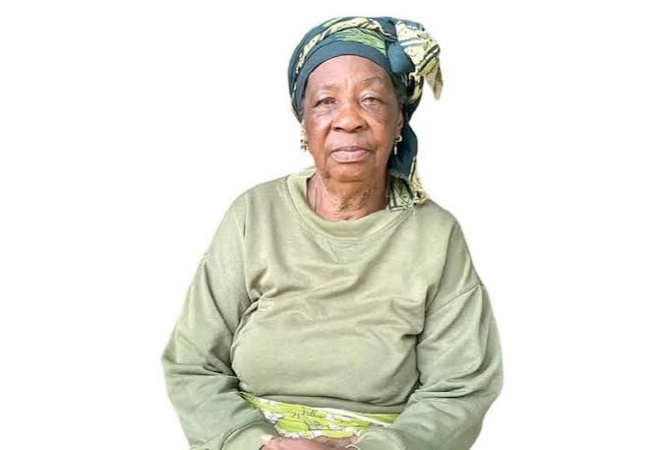
Rev. Chaplain Gbamwuan Samuel Teryima stands before it each day with that negotiation already understood. Born without fingers and without toes on one leg, every lesson begins for him with an arrangement between body and board, between intention and gravity, and between what the world assumes is required and what he has learned to make possible.
On a humid morning in Gboko South, the classroom settles into a steady silence as students open their notebooks and face a chalkboard map that waits unfinished. Samuel steps forward and positions himself with careful familiarity, guiding, steadying, and pressing the chalk into motion with a control refined over decades. He begins to draw a globe. The outline appears slowly at first, then with increasing certainty until a full sphere rests on the board, followed closely by lines of latitude and longitude. The lesson becomes geography, but also something quieter, something the students have long stopped naming directly. A visitor standing at the doorway might pause longer than intended, driven by an instinct to search for difficulty, but inside the room, that interpretation does not survive for long. The students are already with him. He pauses briefly, glances toward the class, and says softly, “Just follow the line.” The room responds by leaning in.
Long before he stood in this classroom, Samuel’s story began in the Buruku Local Government Area of Benue State. He was born at LGEA Primary School, Ker, in the Mbaazager Council Ward, arriving as the seventh child in a family of fifteen born to peasant farmers. His arrival carried questions nobody in the household could immediately answer. When Samuel speaks about those early years, his voice slows as he recalls his mother simply saying, “We would see.” They did not know what life was going to be, but they knew it was life. In a rural community where survival often depends on intense physical labor, uncertainty settled quietly into the household. Yet, Samuel says he cannot remember a single dramatic moment when he discovered he was different; it simply happened little by little.
As a child, he watched other children perform small tasks like tying things, holding objects, and writing quickly without effort. He would attempt the same tasks only to discover that they required immense patience, adaptation, and time.
One afternoon, frustrated by how long a simple chore was taking him, he complained to his mother. She listened quietly and then said something he has never forgotten: “Life is not a race between hands.” At the time, he did not fully understand her words, but years later, he believes he finally does. His mother refused to allow him to become the center of pity. If work needed to be done, he worked. If water needed to be fetched, he joined his siblings, and if there were household chores, he participated fully. She loved him deeply, but she never allowed that love to become a limitation, often reminding him that ‘difficult’ is not the same as ‘impossible’.
Those lessons were assimilated into his life quietly and never left. His father, meanwhile, taught him something different: consistency. The older man was not known for lengthy speeches, he simply worked every day, whether conditions were good or bad, and whether he felt inspired or not. Samuel remembers one particular afternoon from childhood when he had been carrying water alongside his brothers. The journey was long and the weight felt heavier than usual, so he placed the container on the ground and sat beneath a tree, wanting to stop. His father walked over, sat beside him, and after a long silence, broke the quiet by saying, “Rest if you must, but do not build a house there.” The memory still makes Samuel smile. He picked up the container and continued walking, carrying that lesson into adulthood.
For a time, formal school was not immediate, and his older siblings became his first teachers. Letters and numbers entered his world through repetition, patience, and family effort. He liked when they read aloud because the words stayed in his head. When he eventually entered formal education at St. Peter’s Primary School in Igbur, Mkar, the question became entirely practical. How does a child without fingers write? The teachers did not answer with theory, they answered with patience. They experimented with the chalk, the angle of the arm, the pressure, and the balance. Again and again he tried, and again and again the chalk fell. Sometimes classmates laughed, sometimes they stared, and sometimes they encouraged him.
Children, he notes, can be brutally honest and will ask the questions adults are afraid to ask. Yet, he does not speak about those years with resentment, recalling instead the nature of observation. He realized that when you are different, people watch you when you succeed, when you fail, and when you are just trying to write while feeling dozens of eyes fixed on you. Eventually, the attention became exhausting, so he stopped focusing on the audience because the task became far more important than the attention. Slowly, writing became possible, then functional, and finally, precise.
Years later, he would return to the blackboard not as a student struggling to write, but as a teacher helping others learn. Long before he entered a College of Education, however, Samuel had already begun teaching. Friends approached him with questions and younger pupils asked for explanations because he enjoyed helping people understand, not because he enjoyed being right, but because he loved watching confusion disappear. His older brothers, particularly Gbamwuan Akegh Peter and Atenisus Iordye Gbamwuan, recognized this gift before he did, watching him explain lessons and repeat ideas until understanding arrived, predicting that he would one day be a teacher. Samuel did not argue.
By the time he entered the College of Education, Katsina Ala, between 1999 and 2001, teaching no longer felt like a career option; it felt like a natural extension of who he already was. He later attended the University of Calabar, earning a Bachelor of Education in Educational Administration, Planning and Supervision and Religion with Second Class Upper honors, and would go on to complete a Master’s degree in Educational Management at Benue State University. Yet, when he reflects on those years, he rarely speaks about certificates, choosing instead to focus on the simple continuity of keeping going.
His first day as a teacher remains vivid, and he laughs at the memory of being more nervous than the students. He had prepared his notes carefully and knew his subject, but standing before a classroom carried its own unique uncertainty. The students stared, which he expected, but what surprised him was how quickly the staring disappeared once the lesson actually began.
Children are practical; if you can teach them, they move on. Within minutes, questions replaced curiosity and discussion replaced observation. By the end of the hour, the classroom felt entirely normal as he realized they were listening to the lesson, not looking at him. Today, students describe him not just as an inspirational figure, but also as a demanding one who insists on understanding rather than memorization, on clarity rather than guesswork, and on effort rather than excuses. One student recalls entering his classroom for the first time and struggling not to stare, only to completely forget about it after a few weeks because all that mattered was that he wanted them to think. Another remembers a day when nobody wanted to answer a difficult question, leaving the class sitting in a lowered silence. Samuel pointed toward a student at the back who stood reluctantly and said, “Sir, I don’t know.” Samuel simply nodded, replied, “Good, now we know where to start,” and spent the next several minutes helping the student discover the answer rather than just giving it to him, convincing the boy that he was truly capable of learning.
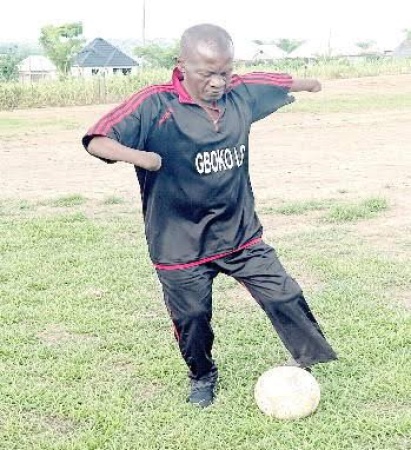
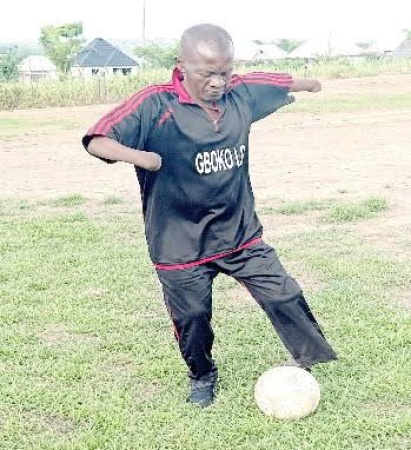
Outside the classroom, another side of Samuel emerges. On certain evenings, as the heat softens over Gboko and shadows lengthen across the ground, he walks toward a football field where children and young men gather. The field changes him; his posture shifts and the atmosphere lightens. He removes his shoes and steps onto the grass with familiar ease, making his first touch of the ball deliberate and measured. When a pass arrives, he receives it, controls it, and redirects it with a movement that feels practiced rather than performative. From the sideline, a young boy might nudge his friend to watch him control the ball, but Samuel hears neither praise nor surprise, only football. He laughs when a challenge arrives too late, telling his opponent they are tardy before continuing onward. Without arms for conventional balance, his movement depends entirely on timing, anticipation, and repetition. Football taught him lessons he carries far beyond the pitch, proving to him that while people think life is about strength, it is often actually about timing, knowing when to move, when to wait, and when to trust another person. The game has little patience for excuses, as the ball responds only to what you do, and he finds great wisdom in that reality.
Away from school and football, Samuel’s life has also known profound loss. He is the father of three daughters—Patience, Deborah, and Bethany—whose names surface frequently in conversation not as symbols, but simply as the people who completely occupy his heart. He smiles when speaking about them, noting that they keep him honest because while students see him as an authority figure, his daughters know exactly where he forgets things, when he is worried, and when he is tired. They remind him that love is not measured by what you provide, but by your presence. Last February, his wife passed away, a loss that drastically altered the rhythm of everyday life. He speaks about her carefully because the memory remains so close, recalling how she had a unique way of making ordinary days feel complete. Most of life, he believes, is made up of ordinary days, ordinary meals, and ordinary conversations, and his wife brought warmth into those exact spaces. After her death, he discovered how much of a home can exist inside one single person, leaving an absence that becomes quieter with time but never truly disappears.
As a chaplain, this grief has deepened rather than weakened his ministry. Members of his congregation often remark that he speaks about suffering without pretending to stand outside of it, describing him as someone who does not speak like he escaped life, but like someone who is still actively inside it. Samuel understands this observation deeply. For many years, people have viewed him entirely through the lens of what is missing, the fingers he never had, the challenges he faced, and the obstacles he encountered. He sees the matter differently, stating that the biggest misunderstanding people have about him is that his life has been defined by what he lacks, when it has actually been defined by what he chose to do with what remained.
The school day is ending now. Students close their notebooks, chairs scrape gently across the floor, and evening settles over the compound. Samuel remains before the blackboard, studying the globe he drew earlier as it begins to disappear beneath chalk dust and erasure. He reaches forward, wipes away the last remaining outline, and brushes the chalk from his clothing. For years, people have looked at his life and seen absence, but he sees possibility, faithfulness, and continuation. When asked what he is most proud of, his answer arrives without a single moment of hesitation: “That I did not allow bitterness to become my identity.” Life gives every person reasons to become bitter, and he certainly had his own, but bitterness is a prison that often disguises itself as protection, so he chose another path. The classroom is almost empty now as the final students drift toward the door and the evening light stretches across the floor. Samuel glances toward the doorway and smiles. He has spent years teaching geography, maps, boundaries, locations, and directions, yet perhaps the most important lesson has never appeared in a textbook. “You do not rush geography,” he says softly, “you understand where things are.”
The chalkboard stands six feet tall and has not changed. The challenges, losses, and limitations were all entirely real, but what changed was the man standing before them. Before leaving, Samuel offers one final reflection, noting that the biggest mistake people make is thinking life is defined by what is missing. The room falls silent as he wipes away the last trace of chalk, leaving only the understanding that a human life is measured by what it does with what remains. (Saturday Vanguard)