ADAD
ADADUpdating your news feed...

NEWS EXPRESS is Nigeria’s leading online newspaper. Published by Africa’s international award-winning journalist, Mr. Isaac Umunna, NEWS EXPRESS is Nigeria’s first truly professional online daily newspaper. It is published from Lagos, Nigeria’s economic and media hub, and has a provision for occasional special print editions. Thanks to our vast network of sources and dedicated team of professional journalists and contributors spread across Nigeria and overseas, NEWS EXPRESS has become synonymous with newsbreaks and exclusive stories from around the world.




Loading banners
Loading banners...

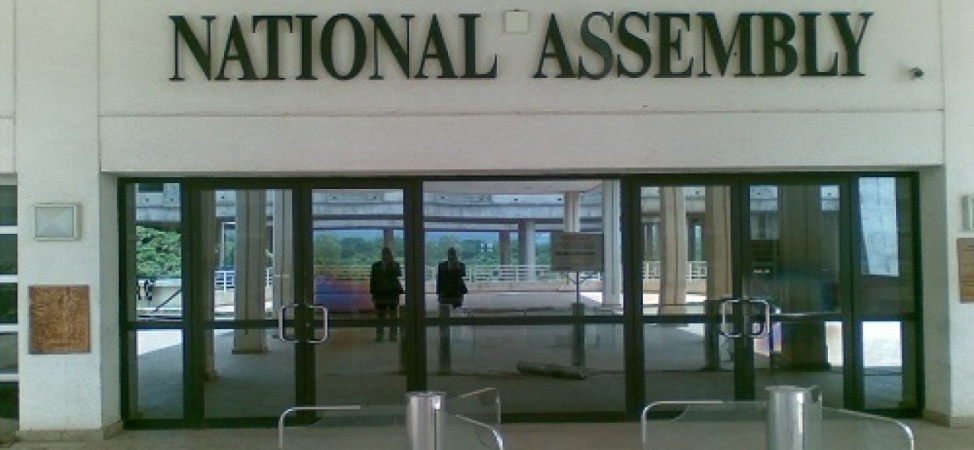
With the National Assembly, especially the Senate, already branded a retirement home for former state governors, another nomenclature is silhouetting in the background – a strategic sanctuary for some high-profile suspects. No thanks to the number of ex-governors trooping there after their tour of duty as states’ helmsmen. While such optics, though not illegal, question the country’s moral quotient and hamper democracy in various ways, they also dent the NASS’ institutional image. ENO-ABASI SUNDAY explores how the presence of prosecuted ex-governors in the Red Chambers creates a cycle of impunity, affects the quality of lawmaking, and engenders the passage of self-preservative laws, just as the colony of accused lawmakers questions the integrity of the country’s democratic institutions.
Every election cycle, the character, composition and hue of the National Assembly change significantly. While this happens, the situation and circumstances of the Nigerian people remain either largely unchanged or simply plummet.
As the turnover of lawmakers soars and institutional memory ebbs, the population density of former state governors, who are taking up seats in the Senate, is steadily climbing. Curiously, many of these ex-governors are being investigated by anti-graft agencies for their alleged sleazy conduct while serving as state governors.
Ahead of the 11th Senate, the plumage of the Red Chambers is not about to change, as some former governors accused of stealing trillions of naira from their people have already obtained their tickets ahead of the National Assembly election slated to hold on January 16, 2027.
One year and six months after the Delta State Chapter of the All Progressives Congress (APC) lauded the Economic and Financial Crimes Commission (EFCC) for interrogating the immediate past governor of the state, Dr Ifeanyi Okowa (then of the Peoples Democratic Party) for allegedly stealing N1.3 trillion, the party did a remarkable volte-face by congratulating Okowa for winning their ticket as candidate for the Delta North Senatorial District.
In the wake of that arrest, the APC described Okowa’s arrest “as the right step in the right direction,” after the anti-graft agency accused him of diverting N1.3 trillion from the federation account between 2015 and 2023, allegedly as proceeds of the 13 per cent derivation fund.
After losing immunity from prosecution upon completing his second term, the former PDP vice-presidential candidate cross-carpeted to the APC. Not only has the case been stalled, as with that of some of his former colleagues, but he was further rewarded with a ticket that would enable him to contest a return to making “laws for the good governance of the country.”
Months after leaving office, Yahaya Adoza Bello, who governed Kogi State for eight years, effectively became a fugitive from justice as the EFCC chased him over billions that he allegedly stole during his tenure as governor between 2016 and 2024. These unfortunate spectacles meant nothing to his people and the APC, which nominated him as its candidate for the Kogi Central Senatorial District.
Among the two separate criminal charges that Bello is facing is the one before Justice Emeka Nwite of the Federal High Court in Abuja, where the EFCC filed a 19-count charge accusing Bello of laundering about N80.2 billion allegedly diverted from Kogi’s vault.
In another case, the EFCC accused Bello, Umar Oricha and Abdulsalami Hudu (his two co-defendants) of involvement in an alleged N110.4 billion fraud and criminal breach of trust.
Should the people of Kogi Central Senatorial District prefer Bello to other candidates for the top job, he would be in the Red Chamber, facing lingering prosecution, making laws for Nigeria as a member of the 11th Senate.
A former Kaduna State governor, Mukhtar Ramalan Yero, who is also standing trial for mismanaging about N700 million while in office, recently won the APC candidacy for the Kaduna North Senatorial District.
For more than a decade, Yero has been battling an EFCC prosecution connected to the $115 million distributed by a former minister of petroleum, Diezani Alison-Madueke, ahead of the 2015 presidential election. A UK court only recently exonerated Diezani of corruption charges.
Yero’s matter, one of Nigeria’s most prominent unresolved election corruption cases, started with his arrest in May 2016, and he was first arraigned in May 2018 alongside a former Kaduna State PDP chairman, Nuhu Haruna Gaya; former Secretary to the Kaduna State Government, Hamza Ishaq, and former Minister of State for Power, Somo Wya, before the Federal High Court in Kaduna.
From state houses to the National Assembly, in whose interest?
THOUGH not illegal, many have described as unfair the practice of sitting governors using their power of incumbency to displace other contenders at party primaries, and muscle their way to grab senatorial tickets after spending four or eight years in office.
The practice, which has percolated since the return of democracy, has enabled some discredited ones among them to march to the NASS seamlessly in a move that strikes at the heart of institutional integrity.
Given the poor performance records of some of them, the trip from government houses to the Senate has not always been a joyful sojourn for all former governors who embark on it. Some get savaged by the people’s fury during the primary election, while others get their just recompense during the election proper.
Former governors Ben Ayade of Cross River State, Okezie Ikpeazu of Abia, Samuel Ortom of Benue State, Ifeanyi Ugwuanyi of Enugu State, Atiku Bagudu of Kebbi State, and Darius Ishaku of Taraba State are some of those who were rejected outright by their people.
However, this major seasonal political realignment by former governors has, in most cases, been in their best interest, as most of them remain passive or lukewarm, and without landmark legislation in the interest of their constituents or ones that will rattle the executive. This is to avoid their case files from being dusted by the executive-backed anti-graft bodies.
On the part of the citizenry, voters watching individuals who allegedly stole hundreds of billions of taxpayers’ money rewriting the country’s rules while sitting in high offices simply engenders systemic cynicism, which ultimately annihilates tax compliance, affects voter turnout, and entrenches the belief that the laws they script are meant to punish the poor.
Without a doubt, a burgeoning colony of accused lawmakers, some of whom may spend their mornings in courtrooms and their afternoons in plenary, cannot provide rigorous oversight, and this fundamentally alters the quality and intent of legislation.
At least 17 former and then-serving state governors were elected to the Ninth Senate. This number was 15.6 per cent of the 109-member Senate. Of this number, 11 were ex-governors, while the remaining six were serving their respective second terms.
By the last count, the 10th Senate plays host to 13 former governors. They include Godswill Akpabio, Seriake Dickson, and Adams Oshiomole (South-South); Adamu Aliero, Aminu Tambuwal, Aliyu Wammako, and Abdulaziz Yari (North-West), while Sani Bello and Simon Lalong hail from the North-Central.
Senators Ibrahim Hassan Dankwambo and Danjuma Goje are from the North-East, while the South-East has only Senator Orji Uzor Kalu, and Senator Gbenga Daniel is the only former governor from the South-West in the 10th Senate.
A look at the list of senators in the 10th Senate revealed that many of them arrived there with charge sheets on their necks. For instance, Adamu Aliero got there with a N10 billion theft allegation on his neck; the EFCC accused Tambuwal of N189 billion fraud; Dickson was being investigated for alleged diversion of N17.5 billion ecological funds and assets declaration breaches, while the EFCC in 2018 revealed that it received many petitions, which alleged the theft and laundering of N15 billion from the treasury of Sokoto State by former governor Wammako.
2022, the EFCC arrested ex-governor Abdul’Aziz Yari over his alleged role in the N84bn fraud involving then suspended Accountant-General of the Federation, Ahmed Idris. In 2019, the EFCC charged the former governor with financial fraud amounting to N84 billion. Governor Muhammadu Inuwa Yahaya of Gombe State, in 2023, disclosed that the Economic and Financial Crimes Commission (EFCC) helped his administration and the state to recover N1.3 billion from former Governor Ibrahim Hassan Dankwambo.
After ex-governor Kalu was convicted of fraud to the tune of N7.56bn and sentenced to 12 years imprisonment, the Supreme Court declared the judgment as a nullity on the ground that Justice Mohammed Idris, who delivered the judgment, was already sworn in as a Justice of the Court of Appeal at the time and so could not act in the capacity of a judge of the High Court.
In the last senatorial primaries conducted by the ruling APC, seven serving governors emerged as senatorial candidates, while 12 former governors also secured their senatorial tickets from the primaries.
Abdullahi Sule of Nasarawa, Umaru Fintiri of Adamawa, Dapo Abiodun of Ogun, and Abdulrahman Abdulrazaq of Kwara State are some of the serving governors.
Apart from Okowa, Bello, and Yero, the other former governors with senatorial tickets in their pockets are Senate President, Akpabio, whose prosecution for allegedly mismanaging N108 billion from Akwa Ibom State between 2007 and 2015 appears to have been “put on hold by the EFCC.” He retained the APC ticket for Akwa Ibom North-West Senatorial District.
Other former governors, who have picked their senatorial tickets, are Kalu (Abia); Oshiomhole (Edo); Wamakko (Sokoto); Gabriel Suswam (Benue); Aliero (Kebbi), Ibrahim Shekarau (Kano) and Sani Bello (Niger).
EVENTS of the recent past have shown that major political parties lack the commitment to wage a sustained war against corruption and work towards the enthronement of probity and accountability. With abundant evidence that about 10 per cent of the 109 Nigeria’s most senior lawmakers, some of whom occupy leadership positions, are being prosecuted for varying shades of crime and criminality, political parties appear not to do enough to sift the grains from the chaff.
This can be gleaned from the way former governors who are being prosecuted for allegedly robbing the people of their commonwealth, some of whom have been jailed, are still being courted by the parties or handed the parties’ senatorial tickets on a platter.
The Chairman of Human and Environmental Development Agenda (HEDA), a non-governmental organisation (NGO), Olanrewaju Suraju, could not agree less. “Political parties in Nigeria are simply a vehicle for the highest bidder to get elected into political offices. This is why nomination forms to political offices in these parties are priced out of the reach of hard-working ordinary citizens. The major parties lack commitment to fight against corruption, and even thrive on the proceeds of crimes to sustain their existence.”
A coalition in Niger State peeved with the status quo petitioned the National Chairman of the African Democratic Congress (ADC), David Mark, as well as the party’s governorship screening committee, to encourage the Niger State ADC governorship aspirant to withdraw from the race over alleged N3 billion rice contract fraud.
The coalition insisted that the opposition could not afford to field a candidate with what it described as a “tainted public image” after Mallam Idris Usman Makanta, popularly known as “Shinkafan Nupe,” decamped from the APC and pitched a tent with the ADC.
A Director and Co-founder of EduTimes Africa, Kammonke Abam, is peeved that those who have, by their actions and inaction, encumbered the country’s democracy by stealing public funds or undermining public trust are repeatedly rewarded with higher political offices, including being saddled with the task of national lawmaking.
“Public trust is not in the dictionary of most Nigerian politicians; their concerns most times are their selfish interests. Not only is Nigeria’s democracy seriously encumbered by actions such as this, but it is also totally flawed. It is regrettable that Nigeria’s political system shuts out noble-minded persons and does not strongly reward policy expertise or technocratic transitions. Politics in Nigeria tends to recycle elites through available offices, at best, a cyclical system that is garbage in, garbage out.”
How prosecuted lawmakers spike reputational damage, cripple oversight capabilities
AFTER party affiliation and constituents’ demands, institutional rules constitute the three most active forces in lawmaking, even as individual lawmakers’ personality traits act as a critical internal sifter. Also, in analysing legislative behaviour through established frameworks like the Big Five Personality Traits, viz. Openness, Conscientiousness, Extraversion, Agreeableness, and Neuroticism (OCEAN), several patterns are thrown up, and they explain how personality traits affect the way that laws are written and passed.
This presupposes that the watchdog function of a lawmaker is deadened or neutralised when he or she is under investigation by anti-graft agencies controlled by the executive, since agencies that are compromised cannot be rigorously audited, thereby leading to a “quid pro quo” kind of arrangement where oversight visits become tools for mutual blackmail as well as personal enrichment.
Furthermore, a legislative assembly that is bogged down by heavily investigated members suffers innumerable operational wounds, including institutional hostage-taking, collateral damage beyond reputation, crippled oversight capabilities, destruction of civil morale and democratic legitimacy.
This perhaps explains why India’s independence movement leader, Mahatma Gandhi, in his display of profound wisdom on law and justice, said: “An unjust law is itself a species of violence.”
One organisation that is particularly worried that the continuous recycling of politically exposed individuals with corruption allegations weakens citizens’ confidence in democratic institutions and undermines anti-corruption efforts championed by the EFCC and the Independent Corrupt Practices and Other Related Offences Commission (ICPC) is the Civil Society Legislative Advocacy Centre (CISLAC).
According to it, this trend contributes to legislative capture, where individuals with questionable records occupy strategic oversight positions capable of influencing investigations, weakening accountability institutions, and frustrating reforms aimed at strengthening transparency in public finance and governance.
While every Nigerian is entitled to the constitutional presumption of innocence until proven guilty, political parties, the group said, have a moral and democratic responsibility to uphold higher ethical standards in candidates’ selection. The mere existence of serious corruption allegations should compel parties to conduct rigorous integrity assessments before awarding tickets for sensitive public offices.
It, therefore, called on political parties to prioritise competence, integrity, and public credibility over political patronage and elite recycling. “Nigerians deserve a legislature populated by individuals committed to national development, accountability, and the rule of law, not one increasingly perceived as a retirement haven for politically exposed persons facing corruption scrutiny,” said Auwal Musa, the Executive Director of CISLAC.
On his part, Suraju, who is also Chairman of the Civil Society Network Against Corruption (CSNAC), emphasised that the hibernation of ex-governors in the Senate tremendously undermines its oversight and lawmaking mandates.
“Former state governors are running to the Senate either to serve as their retirement home, stepping stone for ministerial appointment, or even to angle for presidential slots. There is no genuine commitment to legislation. Some even go to the chamber to get cover from continued EFCC prosecution. An X-ray of ex-governors in the Senate, current or former, will confirm this disturbing trend. This has tremendously undermined the oversight and lawmaking mandates of the Senate.”
For Abam, who is also the Project Director and Chief Executive Officer (CEO) of Profiles & Biographies, on the surface, “it wouldn’t have been a bad idea for former governors to seek other elective offices, including going to the Senate, if the idea behind it was to deploy their wealth of experience in managing their states to the betterment of the nation. But we do know that their reasons are not altruistic. Why do I say so? Most of them have one corruption case or another hanging around their necks. So, that’s where it gets tricky and awry. The ruling party handing senatorial tickets to former governors who are being investigated for stealing public funds reflects the existing political culture in the country.
While deploring the sloppy pace of criminal litigations in the country that allows cases that should be dispatched with military alacrity to span years, the former aide of governors Donald Duke and Liyel Imoke said that compromised lawmakers and their backers were constantly spinning things to weaken or numb the effect of anti-graft agencies.
According to him, his recent interaction with a retired jurist showed that intrigues and the government’s interest were instrumental in bringing down corruption cases across the board.
Delayed trials, Section 308 abuse turning anti-graft war into performance
THE prosecution of highly-placed Politically Exposed Persons (PEPs), including presidents, vice president, governors, and their deputies that span multiple administrations (without success) after they have spent four to eight years in office, enjoying immunity, is a worrisome trend that makes a mockery of the country’s anti-graft war.
While this remains a huge challenge that must be addressed willy-nilly, much of this fad is fed by the sloppy justice dispensation system, which grinds slowly, and the constitutional provision that allows suspected looters to swagger like vacationing millionaires for years, since every accused is deemed innocent until proven guilty.
In a 2018 report titled “Letting the Big Fish Swim,” the Socio-Economic Rights and Accountability Project (SERAP) noted that while “main anti-corruption agencies secured more than 1, 500 non-high profile convictions between 2000 – 2017, they could only muster 10 high-profile convictions within the same period.”
Repeatedly, the EFCC has shrugged off allegations of favouritism and reiterated its determination to prosecute thieving governors and other Nigerians, but its record of prosecuting PEPs remains very poor. The Chairman of the EFCC, Ola Olukoyede, recently announced the ongoing investigation of 18 governors for various financial malpractices. Though heartwarming, it is still taken by Nigerians with a pinch of salt.
“The misuse of immunity provisions has had devastating implications for Nigeria’s development, as resources meant for healthcare, education, infrastructure, security, and poverty alleviation are allegedly diverted without immediate legal consequences. Citizens continue to bear the burden of poor governance while accountability is postponed indefinitely,” the CISLAC boss explained.
“CISLAC therefore calls for a national conversation on the urgent need to review and reform Section 308 of the Constitution to prevent its abuse. Immunity should not translate into absolute protection from investigation or accountability. At the very least, anti-corruption agencies such as the EFCC and ICPC should be empowered to carry out thorough investigations and preserve evidence against serving public officials pending the expiration of their tenure…Political parties must take responsibility for promoting credible candidates with demonstrable integrity and competence rather than rewarding political influence and financial power.”
In chipping in his view, whether immunity should translate into absolute protection from investigation, accountability, Suraju regretted that the constitutional immunity clause is exploited by occupants of the office of governor.
Unfortunately, some of them either escaped or frustrated their trial with their assumption of offices as governors.
Immunity clause as “biggest” facilitator of corruption in governance
THE immunity clause in the Nigerian Constitution, which is unconditional and total for presidents, vice presidents, governors, and deputy governors, some say, is the biggest and most fundamental cause of the massive stealing of public funds by mostly the state governors and other officials that enjoy immunity.
State governors are the greatest thieves of public funds, as well as the greatest threats to sustainable development, economic prosperity, infrastructural development and human security,” a former National Commissioner at the National Human Rights Commission of Nigeria (NHRC), Comrade Emmanuel Nnadozie Onwubiko, alleged.
“The fact is that the high level of corruption perpetrated by governors in states is the single and largest creator of mass and multidimensional poverty afflicting over 130 million Nigerians, going by the 2018 statistical report of the National Bureau of Statistics…The failure of the National Assembly to provide oversight for the executive arm of government in the area of public procurement and execution of projects effectively creates room for corruption to thrive, even in the presidency and federal agencies. Poverty is ballooning out of control, and the cost of living crisis and high costs of fuel are raging ferociously, even when Nigeria is the 8th largest crude oil producer. This is a big irony.”
Onwubiko, who is the Founder of Human Rights Writers Association of Nigeria (HURIWA), wondered why the EFCC and the ICPC, which are busy prosecuting opposition politicians such as the former governor of Kaduna State, Nasir el-Rufai, and ex-Attorney General of the Federation (AGF) Abubakar Malami, while looking the other way as Yahaya Bello, Okowa and Akpabio that have all been indicted of alleged thefts of public fund are running for offices on the ruling party’s platform. So, blame the EFCC and ICPC for mortgaging their independence and being tied to the apron strings of APC and President Bola Ahmed Tinubu, who are dictating to the anti-graft agencies who to catch and who not to catch, therefore making APC a refuge for indicted politically exposed individuals in Nigeria.” (The Guardian)