ADVERTISEMENT

ADVERTISEMENT

ADVERTISEMENT

ADVERTISEMENT




Loading banners
Loading banners...


NEWS EXPRESS is Nigeria’s leading online newspaper. Published by Africa’s international award-winning journalist, Mr. Isaac Umunna, NEWS EXPRESS is Nigeria’s first truly professional online daily newspaper. It is published from Lagos, Nigeria’s economic and media hub, and has a provision for occasional special print editions. Thanks to our vast network of sources and dedicated team of professional journalists and contributors spread across Nigeria and overseas, NEWS EXPRESS has become synonymous with newsbreaks and exclusive stories from around the world.
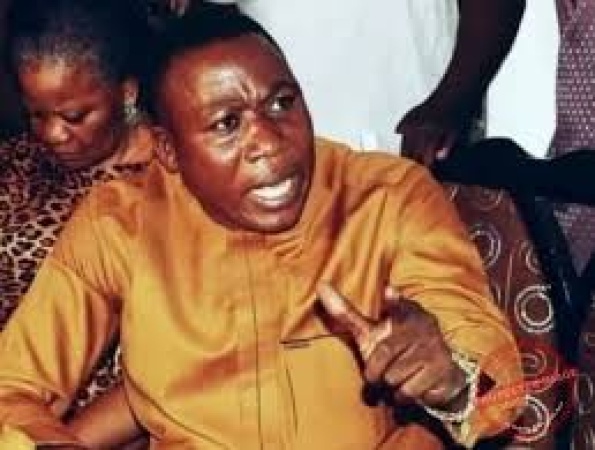
Sunday Igboho
By 3 pm on Wednesday, the co-working lounge inside a popular hotel in Abuja’s Central Business District (CBD) is alive in a quiet, con’rolled way; soft conversations, laptop clicks, and the low hum of people trying to stay ahead of their day.
In one corner, Terna Iorfa sits still. A half-empty bottle of water rests beside him. His pen taps lightly against it; steady, almost rhythmic. He’s not just watching. He’s recognising something familiar.
Speaking with Saturday Vanguard, the governance risk analyst, election forecaster and conflict tracker leans back slightly, eyes narrowing as he thinks.
“This kind of thing… it doesn’t just happen. You start hearing certain words, certain tones… and if you’ve followed Nigerian politics long enough, you know where it can lead,” Terna says.
He pauses, then continues, “I’ve seen this pattern before, and it doesn’t end well.”
A Warning Before the Race Begins
Official campaigns haven’t started. No rallies. No campaign tours. Nothing formal. But something has already entered the space.
In a widely circulated video, Sunday Adeyemo, also known as Igboho, made his position unmistakably clear: “If you know that you are crazy, campaign for one Atiku or Obi in Yorubaland. No more ‘useless’ Atiku or Obi in Yorubaland.”
He urged supporters planning to campaign for opposition figures to ‘wear trainers boots’.
Igboho followed it with a strong endorsement of President Bola Tinubu: “Tinubu for second term; beyond 2027. A 100 per cent. After eight years of Asiwaju, we’ll pray for extra years. Throughout Lagos and Yorubaland, it’s for Asiwaju. We will all vote for him.”
Campaigns haven’t started. But the warning already has. Terna shakes his head slowly.
“See, the thing is… this is not about campaigning yet. This one is about setting the mood. It’s like telling people, ‘Before we even start, know where you stand.’ And in this country, people hear that kind of message,” he says, leaning forward slightly.
From Defiance to Alignment
Five years ago, Igboho was something else entirely. At the height of insecurity in the South-West, he was loud, confrontational and, to many, a necessary voice. He challenged power, accused leaders of failing their people, and demanded something different.
“He wasn’t talking like a politician then. He was talking like someone who felt people were not being protected,” Terna says.
Now, that same voice is warning opposition figures like Atiku Abubakar and Peter Obi not to campaign in the region. Same influence. Different direction.
“You don’t ignore that kind of shift. People trusted that voice. So when it changes like this, it affects how people think, whether they realise it or not. You don’t need violence to control the political space. Sometimes, words do the job,” Terna says quietly before pausing briefly.
Return, Gratitude, and Realignment
Igboho returned to Nigeria in January 2026 after years in exile following a 2021 security crackdown. His name was removed from the wanted list under Tinubu’s administration. Traditional rulers intervened. He came back.
“Look, if someone helps you, it’s normal to appreciate it. That part is human. But when appreciation starts sounding like you’re now deciding who gets to express his political choice or preferences in a specific space, and who doesn’t… that’s where it changes,” Terna adds.
Public Reactions: A Chorus of Warning
As the video spread, reactions came quickly, cutting across media, activism and political movements, many of them framing the moment as a test of Nigeria’s democratic boundaries.
Preach Peace, Not Threats — Dele Momodu
Veteran journalist and publisher Dele Momodu, drawing on decades of experience around power and political conflict, issued a direct public appeal for restraint:
“My dear brother Sunday Igboho, let me appeal to you to support any candidate of your choice, peacefully, and others will support theirs, freely. Atiku or Obi cannot be stopped by you, or anyone else for that matter from campaigning in any part of Yorubaland or Nigeria as a whole. I respect your choice of Tinubu, as your current benefactor, but please, Aburo mi atata, do not get carried away to the extent of threatening your fellow citizens. You should be preaching peace and not war,” Momodu advised.
Nobody Can Stop Me — Omoyele Sowore
Human rights activist and former presidential candidate Omoyele Sowore responded in his characteristic confrontational style, rejecting both the warning and the idea behind it:
“I am not Peter Obi. I will go anywhere in this country to campaign and I want to see who will come and stop me,” Sowore stated. He described the shift as “transactional politics.”
Campaigning Is a Constitutional Right — Obidient Movement
The Obidient Movement, representing a large base of politically active Nigerians and supporters of Peter Obi, framed the issue as a broader democratic concern:
“The Obidient Movement has watched with deep concern the viral video of Sunday Igboho threatening Atiku Abubakar and Peter Obi against campaigning in the South-West, and vowing to push for an unconstitutional third term for President Tinubu… Anybody Can Campaign ANYWHERE in Nigeria,” Dr Yunusa Tanko, the National Coordinator of the Obidient Movement, said.
A Threat to Democracy — Segun Ben-Ajayi
Public affairs commentator Segun Ben-Ajayi, speaking from a civic accountability standpoint, warned that such rhetoric crosses a constitutional line:
“Yoruba conservatives should caution Sunday Igboho. In a new video, he said Atiku and Obi should not come to the South-West to campaign. That is a threat to their human rights and to democracy,” Ben-Ajayi said.
It’s a Dangerous Escalation — Asabor
Similarly, Isaac Asabor, situating the moment within Nigeria’s history of politically charged rhetoric, described it as a dangerous escalation: “The recent fire-and-brimstone threats issued by Sunday Igboho against those who may support Atiku Abubakar or Peter Obi in the 2027 elections represent not just an alarming lapse in judgment, but a dangerous escalation in Nigeria’s already fragile political climate,” Asabor said.
History, Memory, and Political Space
This kind of tension isn’t new in Nigeria. We’ve seen it before. In the build-up to the 2015 general elections in Nigeria, the atmosphere was already tight, and people paid close attention to where candidates could go and how freely they could campaign. By the 2019 general elections in Nigeria and the 2023 general elections in Nigeria, concerns about pressure, strong political language, and whether voters felt safe enough to openly support their choices had become more visible.
So for many observers, what is happening now doesn’t feel new. It feels familiar. It’s that early stage; when nothing official has started, but the tone is already being set. When words begin to shape behaviour, and people quietly start asking themselves what is safe, and what is not.
Former Vice President Atiku Abubakar has, over time, spoken consistently about the need for an open political space.
“Democracy cannot thrive where citizens are denied the freedom to participate fully in the political process,” he said after the 2023 elections.
On another occasion, he added: “Nigeria belongs to all of us, and every Nigerian must have the right to aspire, to campaign and to be heard in any part of the country.”
For analysts, these are not just political statements. They reflect a deeper, long-running conversation in Nigeria about fairness, access, and whether everyone truly has the same space to participate.
Placed against that backdrop, this moment feels bigger than one comment or one individual. It brings the same question back into focus, quietly, but unmistakably: how open is Nigeria’s political space, really?
Data-Backed Context
The data tells a similar story. Voter turnout in Nigeria has declined steadily over the last three election cycles; from 43.7 per cent in 2015 to 34.75 per cent in 2019, before dropping to between 26.7 and 28.6 per cent in 2023, the lowest since the return to democracy. In real terms, fewer than 25 million Nigerians voted out of over 93 million registered voters in the last presidential election.
At the same time, concerns about the environment in which elections are conducted have persisted. During the 2023 polls, ’bservers recorded at least 135 critical incidents, including voter intimidation, ballot snatching and disruptions across several states.
For electoral authorities and analysts alike, the trend raises a deeper concern: not just whether Nigerians can campaign and vote, but whether they feel free, and safe enough, to do so.
The Silence That Speaks
Even as criticism grows louder, attention has shifted to what has not been said.
Observers say there has been no clear public distancing from Igboho’s remarks by the ruling All Progressives Congress, APC, or the presidency, a silence that, in Nigeria’s political history, often carries its own meaning and has begun to attract scrutiny.
Terna exhales slowly. “In this country, people are always watching who speaks… and who doesn’t. And sometimes, that silence… it says a lot,” he says, tapping the pen again.
Before the Ballot, There Is Behaviour
Terna circles a phrase in his notes: pre-election conditioning.
“Elections don’t just start on election day. They start from moments like this. From when people begin to ask themselves, ‘If I show support, will there be a problem?’ In Nigeria, people don’t always wait to be stopped. Sometimes, they just hear the message, and step back,” he says, looking up.
The Question That Remains
As the afternoon light softens across Abuja, Terna packs up slowly. Calm. Certain.
“This is bigger than one person. It’s about the political space. Are we expanding it… or are we quietly shrinking it, before anyone even realises it’s gone?” he says, pausing at the edge of the table.
Outside, the nation moves as it always does. But beneath that movement, something else is taking shape. Not the campaign. The conditions under which it will happen. (Saturday Vanguard)