
Updating your news feed...
NEWS EXPRESS is Nigeria’s leading online newspaper. Published by Africa’s international award-winning journalist, Mr. Isaac Umunna, NEWS EXPRESS is Nigeria’s first truly professional online daily newspaper. It is published from Lagos, Nigeria’s economic and media hub, and has a provision for occasional special print editions. Thanks to our vast network of sources and dedicated team of professional journalists and contributors spread across Nigeria and overseas, NEWS EXPRESS has become synonymous with newsbreaks and exclusive stories from around the world.


























Loading banners
Loading banners...

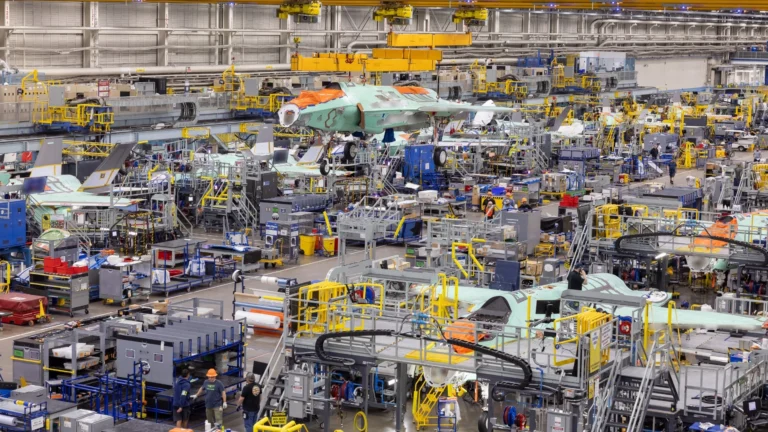
Lockheed Martin has initiated final assembly of Germany’s first F-35A stealth fighter at its production facility in Fort Worth, marking a major step in Berlin’s military modernization programme. The aircraft, designated MG-01, represents the first of 35 jets ordered by Germany to strengthen its air combat capabilities.
The milestone comes as Germany advances its transition to fifth-generation fighter technology, with initial aircraft expected to support training operations in the United States. The programme will see early deliveries routed through Ebbing Air National Guard Base in Fort Smith (FSM), where Luftwaffe crews will begin certification.
Final assembly begins once the aircraft’s major structural sections are joined and the landing gear is installed. These sections include the forward, centre, and aft fuselage, along with the wing assemblies.
At this stage, the aircraft can support its own weight and move through advanced production stations. The process marks a shift from structural manufacturing to systems integration and finishing.
Lockheed Martin has confirmed that multiple German aircraft are already progressing through different production phases. Work on key structural components for these jets started in late 2024, Flight Global reported.
During final assembly, engineers install the Pratt & Whitney F135 engine, which powers the F-35A. Teams also integrate flight control surfaces, avionics systems, and the cockpit canopy.
This phase ensures that the aircraft’s onboard systems function together as a single operational platform. Each step undergoes strict quality checks before the aircraft proceeds further.
After system integration, the jet will receive its external coating. This includes the specialized stealth finish designed to reduce radar visibility and enhance survivability in contested airspace.
Germany plans to induct 35 F-35A fighters into its air force as part of a broader modernization effort. The first eight aircraft will be delivered to the United States for pilot and crew training.
Training operations will take place at Ebbing Air National Guard Base, where German personnel will undergo qualification on the new platform. This approach allows crews to gain experience before the aircraft are deployed domestically.
Initial evaluation and check flights for Germany’s first F-35A are expected to begin later this year. These flights will validate aircraft performance and readiness before formal delivery milestones are completed.
The F-35 Lightning II, built by Lockheed Martin, is the world’s most advanced multi-role stealth fighter jet, combining 5th Generation technology with unmatched combat capabilities. Operated by 20 nations, it serves as a cornerstone of modern air dominance and allied defense strategy.
Designed to replace aging legacy aircraft, the F-35 integrates stealth, advanced sensors, and electronic warfare across three distinct variants. With over 1,150 aircraft in service and more than one million flight hours logged, it remains one of the most reliable and combat-proven platforms in aviation history.
F-35 Program Overview
The F-35 program currently includes 20 partner and customer nations. Partner countries include the U.S., U.K., Italy, Netherlands, Canada, Australia, Denmark, and Norway. Foreign Military Sales customers include Israel, Japan, the Republic of Korea, Belgium, Poland, Singapore, Finland, Switzerland, Germany, Czech Republic, Greece, and Romania. The program delivers seamless interoperability, allowing allied forces to conduct integrated operations with a shared platform across different theaters of war.
Production continues at a steady pace, with an expected annual output of 156 aircraft per year. Every delivery strengthens the global fleet and enhances allied readiness against evolving threats.
F-35A Lightning II: Technical Specifications
The F-35A is the conventional takeoff and landing (CTOL) variant, designed to operate from standard runways. It is the most widely operated version among U.S. Air Force and international allied customers.
SpecificationValue
Length
51.4 ft / 15.7 m
Height
14.4 ft / 4.38 m
Wingspan
35 ft / 10.7 m
Wing Area
460 ft² / 42.7 m²
Horizontal Tail Span
22.5 ft / 6.86 m
Empty Weight
29,300 lbs
Internal Fuel Capacity
18,250 lbs / 8,278 kg
Weapons Payload
18,000 lbs / 8,160 kg
Maximum Weight
70,000 lb class
Top Speed
Mach 1.6 (~1,200 mph)
Combat Radius
Over 590 nm / 1,093 km (USAF profile)
Range (Internal Fuel)
Over 1,200 nm / 2,200 km (USAF profile)
Max G-Rating
9.0
Propulsion: The F-35A is powered by the Pratt & Whitney F135-PW-100 engine, rated at 40,000 lbs maximum thrust and 25,000 lbs military thrust.
Standard Internal Weapons Load:
Stealth Capabilities: How the F-35 Avoids Detection
Stealth does not make the F-35 invisible but significantly complicates an adversary’s ability to detect, track, and engage it. The aircraft’s low observability is achieved through multiple design and engineering factors:
Together, these features give F-35 pilots a significant tactical advantage against threats from air, land, and sea.
National Security and Multi-Domain Dominance
The F-35 is not a single-role platform. It operates across every domain — land, sea, air, space, and cyber — making it central to the United States’ multi-domain operations strategy. Its ability to fuse battlefield intelligence from multiple sensors and share it across platforms gives it a decisive edge over adversaries and legacy alternatives.
Block 4 upgrades are currently expanding the aircraft’s capabilities further, including broader weapons integration and enhanced electronic systems. Future operations will require F-35s to work alongside uncrewed aircraft systems and artificial intelligence-driven platforms to maintain allied air superiority well into the future.
Cost Efficiency and Economic Contribution
Since 2015, Lockheed Martin has reduced its portion of the F-35’s cost per flight hour by 50%, making it a competitive option for international customers. The F-35 program contributes over $79 billion to the U.S. economy annually, supporting thousands of jobs across the defense supply chain.
Affordability has been a key procurement factor for nations including Romania, Canada, Germany, Finland, and Switzerland, all of which selected the F-35 as the most cost-effective 5th Generation option available in the market.
Sustainment: Mission Ready Anytime, Anywhere
Lockheed Martin operates 24/7 operations centers staffed by sustainment engineers who work directly with customers on the flight line. This integrated sustainment model ensures the F-35 remains mission-ready in any environment, from shipboard deployments to high-tempo land operations.
Surface discoloration sometimes observed on F-35 aircraft after harsh deployments is cosmetic, caused by exposure to sea spray, fuel, oils, and jet blast. It does not affect stealth performance or structural integrity. A next-generation coating has been introduced to reduce visible wear and extend service life as part of the program’s evolving corrosion control strategy.
A common concern regarding allied F-35 operations is the existence of a U.S.-controlled “kill switch.” No such mechanism exists. Nations including the U.K., Norway, Netherlands, Finland, Switzerland, Belgium, and Czech Republic have each confirmed full sovereign control of their aircraft. Allied nations can integrate their own national weapons systems and conduct independent flight operations without U.S. oversight.
The F-35B also completed successful test flights of the Meteor missile, demonstrating the platform’s capacity to carry and deploy non-U.S. weapons systems. The Block 4 modernization program continues to expand this weapons integration capability. (AviationA2Z)




