Updating your news feed...
NEWS EXPRESS is Nigeria’s leading online newspaper. Published by Africa’s international award-winning journalist, Mr. Isaac Umunna, NEWS EXPRESS is Nigeria’s first truly professional online daily newspaper. It is published from Lagos, Nigeria’s economic and media hub, and has a provision for occasional special print editions. Thanks to our vast network of sources and dedicated team of professional journalists and contributors spread across Nigeria and overseas, NEWS EXPRESS has become synonymous with newsbreaks and exclusive stories from around the world.


























Loading banners
Loading banners...

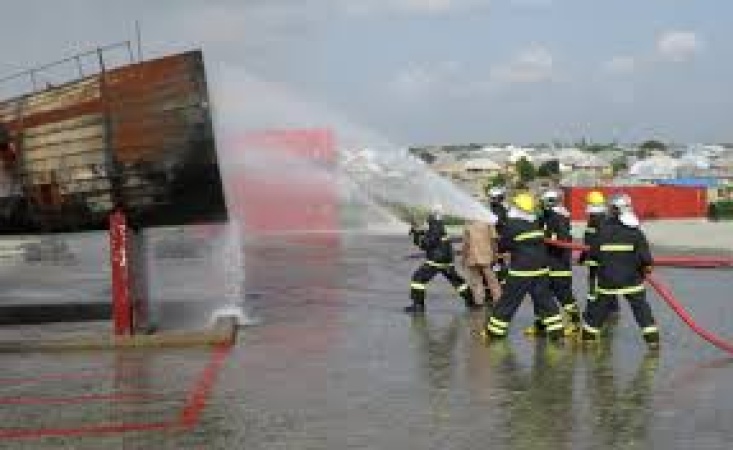
FAAN firefighters during a training exercise
Airport firefighters under the Federal Airports Authority of Nigeria (FAAN), have rejected a proposed online basic firefighting training programme for the staff of the agency.
The firefighters under the aegis of the Nigerian Aviation Fire and Safety Association (NAFSA), warned that the move could compromise aviation safety standards and potentially weaken Nigeria’s global aviation safety standing.
The opposition comes amidst plans by FAAN to introduce a four-week e-learning course followed by two weeks of practical training for over 200 airport firefighters across the country.
NAFSA in a protest letter, signed by its President, Sunday Ugbeikwu, dated March 9, 2026, specifically addressed to the Managing Director of FAAN, Olubunmi Kuku and obtained by The Guardian on Wednesday, described the programme as an “aberration and travesty.”
Ugbeikwu insisted that aviation firefighting training could not be effectively conducted online.
He warned that replacing extensive practical drills with virtual learning would significantly weaken the competence of firefighters responsible for responding to aircraft emergencies at Nigerian airports.
According to the association, the proposal also contradicted global aviation safety standards prescribed by the International Civil Aviation Organization (ICAO) and the Nigeria Civil Aviation Authority (NCAA).
Ugbeikwu cited ICAO Annex 14, which stipulates that airport rescue and firefighting training must include hands-on practical exercises and live simulations.
The association said core components of aviation firefighting training such as aircraft rescue operations, live fuel fire suppression, breathing apparatus drills and emergency response procedures, could not be effectively delivered through virtual platforms.
Keyamo orders hybrid payment system at airport access gates
The letter read in part: “The national leadership of NAFSA at this juncture cannot stand aloof and watch the colossal damage that is about to happen to FAAN firefighters, hence this important letter to draw your attention to the matter and to notify you that the firefighters are distraught and disgruntled.
“The leadership of NAFSA has taken a strong stance against the proposal to conduct an e-learning initial (Basic) Firefighters Course for FAAN firefighters. This move is contrary to the NCAA/ICAO standards and best practices.”
NAFSA warned that firefighters trained under a predominantly online model may not meet the operational requirements expected of airport rescue and firefighting personnel.
Ugbeikwu expressed confidence that the NCAA, led by its Director-General, Chris Najomo, would insist on strict compliance with internationally recommended standards for aviation firefighting training.
He declared that airport firefighters remained one of the most critical safety components of aviation operations and must undergo rigorous physical training to effectively handle aircraft emergencies.
The association also warned that attempts to shorten training duration and replace physical exercises with online learning could reduce the preparedness of firefighters during real-life aviation emergencies.
He pointed out that the initial training for aviation firefighters lasted about three months before it was recently reduced to six weeks of intensive physical training by FAAN.
He purported that the e-learning model was introduced as part of efforts to cut training costs, but insisted that safety considerations must always take precedence over financial constraints in aviation.
Ugbeikwu further suggested that the over 200 firefighters scheduled for the training should be trained in batches of between 50 and 70 personnel if logistical limitations prevented them from undergoing the programme simultaneously.
NAFSA further called for the immediate closure of the online platform created for the training programme, arguing that it could distract personnel from their operational duties (The Guardian)