
ADVERTISEMENT

ADVERTISEMENT

ADVERTISEMENT

ADVERTISEMENT

.webp&w=640&q=75)




















Loading banners


NEWS EXPRESS is Nigeria’s leading online newspaper. Published by Africa’s international award-winning journalist, Mr. Isaac Umunna, NEWS EXPRESS is Nigeria’s first truly professional online daily newspaper. It is published from Lagos, Nigeria’s economic and media hub, and has a provision for occasional special print editions. Thanks to our vast network of sources and dedicated team of professional journalists and contributors spread across Nigeria and overseas, NEWS EXPRESS has become synonymous with newsbreaks and exclusive stories from around the world.
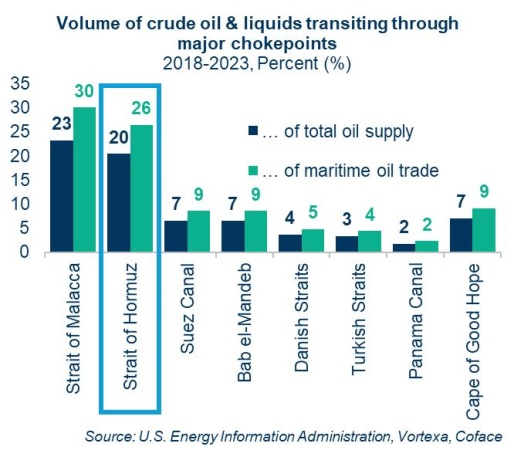
The military escalation between the United States, Israel and Iran is putting extreme pressure on energy markets. Although no major supply disruptions have been reported yet, the risks surrounding the Strait of Hormuz pose a threat to the global economy if the conflict continues.
Key figures:
‘A conflict limited to a few days or weeks – the most likely scenario at present – should have a limited impact. However, if the conflict were to continue, its macroeconomic impact could be significant and go beyond the issue of energy prices,’ Ruben Nizard, Head of Sector Research, Coface.
An immediate short-term effect on energy markets
The US and Israeli strikes in Iran mark a major turning point for energy markets. At the opening of trading on the morning of 2 March, Brent jumped by more than 10%, mainly reflecting an increase in the geopolitical risk premium rather than immediate and concrete supply disruptions.
Prior to this escalation, oil markets were largely in surplus. Abundant supply, driven by non-OPEC+ producers and rapid restocking, kept prices under pressure (averaging £68 per barrel in 2025). The conflict is a game changer, reintroducing extreme uncertainty about the security of supplies.
The Strait of Hormuz, a strategic energy chokepoint
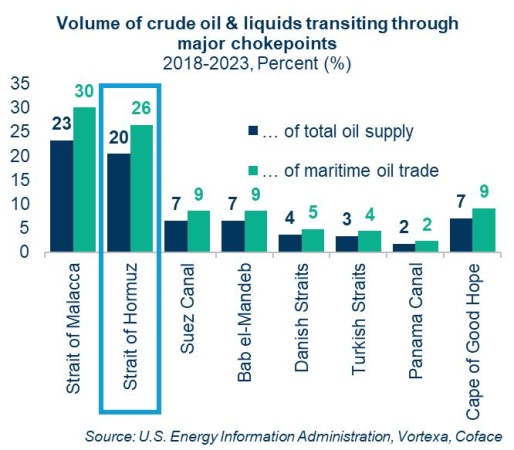
The main risk lies in the Strait of Hormuz, through which approximately 20% of the oil consumed worldwide and nearly 30% of crude oil seaborne shipments transit. The current disruptions are already leading to higher prices.
The capacity to bypass this strait is limited and insufficient to absorb a major shock. Prolonged or repeated interruptions could plausibly push Brent into triple-digit territory, with the possibility of exceeding the February 2022 peak (122 USD/barrel) or even the 2008 record (147 USD/barrel).
Oil: the risk of infrastructure destruction
Although Iran is not the region's leading producer, a disruption to its supply would have an immediate impact on already fragile markets. With more than 3 million barrels per day produced and nearly over 1.5 million exported — mainly to China — an interruption would force buyers, particularly in Asia, to turn to more expensive alternatives, increasing upward pressure on oil prices.
Beyond Iranian supply or a possible closure of the Strait of Hormuz, Iran could also target oil infrastructure in other Gulf countries. The impact would then depend on the extent of the damage and the duration of the disruption, in a context where OPEC+'s spare capacity — around 4 to 5 million barrels per day — remains limited and concentrated, particularly in Saudi Arabia and the UAE, where logistical trade flows could be disrupted.
Ripple effects far beyond oil
The stakes go far beyond the oil market alone. The Strait of Hormuz is also crucial for the transport of liquefied natural gas (LNG), fertilisers, industrial metals (aluminium) and petrochemicals. In addition, other strategic chokepoints, such as Bab el-Mandeb[1] or the Suez Canal, could also be affected in the event of regional escalation. This could increase freight costs and shipping insurance premiums.
This gradual disruption of supply chains poses a growing risk of shortages and inflationary pressures, particularly for economies that are most dependent on energy imports.
The long-term risk: a global macroeconomic shock
An extreme scenario of oil prices remaining above USD 100 per barrel would trigger a new surge in global inflation and would likely force central banks to reverse their strategy, moving from monetary easing to widespread tightening. A prolonged USD 15 increase in Brent crude oil prices could thus reduce global growth by around 0.2 percentage points and add nearly 0.5 percentage points to inflation. In such a context, the risk of stagflation – a combination of weak growth and high inflation – would once again become a credible threat to the global economy, with serious consequences for businesses and international trade. (Courtesy of Coface, a leading player in trade credit risk management)


