Updating your news feed...
NEWS EXPRESS is Nigeria’s leading online newspaper. Published by Africa’s international award-winning journalist, Mr. Isaac Umunna, NEWS EXPRESS is Nigeria’s first truly professional online daily newspaper. It is published from Lagos, Nigeria’s economic and media hub, and has a provision for occasional special print editions. Thanks to our vast network of sources and dedicated team of professional journalists and contributors spread across Nigeria and overseas, NEWS EXPRESS has become synonymous with newsbreaks and exclusive stories from around the world.























Loading banners
Loading banners...

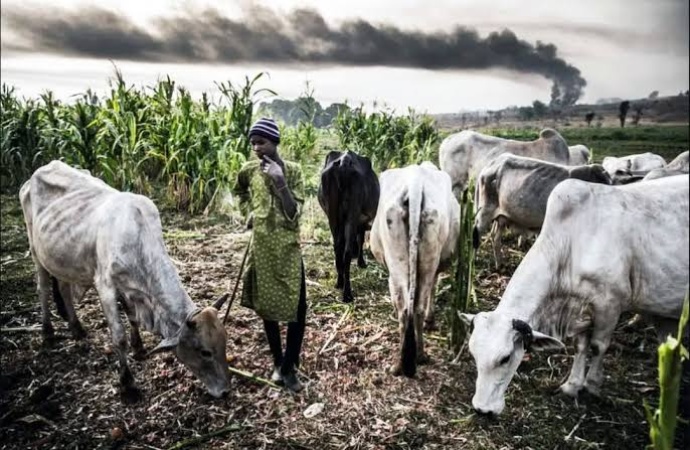
Fulani herdsmen in a farm
A report by the Nigerian Security Tracker has revealed that farmer-herder clashes has claimed the lives of about 3,000 Nigerians and led to the displacement of more than 300,000 between 2018 and 2023.
Speaking on the perpetual clashes between farmers and herdsmen in Abuja yesterday, Farouk Bala of the Youth Against Disaster Initiative (YADI) cited the 2024 Nigeria Watch Report, which estimated another 567 deaths linked to such violence across 20 states and the Federal Capital Territory within a year.
The group urged the Federal Government to fasten the introduction of structured ranching as a national security and economic reform imperative, saying beyond addressing conflict, ranching offers an opportunity to modernise the country’s underwhelming livestock sector and unlock export revenue.
Bala stated that while official figures indicate that Nigeria’s livestock sector contributes over $32 billion to Gross Domestic Product (GDP), the country earns only $172,000 from meat exports.
His words: “Despite an estimated cattle population of 20 million, which places Nigeria among the top 15 globally, the country generated only $172,000 from cow exports in 2024. Live animal exports stood at $1.15 million in 2021, while earnings from meat and edible offal exports remained below $200,000.’
Bala, who bemoaned the state of meat production in the country, revealed that Brazil recorded about $9.3 billion in beef exports in 2024; the United States posted $7.2 billion; Australia earned about $8 billion, while Uruguay attracted $2.85 billion through high-quality, traceable beef production.
He argued that the gap reflects deep-rooted inefficiencies associated with open grazing, weak traceability systems, limited cold-chain infrastructure and low compliance with international health and sanitary standards.
Bala, while calling for the adoption of ranching, argued that geographically defined ranching zones would enable dispute resolution through legal and mediation mechanisms rather than violence, and that settled pastoral communities would improve cooperation with security agencies.
According to him, structured ranching offers Nigeria a strategic opportunity to transform its archaic and underutilised livestock potential into tangible economic gains that are capable of driving broader national economic development.
YADI emphasised that ranching reform is neither a cultural eradication policy nor a land-grab agenda, explaining that it is a development-oriented reform designed to modernise livestock production while preserving dignity, livelihoods, and social cohesion.
For ranching reform to succeed, the group is advocating a holistic, inclusive, and incentive-driven framework.
It urged the National Orientation Agency (NOA), media institutions, civil society, and traditional and religious leaders to coordinate sustained awareness campaigns that clearly communicate the economic and security benefits of ranching. (The Guardian)