
Updating your news feed...
NEWS EXPRESS is Nigeria’s leading online newspaper. Published by Africa’s international award-winning journalist, Mr. Isaac Umunna, NEWS EXPRESS is Nigeria’s first truly professional online daily newspaper. It is published from Lagos, Nigeria’s economic and media hub, and has a provision for occasional special print editions. Thanks to our vast network of sources and dedicated team of professional journalists and contributors spread across Nigeria and overseas, NEWS EXPRESS has become synonymous with newsbreaks and exclusive stories from around the world.





Loading banners
Loading banners...

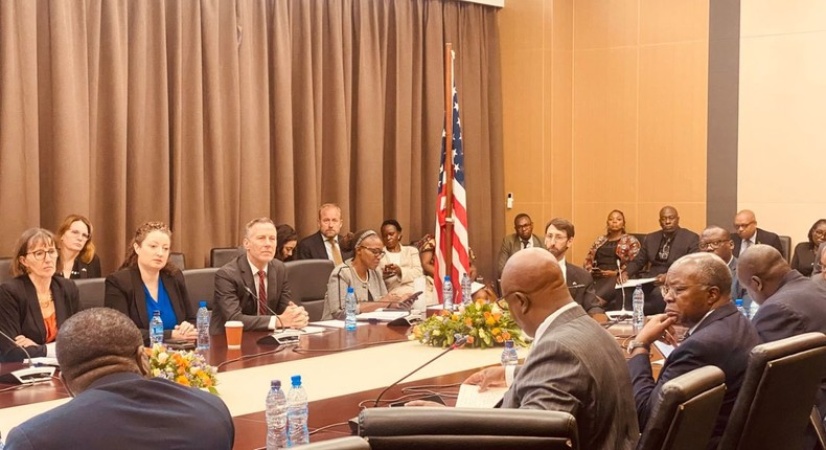
Zambia has halted a proposed health funding agreement worth more than $1 billion from the United States, citing concerns that certain clauses in the draft do not fit with the country's national interests.
The agreement, which would regulate more than $1 billion in U.S. funding over the next five years, aims to battle HIV/AIDS and malaria, strengthen maternity and child health services, and improve epidemic preparation.
However, according to a draft document seen by Reuters, Zambia would also commit around $340 million in co-financing over the same period, representing a major domestic investment in an era of fiscal difficulties.
The agreement, which was supposed to be completed in November 2025, came to a halt after amended drafts included a contentious provision.
According to some sources, the deal included language suggesting that funding may be withdrawn if Zambia and the United States could not reach an agreement on a proposed "bilateral compact" by April 1.
That agreement, which was apparently tied to a mining partnership, prompted questions about whether crucial health financing was linked to strategic resource access.
The optics are important for a copper-rich country that is becoming increasingly essential to global critical mineral supply chains.
Some analysts seem to agree as they deduce that the U.S.’s health funding would be intricately tied to Zambia’s natural resources.
“We need support from the U.S., but there should be transparency,” Owen Mulenga, an officer at the Treatment, Advocacy and Literacy Campaign, a local non-governmental organization lobbying for equitable, affordable, and sustainable access to treatment, care, and support for people living with HIV and AIDS in Zambia, told Reuters.
The government has refused to discuss with activists the widespread speculation that the deal is linked to mining, he stated.
“This deal would slash U.S. government funding to life-saving programs… while prioritizing the interests of mining corporations over the needs of Zambians with HIV,” said Asia Russell, executive director of Health GAP, a global HIV advocacy organization that has closely followed the deal.
President Hakainde Hichilema has already said that Zambia should reconsider its reliance on international aid.
In October 2025, he viewed international aid cuts as "long overdue," viewing the closure of specific aid channels as an opportunity for Zambia to "take care of our own affairs," despite the risks being obviously significant.
The United States disbursed around $598 million the previous year to Zambia's health sector, representing roughly one-third of the country's health budget.
Much of that money goes toward HIV/AIDS treatment programs and critical maternal health services.
Earlier in 2025, Washington reduced medical aid by $50 million in response to discoveries of stolen and resold donated pharmaceuticals, significantly restricting the financing climate.
Zambia's hesitancy is hardly isolated, as across the continent, governments are reviewing the structure and terms of foreign assistance.
Zimbabwe, for example, recently withdrew from discussions on a $350 million US health funding agreement, citing unacceptable sovereignty concerns.
Harare is specifically opposed to clauses requiring long-term access to national health data, claiming that such access could reveal sensitive population-level information.
However, in the Sahel, the US has signed a $147 million health-care agreement with Burkina Faso, combining humanitarian goals with strategic rebalancing in a region marked by shifting alliances and security realignments.
Burkina Faso will provide $107 million domestically, along with extra investments in digitization and laboratory capacity, proving that co-financing is becoming a standard part of modern aid architecture. (Business Insider Africa)



