
Updating your news feed...
NEWS EXPRESS is Nigeria’s leading online newspaper. Published by Africa’s international award-winning journalist, Mr. Isaac Umunna, NEWS EXPRESS is Nigeria’s first truly professional online daily newspaper. It is published from Lagos, Nigeria’s economic and media hub, and has a provision for occasional special print editions. Thanks to our vast network of sources and dedicated team of professional journalists and contributors spread across Nigeria and overseas, NEWS EXPRESS has become synonymous with newsbreaks and exclusive stories from around the world.























Loading banners
Loading banners...

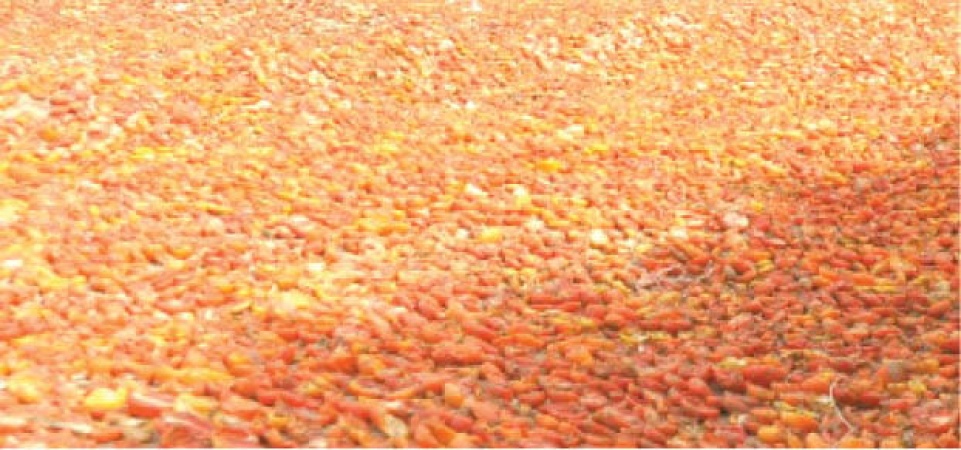
Photo of tomato farm courtesy of Weekend Trust
Tomato farmers in Nigeria over the years have continued to face severe post-harvest storage challenges, including a lack of cold chain infrastructure, causing up to 50 per cent or more loss for farmers, especially those who took loans for the dry season farming, and the resultant glut-induced price collapses. Key issues include inadequate cold storage, poor transport infrastructure, high perishability (2-3 weeks shelf life), and pests like Tuta. Weekend Trust gathered that after labouring to cultivate tomato for about five months, they were destroyed in 48 hours.
From fields to the market, large quantities of tomatoes produced by dry season farmers in Alau and other parts of Borno State are rotting away.
The scenario, a sad and devastating one, is what thousands of farmers in Borno State are currently experiencing. The farmers have called on the government to intervene in the situation by establishing tomato processing industries to save them from post- harvest losses as a way of coming to their aid.
Our correspondent, who went around irrigation farms in Alau, Maiduguri and Jere, reports how the situation is creating havoc, leaving a majority of the farmers in distress.
While tomato growers in Alau have suffered huge losses due to high cost of transportation, tomato farmers within Maiduguri town say they can’t get buyers or a minimum support price for their produce which continues to flood major markets across the state and beyond.
In an interview with Weekend Trust, most of these farmers said they make bountiful produce, but they continue to experience common challenges of inadequate or lack of proper storage and preservation facilities to avert waste which has become a perennial issue for tomato and vegetable farmers in the state.
According to them, they plant seeds in early October and nurture it for four – five months till it begins to bear fruits in January, however the majority of the tomato harvested goes to waste due to poor storage facility chains.
One of the tomato farmers in Alau, Malam Ardo Modu, who had grown and recorded a bumper harvest and fruits due to quality seeds and fertiliser, said he has no option now but to allow some of the tomato to rot while dumping a majority of the harvest into the dam.
“Sometimes we are left with no choice but to dispose of the tomatoes, because they get rotten and smell. This is what we have suffered for many years.
“I harvest 30 baskets of tomatoes daily, compared to what I invested in the farm, the loss is unimaginable,” he explained.
Modu, who claims to have been into dry season farming for 40 years, said before the devastating flood caused by Alau dam collapse, he used to cultivate six vegetable farms.
“Although each season comes with its challenges, we haven’t had it this bad. We don’t make much profit and the farm inputs are very expensive. A bag of fertiliser now costs N70,000.
“Yesterday, I dumped the tomato I took to Gambarou market in the river because people refused to buy or even take it on credit. Whatever I sold could not cover the transportation cost” he lamented.
In a devastated state, he appealed to the state and federal government to intervene by building modern industries that would preserve excess tomatoes and other perishable vegetables they produce and harvest yearly.
“We want a tomato processing company to stop the waste. We also want affordable fertilisers. If the price drops from N70, 000 to N25, 000 it’ll be good as we farm rice, cassava, potatoes and other different crops here,” he said
Modu and his colleagues hope that their plea will reach the ears of relevant authorities, and while that happens, he assured that dry season farming will continue to boom and impact positively on the economy.
Alaramma Zarami, another tomato farmer, said that the government had encouraged them to return to farm and grow crops and vegetables for livelihood but lamented that food importation is on the increase, leaving farmers suffering the loss.
He noted saying, “Instead of supporting us locally, the borders have been opened for food importation and we the real farmers are the ones losing.
“Can and powdered tomato, pepper and even onions are being imported into the country, while our produce rots away in farms. We don’t have the capacity to establish the processing industry and the government is not helping us to build them.
“We also want their intervention in terms of inputs, such as improved seeds, insecticides and water pumping machines to improve production,” he added.
Another farmer, Muhammad Kudu, said It took four months to cultivate tomatoes, but could not get buyers after the harvest.
“When we harvest and we don’t make sales, we quickly dry it before it gets rotten. Then we sell again as dried tomato to consumers.
“Tomato farming is tedious and can become waste, so only those who are buoyant can sustain the farming because you have to buy fuel for the water pump machine, fertilisers and insecticides.
Kudu, who initially declined speaking to Weekend Trust said, many journalists had interviewed him in the past without getting him any intervention from the government.
“The State Government announced repeatedly that they were supporting farmers but I have never seen any of their intervention in my forty years in this occupation.
“I used my resources to grow the tomatoes but have nowhere to sell them now. We either dry it in two days or it gets rotten.
“Even whole-sellers coming from other parts of the States have stopped coming, because of the massive production of tomatoes this season. There is no opportunity to sell the produce locally.
“We invested a lot from this farm; fuel, seeds, labor, insecticides and fertilizer. Some of us have to repay the loans taken to grow these vegetables,” he said.
He called on the government to send a delegation to the fields to assess the situation and intervene in areas that would save farmers from the difficult conditions they have found themselves in.
“If the government can support a tomato processing factory, it’ll encourage us to boost our produce. We’re ready to work. We’re farmers, it’s what we do.” he said.
Speaking to our correspondent, a lecturer and agriculturalist, Magaji Zakari, said most of the farmers were forced to dump the produce due to over production.
“Since the price of grains crashed, many farmers resorted to cultivating tomato and other vegetables which resulted in the market becoming flooded, leading to the price collapse,” he said.
He noted that the harvested tomatoes have become a burden to farmers such that it is considered cheaper to throw them away than transporting them back home from the market.
He also observed that the absence of local processing facilities or functional cooling systems to store excess produce continues to cripple the efforts and profit margins of farmers if the relevant authorities do not take the matter seriously.
He also cited the tropical and humid condition of Maidugu as responsible for quick decay of vegetables.
“It’s been established that, without proper storage, tomato go bad within 48 hours under a tropical and humid condition in places like Maiduguri,” he said.
In his response, the Borno State Commission of Agriculture, Bawu Musami, said the state government had already procured and installed a modular tomato processing plant to address some of the issues raised by the farmers.
“We finished installation not more than two to three months ago at the industrial park. We now have two, the one that was installed initially is the commercial type which requires a high volume of tomato in order for it to work well.
He said, on a larger scale, they need to partner with a private company where the special agro processing zone will come in. “It’ll start working effectively if they fully key into the START 2 project.”
He revealed that study shows that 30 per cent of all the produce is lost due to poor post-harvest storage and post-harvest handling, acknowledging that there is a gap between the ministry and some of the farmers regarding value addition of the harvested produce. (Weekend Trust)