
Updating your news feed...
NEWS EXPRESS is Nigeria’s leading online newspaper. Published by Africa’s international award-winning journalist, Mr. Isaac Umunna, NEWS EXPRESS is Nigeria’s first truly professional online daily newspaper. It is published from Lagos, Nigeria’s economic and media hub, and has a provision for occasional special print editions. Thanks to our vast network of sources and dedicated team of professional journalists and contributors spread across Nigeria and overseas, NEWS EXPRESS has become synonymous with newsbreaks and exclusive stories from around the world.





.webp)
.webp)
.webp)



.webp)

Loading banners
Loading banners...

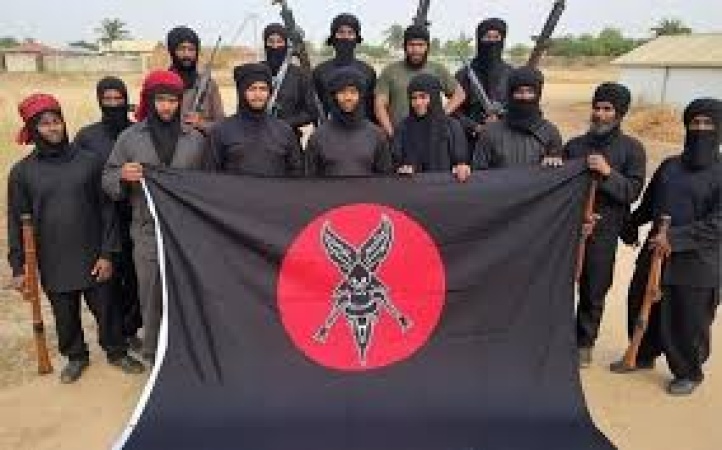
Lakurawa terrorists
Deep fear has long pervaded the arid savannah plains and highlands of north-western Nigeria – even before the US air strikes on the Islamist militants who have made this area their base on Christmas night.
The heavily armed jihadists, who dress in camouflage and wear vibrant turbans, have lived in camps in Tangaza, a remote area of Sokoto state near the border with Niger, for several years.
They belong to a group called Lakurawa and hail from areas north of Nigeria in the Sahel.
Locals in Tangaza, a community made up of mainly moderate Muslims, believe they come from Niger and Mali – and are terrified of them.
Recently, both US and Nigerian authorities have said the militants are affiliated to Islamic State (IS) groups in the Sahel – though IS has not linked itself to any of the group's activities or announced ties to Lakurawa as it has done with other groups in the region that it backs.
When the BBC visited Nukuru, one of several remote villages in Tangaza around 10km (six miles) from where the US missiles struck, most people were deeply suspicious and did not want to talk about Lakurawa – fearing reprisal if they spoke.
It was only after assurances that their identities would be kept anonymous that some men agreed to be interviewed, speaking in hushed tones.
We had travelled into the dangerous area, about 12km from the Niger border, on Saturday under police escort and with extra security personnel for protection.
The police do not usually venture into this region as they say they do not have enough fire power to confront the militants should they come under attack.
Our team was not able to reach the site of the strikes because of ongoing security risks - and was advised not to stay too long in the area so as not to allow the militants time to plant land mines along our exit route.
A farmer, who lives not far from Nukuru, said shortly after the strikes on Thursday night, some fleeing militants converged on his community.
He heard them phoning others, urging them to leave quickly, before escaping on motorbikes.
"It seems they were devastated - we were afraid too," he said. "They were not carrying any dead person; they just carried some luggage."
It is unclear if there were any causalities in the strikes on the two camps ordered by US President Donald Trump.
But the residents of Nukuru – a tiny hamlet with around 40 mud-walled and thatched houses and clay granaries used to store the crops harvested a few months ago – can vouch for the ferocity of the missiles.
"The doors and roof were shaking, old roofs were torn," a 70-year-old man told us.
"We couldn't sleep because everywhere was shaking. We couldn't figure out what it was, and we heard things falling from the sky, and then there was fire."
It is not hard to see how the group has been able to gain a foothold here as there is very little sign of a government presence.
There are no visible schools, hospitals or paved roads. Much of the terrain can only be reached using vehicles capable of navigating rough desert paths.
In Nukuru, the villagers' main means of transport appeared to be donkeys.
They said that by day the Lakurawa militants come into the community – having established themselves as the de facto governing authority.
The farmers and villagers have no option but to agree to their terms and taxes as the Islamists are well-armed. If they do not comply, they are attacked and their livestock is stolen.
The farmer who spoke to the BBC said the fighters passed through his hamlet most days on their way to other communities.
"We knew they are Lakurawa because of their dressing," he said, describing their camouflage uniforms and their turbans usually worn by men in desert areas of Mali and Niger.
Amongst themselves the militants spoke Fulfulde – the language of the Fulani ethnic group spoken in many West African countries – but communicated with the locals in Hausa, the lingua franca of the region, he said.
At night, the fighters go back to their isolated camps, which are on higher ground and give them a good vantage point over the plains. No women or families are thought to be living in these makeshift bases.
When Lakurawa initially arrived in the largely Muslim states of Sokoto and Kebbi, the group presented itself as a religious force that wanted to help a vulnerable community in an insecure region.
Nigeria faces an array of complex security issues. For the past 15 years, it has been the north-east of the country that has suffered from a devastating Islamist insurgency at the hands of jihadist groups such as Boko Haram.
But more recently swathes of the country's north-west have been terrorised by criminal gangs, known locally as bandits, who make money by kidnapping and holding people for ransom.
When Lakurawa moved into communities along the Niger-Nigeria border, it prompted the bandits to move elsewhere.
At first, this is thought to have ingratiated the group with some locals - but this was short-lived. People in Tangaza area say the religious militants became heavy-handed, and began enforcing harsh rules and spreading fear.
A resident of Nukuru spoke about the hard-line, strict Muslim ideology the militants have imposed – including banning things they deem to be against Islamic Sharia law.
"We cannot live freely," the young man told the BBC. "You cannot even play music on your phone – they will not only confiscate it, but also punish you."
Music is seen as distracting from religious duties or encouraging of immoral behaviour by some highly conservative Muslim sects – and offenders have been flogged.
Some Lakurawa militants are thought to have married into border communities – keeping their families away from the camps – and recruited young people.
Some of these recruits are used as informants, while others help the militants trade or gather supplies from residents.
The strikes on Thursday were the second time the group has been targeted in operations on a Christmas Day.
Last Christmas, Nigeria's military launched an attack against them near Gidan Sama and Rumtuwa, several kilometres from Nukuru. Around 10 civilians were killed.
A month later, several days after Trump's inauguration, the Nigerian government designated the group a terrorist organisation.
The militants were accused in court documents of cattle rustling, kidnapping for ransom, hostage-taking and attacks on senior government officials.
The move gave the government sweeping powers to take strong actions against the group.
When Trump announced his Christmas Day strikes, he said it was because the group was "viciously killing, primarily, innocent Christians, at levels not seen for many years, and even centuries".
Nigeria's Foreign Minister Yusuf Maitama Tuggar has been at pains to point out that the recent strikes were a "joint operation" and "nothing to do with a particular religion".
Most of the villagers and farmers who live in the shadow of the militants are Muslims, not Christians.
But should the US-Nigerian operation be able to dismantle Lakuwara's hold over their lives, it is clear they will be grateful to be free of the terror. (BBC)