
Updating your news feed...
NEWS EXPRESS is Nigeria’s leading online newspaper. Published by Africa’s international award-winning journalist, Mr. Isaac Umunna, NEWS EXPRESS is Nigeria’s first truly professional online daily newspaper. It is published from Lagos, Nigeria’s economic and media hub, and has a provision for occasional special print editions. Thanks to our vast network of sources and dedicated team of professional journalists and contributors spread across Nigeria and overseas, NEWS EXPRESS has become synonymous with newsbreaks and exclusive stories from around the world.

Loading banners
Loading banners...
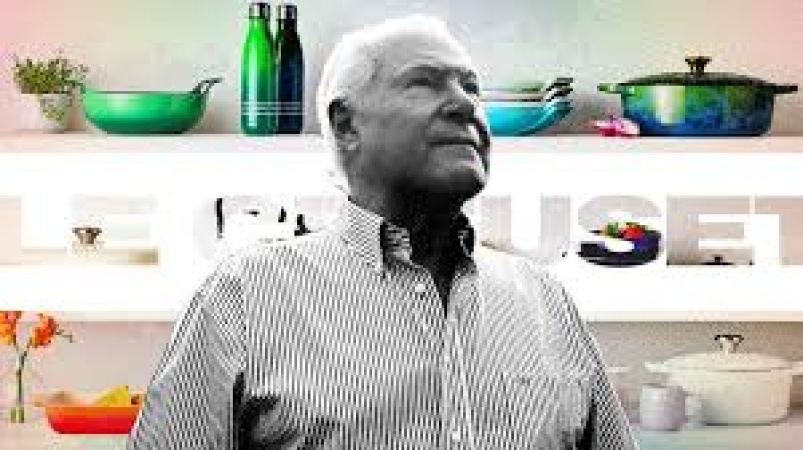
Owner and president of Le Creuset, Paul van Zuydam, has been added among South Africa’s dollar-billionaires on Forbes’ real-time tracking of billionaires.
Le Creuset was founded in 1925 in the small French town of Fresnoy-le-Grand, strategically located along major shipping routes for iron, coke, and sand.
The company stood out early by applying colourful enamel to cast-iron cookware, first showcased in its now-famous “Volcanic Flame” orange pot.
Using traditional sand-casting methods, each piece was hand-finished and coated with multiple layers of enamel, a technically difficult process because enamel and cast iron expand at different rates when heated
After surviving World War II, the company expanded rapidly, buying local competitors and widening its range to include grills, fondue sets, and, in 1958, its first casserole pot.
That casserole would become the brand’s defining product. The combination of durability and colour turned Le Creuset into a cultural icon, famously used by early television chefs such as Julia Child.
By the mid-1980s, however, the company’s success had unravelled. Family infighting and rising debt left Le Creuset financially weakened.
Around this time, South African businessman Paul van Zuydam, then chairman and CEO of homeware group Prestige, was tipped off that the company was in trouble.
He visited the factory discreetly and was struck by the craftsmanship and rigorous quality control, where every cast-iron product is measured, inspected, and rejected if imperfect. Around a quarter of production is melted down and recast, resulting in zero waste.
Convinced of the brand’s potential, Van Zuydam negotiated a deal to buy Le Creuset on Prestige’s behalf without even reviewing its financials.
Despite scepticism from colleagues, he secured agreement from management. The deal stalled when Prestige was acquired by an American tobacco company, triggering a strike by French workers opposed to American ownership.
In 1988, Van Zuydam resigned from Prestige, obtained French government approval, and personally purchased Le Creuset.
Under his ownership, Le Creuset was rebuilt around its core strengths. Van Zuydam refocused production in Fresnoy-le-Grand, closing scattered facilities, cutting costs, and investing in automation that reduced staff overheads by 10%.
Capacity was doubled, output rose to more than 20,000 products a day, and the company expanded globally, particularly into the United States and Asia.
It also diversified into ceramics and other cookware while keeping cast-iron production in France.
Since 2001, Le Creuset has expanded without taking on external debt. Today, it generates over $850 million (R14 billion) in annual revenue. At 87, Van Zuydam remains involved in daily operations as president of the company.
As of December 2025, Paul van Zuydam has emerged on Forbes’ radar as the 2,186th richest person in the world.
According to Forbes’ real-time tracking of billionaires, van Zuydam has a net worth of $1.7 billion (R28.4 billion).
Van Zuydam’s addition to Forbes’ list means that eight South Africans now rank among the world’s dollar-billionaires, with van Zuydam being the oldest among them at 87 years of age.
The other billionaires include luxury goods magnate Johann Rupert, former diamond baron Nicky Oppenheimer, media tycoon Koos Bekker, mining executive Patrice Motsepe, Capitec founder Michiel le Roux, retail titan Christo Wiese, and recently added finance giant Jannie Mouton.
These individuals consolidated their positions as South Africa’s wealthiest while also climbing the global billionaire rankings tracked by Forbes.
Johann Rupert maintained his status as the richest person in South Africa and the second richest in Africa, following Nigerian industrialist Aliko Dangote.
Rupert’s fortune, valued at $16 billion (R268 billion), was buoyed by a diversified portfolio of investments.
Nicky Oppenheimer, who once controlled De Beers, secured his place among the world’s top 300 billionaires, although he dropped 22 spots to rank 292nd globally.
Despite the drop, his net worth increased by $1.0 billion (R16.8 billion).
Oppenheimer’s investments and strategic asset management have continued to yield impressive returns.
Patrice Motsepe, recognised as Africa’s first black billionaire, posted notable gains in his net worth, with an estimated $900 million (R15.1 billion) added to his fortune.
Despite this comparatively modest increase, Motsepe remains a significant figure in the global mining sector.
Media mogul Koos Bekker, Capitec founder Michiel le Roux, and retail magnate Christo Wiese collectively saw their net worth grow by approximately $2.8 million (R46.9 billion).
These gains propelled the trio up the global billionaire rankings, with their combined rise totalling 680 spots. (Business Tech)



