
Updating your news feed...
NEWS EXPRESS is Nigeria’s leading online newspaper. Published by Africa’s international award-winning journalist, Mr. Isaac Umunna, NEWS EXPRESS is Nigeria’s first truly professional online daily newspaper. It is published from Lagos, Nigeria’s economic and media hub, and has a provision for occasional special print editions. Thanks to our vast network of sources and dedicated team of professional journalists and contributors spread across Nigeria and overseas, NEWS EXPRESS has become synonymous with newsbreaks and exclusive stories from around the world.
























Loading banners
Loading banners...

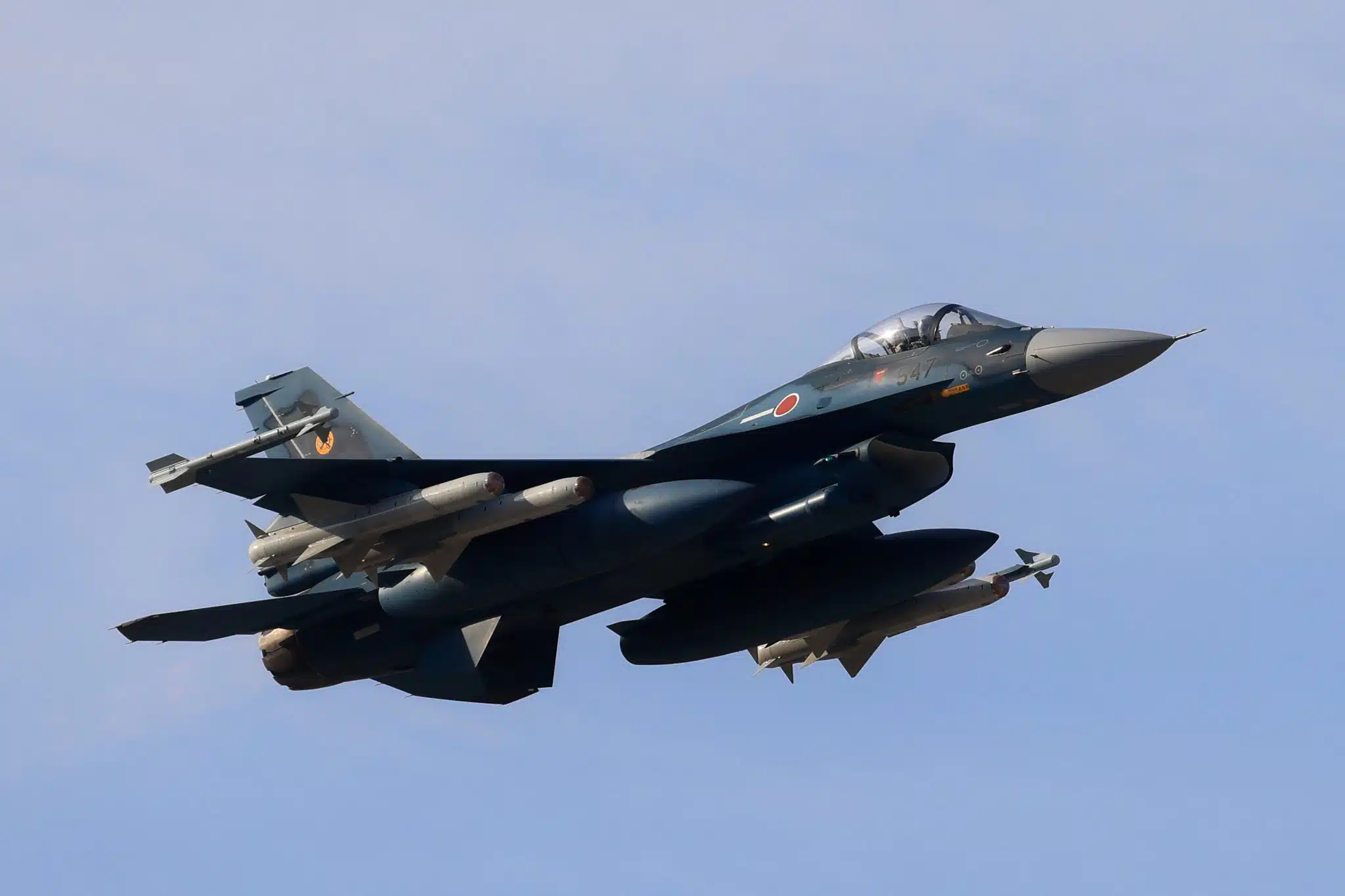
In December 2025, Japan responded in an unusual manner to activities conducted by Chinese Navy vessels in waters near Japan: JASDF F-2 fighters were observed with a combined total of 64 anti-ship missiles…
On 9 December 2025, at Tsuiki Air Base of the Japan Air Self-Defense Force (JASDF), at least 16 F-2 fighter aircraft were observed conducting training flights with each jet carrying four ASM-2 air-to-ship missiles (Type 93 Air-to-Ship Guided Missile) mounted under their main wings. The ASM-2 is an indigenously developed Japanese anti-ship missile with a range exceeding 140 km. It employs an imaging infrared (IIR) seeker and is equipped with infrared counter-countermeasures (IRCCM) as well as target discrimination capabilities.
At JASDF Tsuiki Air Base, located in Fukuoka Prefecture in Kyushu, southwestern Japan, two Tactical Fighter Squadrons—the 6th and 8th Squadrons—are deployed, both operating the F-2 fighter. Each squadron consists of a total of twenty aircraft: eighteen single-seat F-2As and two dual-seat F-2Bs.
It is highly unusual to see this many F-2s appear with a full loadout of ASM-2s, making the situation extremely distinctive. It is likely intended as a deterrent response to the People’s Liberation Army Navy (PLAN)’s aircraft carrier Liaoning, which has operated nearby Kyushu. After transiting the Miyako Strait between Okinawa Main Island and Miyako Island on 6 December and entering the Pacific Ocean, the aircraft carrier Liaoning abruptly altered course to the northeast in waters south of Okinawa Main Island. On 7 December, it continued its advance into waters south of Kyushu.
During this period, J-15 carrier-borne fighter jet operating from Liaoning illuminated JASDF F-15 fighter jets with radar, among other actions, leading to heightened tensions between the Chinese military and the Japan Self-Defense Forces.
Urgent Need to Strengthen Defensive Capabilities in the Pacific Theater
The Japanese government has recently stepped up its vigilance in response to activities by PLAN task forces centered on aircraft carriers. In June this year, two Chinese aircraft carriers—Liaoning and Shandong—were simultaneously deployed in the Pacific, where they conducted an opposing-force exercise that reportedly simulated a confrontation with a U.S. Navy carrier strike group. Against this backdrop, Liaoning’s subsequent operations in waters near Japan are considered by Japan’s Ministry of Defense to have constituted a serious development.
Furthermore, should the PLAN’s third aircraft carrier, Fujian, fully enter operational fleet service in the future, it is conceivable that Chinese aircraft carriers could be operating on a continuous basis in the East China Sea and the Pacific Ocean.
In response to these developments, the Japan Self-Defense Forces—having previously focused on strengthening their defensive posture in the Southwestern Islands, including Okinawa, and in the East China Sea—are now rapidly reinforcing their defense posture in the Pacific direction, which has until now been regarded as a relative “defense gap.” For example, on Kita-Daito Island, located southwest of Okinawa Main Island, plans are underway to deploy a mobile air-surveillance radar system. Japan’s FY2026 defense budget request includes approximately ¥16 billion($102 million) for the construction of facilities to support this deployment.
In addition, Japan is proceeding with a plan to modify the two Izumo-class destroyers—the largest surface combatants in the Japan Maritime Self-Defense Force (JMSDF)—to provide them with the capability to operate the F-35B. This initiative was originally launched around 2018 in response to the Chinese military’s H-6K bombers beginning, from around 2017, to transit the Bashi Channel between Taiwan and the Philippines and advance into the Pacific. However, the program has since taken on an additional role as a measure to counter the PLAN’s aircraft carrier forces.
In the Pacific theater, Iwo Jima is currently the only island with a runway capable of supporting the operation of JASDF fighter aircraft. The modification of the Izumo-class was therefore intended to fill this operational gap.
Furthermore, Japan’s FY2026 defense budget request includes the establishment of a new Pacific Defense Concept Office within the Ministry of Defense. This office is intended to conduct dedicated and cross-cutting assessments of the force posture required by the Self-Defense Forces for the defense of the Pacific theater.
Going forward, the Self-Defense Forces are likely to implement a range of measures to counter imminent threats in the Pacific. In the near term, operations by Chinese naval carrier air wings are expected to be addressed through the operation of F-35B embarked on the Izumo-class. However, numerous other challenges will also need to be addressed.
For example, continuous monitoring of Chinese naval vessels and aircraft would require radar sites capable of covering the Pacific. Unlike the East China Sea, however, the Pacific does not feature a dense chain of islands, limiting the coverage achievable by ground-based radar systems. In this context, expanding the fleet of E-2D airborne early warning aircraft—which are capable of short takeoff and landing and already have an established operational track record within the JASDF—would represent one highly viable option. (Naval News)



