Updating your news feed...

NEWS EXPRESS is Nigeria’s leading online newspaper. Published by Africa’s international award-winning journalist, Mr. Isaac Umunna, NEWS EXPRESS is Nigeria’s first truly professional online daily newspaper. It is published from Lagos, Nigeria’s economic and media hub, and has a provision for occasional special print editions. Thanks to our vast network of sources and dedicated team of professional journalists and contributors spread across Nigeria and overseas, NEWS EXPRESS has become synonymous with newsbreaks and exclusive stories from around the world.













Loading banners
Loading banners...

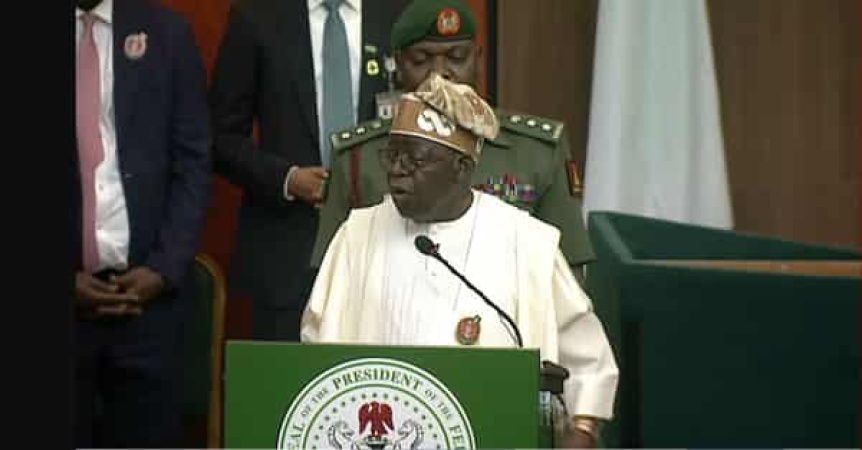
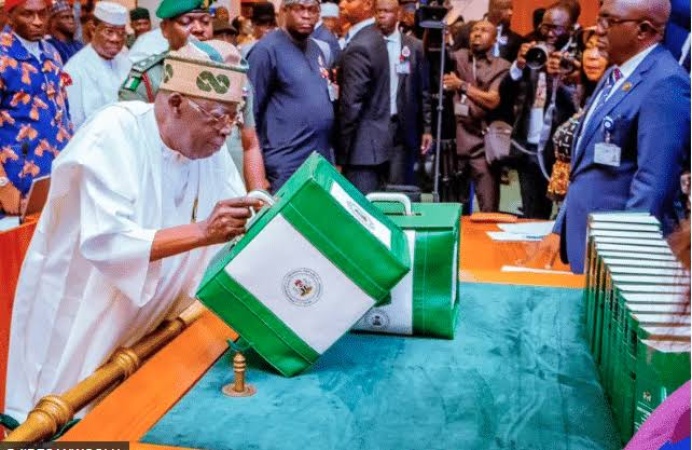
President Tinubu presenting the 2026 Appropriation Bill to the joint session of the National Assem
Nigeria is engineering a self-inflicted fiscal crisis, pushing a budget far beyond its actual capacity even as the numbers fail to add up.
The split between the budget and finance ministries has deepened internal divisions, fuelling a 115% increase in the federal budget in just two years despite underperforming revenues. In this period, the budget has jumped from N27.5 trillion in 2024 to N58 trillion in 2026.
Despite facing a staggering 75 percent revenue shortfall this year alone, the government is heading into 2026 with a N58 trillion budget, raising the prospect of the largest fiscal deficit in the country’s history next year.
Revenue assumptions of N34.33 trillion for next year, have been built on unrealistic oil prices and production levels that Nigeria has struggled to meet, with the latest example coming this year.
Nigeria missed its pro-rated oil and gas revenue target by 62.2% in the first seven months of 2025, government data show, as weaker crude output and softer prices undercut budget assumptions.
The federal government anchored its revenue forecasts on $75 a barrel in the 2025 budget, but oil prices have averaged closer to $65, according to figures in the 2025–27 Medium-Term Expenditure Framework.
Average oil production of 1.5 million barrels a day has also fallen short of the budget benchmark of 2.1 million barrels daily.
“When oil volumes miss, everything else falls flat– company income tax and petroleum profit tax,” said one senior government adviser. “That is the arithmetic.”
If revenues miss the mark again in 2026, the government could end up with a deficit larger than the entire 2024 budget.
On paper, the expectation is for a fiscal deficit of N23.85 trillion, 4.28 percent of gross domestic product in 2026, which is slightly below the 5 percent target in the Fiscal Responsibility Act (FRA). But the experience of 2025 suggests that figure may prove wildly optimistic.
Given the revenue performance this year, if 2026 revenues come in at just half of the projection – about N17 trillion – spending plans would imply a deficit of about N40 trillion, which may end up not being funded, the same affliction the 2025 budget suffered.
If 2026 revenues fail to meet projections, Nigeria’s fiscal squeeze will be self-inflicted – a product of overambitious budgeting, not weak income.
Officials privately concede the budget would be impossible to finance from current revenues. Either spending would have to be slashed, potentially by close to half, or borrowing would surge, pushing debt service costs even higher.
The warning signs are already visible with public finances under strain this year.
The consequences of a N30 trillion revenue shortfall as said by the government are already rippling through the system. Up to 70 percent of the capital budget is being rolled-over to next year, implying that no more than 30 percent of the entire capital budget has been implemented.
Government departments including security agencies have complained of lack of cash for basic operations, while the N220 billion capital allocation for the national security adviser’s office has yet to be funded, according to people familiar with the matter.
Wale Edun, the finance minister and coordinating minister of the economy, disclosed recently that the federal government generated only about N10.7 trillion in revenue in 2025, far below the N40.8 trillion projected in the budget. The scale of the shortfall has forced the presidency to slow spending releases, delayed payments across ministries and left borrowing doing much of the heavy lifting.
It hasn’t, however, forced a rethink. The President presented the budget last Friday, expecting a near tripling of revenues from their current levels in order to implement the budget.
Lawmakers have endorsed oil production of 1.84 million barrels a day and an oil price benchmark of $64.85 a barrel in the House of Representatives, even as the Senate opted for a lower $60. The assumptions underpin a revenue target of roughly N34 trillion against planned spending of about N58 trillion. Markets are unconvinced.
Brent crude has traded close to $60 a barrel in December, while forecasts from the US Energy Information Administration and major banks point to average prices in the $50–$58 range in 2026.
Virtually all of the world’s biggest traders see the oil market in a state of oversupply early next year. The International Energy Agency (IEA) estimates that output could exceed consumption by around 3.8 million barrels a day in 2026. Many traders predict smaller numbers than that, but storage levels are still expected to grow.
Nigeria, meanwhile, has a long history of missing production targets because of oil theft, outages and under-investment.
How governance weakened discipline
Part of the problem lies in how Nigeria now makes its budgets.
The process was upended when budget preparation was separated from the Ministry of Finance, leaving the Ministry of Budget to design assumptions while finance officials are left to fund and execute them. That split has diluted the rigour applied to revenue forecasts, critics say.
The risks were evident as far back as 2024. While total revenue reached N27.9 trillion, beating the budget target, oil revenue underperformed sharply, coming in at N12.9 trillion versus N17 trillion projected. Non-oil revenue made up the difference, masking the fragility of oil-linked assumptions.
Instead of recalibrating, the government raised revenue projections aggressively for 2025.
A credibility test ahead
Officials insist Nigeria does not yet face a debt crisis. But it is undeniably facing a revenue credibility crisis.
Debt service and recurrent spending already exceed more than this year’s realised revenue, leaving little room for error. Another year of missed targets would tighten the squeeze on capital spending, security funding and social services. (BusinessDay)