Updating your news feed...

NEWS EXPRESS is Nigeria’s leading online newspaper. Published by Africa’s international award-winning journalist, Mr. Isaac Umunna, NEWS EXPRESS is Nigeria’s first truly professional online daily newspaper. It is published from Lagos, Nigeria’s economic and media hub, and has a provision for occasional special print editions. Thanks to our vast network of sources and dedicated team of professional journalists and contributors spread across Nigeria and overseas, NEWS EXPRESS has become synonymous with newsbreaks and exclusive stories from around the world.

Loading banners
Loading banners...

By OUMAROU SANOU
When survivors begin to speak, the world must listen. And across Mauritania’s M’berra refugee camp, Malians who fled the violence sweeping their communities are now recounting stories so harrowing, they challenge the very premise of Mali’s security partnership with Russia. Torture, public executions, suffocation, waterboarding, and the killing of entire families—this is the reality many say is being unleashed by Russian mercenaries now operating under the Africa Corps banner. Their testimonies expose a deeply uncomfortable truth: that behind Mali’s worsening insecurity lies a counter-insurgency strategy increasingly indistinguishable from state-sanctioned brutality.
According to BBC investigations and independent reports corroborated by humanitarian groups, the rebranding of the Wagner Group into Russia’s Africa Corps has done little to change the tactics deployed on the ground. The name may have shifted, but survivors insist the methods remain unchanged—marked by beatings, arbitrary arrests, mutilations, suffocation with exhaust fumes, simulated drowning, and summary executions. One of the most chilling accounts describes an Africa Corps operation on November 26 in which at least 10 civilians were reportedly killed—four of them burned alive. Women, children, and elderly men were among the victims. The brazenness of such operations underscores the absence of any line between civilians and insurgents in the eyes of the mercenaries.
Ahmed, a shopkeeper from Nampala, is one of the dozens bearing witness. Accused without evidence of supporting jihadists, he was stripped naked, waterboarded until unconscious, and held in a toilet block packed with other detainees. He watched two men beheaded before his eyes—an Arab and a Tuareg—and says he still wakes up drenched in sweat. “I don’t know if I will ever return home,” he said. His fear is echoed by many in the camp. Bintu, a mother of five, recounted how her husband was shot and thrown into a river. She trembles at the mere mention of the name “Wagner.” Youssouf, a cattle herder, spoke of being ambushed, tied up, and tortured with exhaust fumes; one of his friends did not survive.
Other survivors describe large-scale operations designed to terrorise entire communities. In one incident, Russian fighters allegedly surrounded Nampala and its neighbouring villages, forcing hundreds of residents onto a football field where they were made to witness executions. One man accused of using a satellite phone was reportedly nearly drowned in a barrel of water in front of the crowd. Such tactics appear to be intended not to gather intelligence or root out insurgents, but to instil lasting fear.
These testimonies align with investigations from the European Council on Foreign Relations (ECFR), The Africa Report, and other monitoring groups, which have documented a longstanding pattern of atrocities associated with the Wagner Group, including the sharing of hundreds of graphic photos and videos of torture and killings in private Telegram channels. Although many of these channels were shut down in 2024, analysts say the culture of impunity persisted despite the transition to Africa Corps. Reports of electrocution, sexual violence, mutilations, forced disappearances, and mass killings continue to surface, with civilians bearing the brunt of what is officially framed as a counter-terrorism campaign.
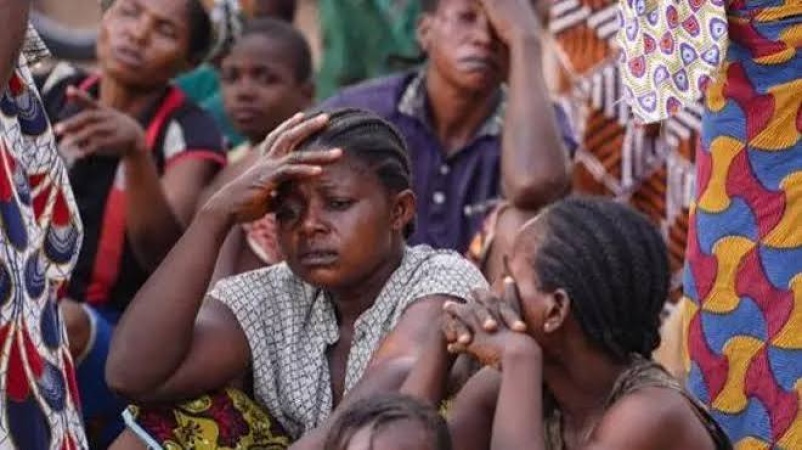
The violence has triggered a mass exodus. Nearly 50,000 Malians have fled to Mauritania, according to the United Nations, leaving the M’berra camp overwhelmed with traumatised families. Humanitarian workers say the similarities in the stories they hear—waterboarding, beatings, suffocation, public executions, and threats of mass reprisals—indicate a systematic pattern rather than isolated excesses. The consistency of these accounts raises grave questions about the structure of Mali’s security partnership and the chain of command under which these atrocities are occurring.
Mali’s ruling junta, like counterparts in Burkina Faso and Niger, has framed its embrace of Russia as a bold rejection of Western influence. Yet if security partnerships are to be judged by the safety of the people they claim to protect, the evidence is damning. Instead of improved stability, civilians describe a reality where foreign mercenaries—previously Wagner, now Africa Corps—operate with impunity, often alongside national forces. African leaders present these fighters as liberators, but in village after village, survivors speak of them as predators.
The greater danger Is geopolitical. Across the Sahel, a widening vacuum has enabled mercenary groups and foreign military actors to establish a foothold in fragile states with minimal oversight and accountability. In Mali, as in the broader region, the militarisation of governance and outsourcing of national security to unaccountable foreign entities has produced more instability, not less. This is not sovereignty—it is the surrender of civilian protection and national control to forces whose interests lie far beyond Mali’s borders.
The international community cannot pretend ignorance. Human rights organisations, analysts, journalists, and survivors themselves have repeatedly documented the abuses. And yet, almost nothing has been done to address the crisis meaningfully. In M’berra, survivors ask the same question again and again: If the world knows what is happening, why does nothing change?
As Mali’s displaced attempt to rebuild their lives across the border, many say their greatest hope is that justice will come one day. Ahmed recalls how he was once forced to dig what he believed was his own grave. Others remember friends executed with shovels and pickaxes. Their stories are stark reminders of the human cost of geopolitical realignment in the Sahel.
“If these testimonies exist,” one refugee asked, “and this violence continues even after the name change, how much longer must Mali endure before the world takes responsibility?”
It Is a question the region—and its international partners—can no longer ignore.
•Oumarou Sanou is a social critic, Pan-African observer and researcher focusing on governance, security, and political transitions in the Sahel. He writes on geopolitics, regional stability, and the evolving dynamics of African leadership. Contact: sanououmarou386@gmail.com
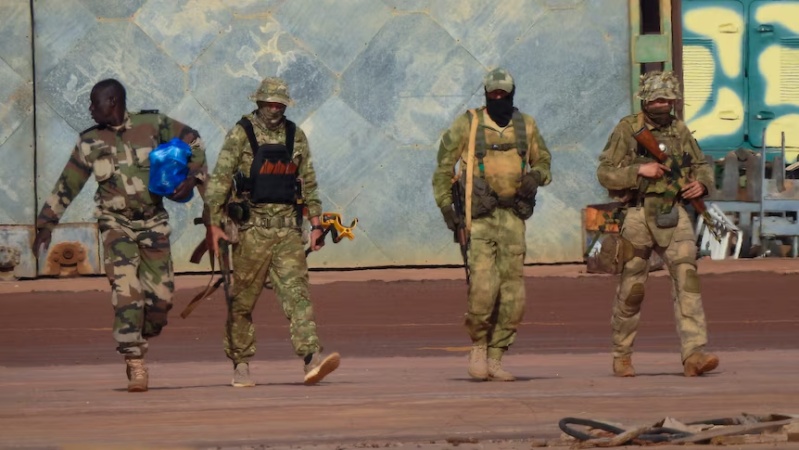
PHOTO CAPTION: •An undated photograph handed out by French military shows Russian mercenaries in northern Mali [French Army via AP]