Updating your news feed...

NEWS EXPRESS is Nigeria’s leading online newspaper. Published by Africa’s international award-winning journalist, Mr. Isaac Umunna, NEWS EXPRESS is Nigeria’s first truly professional online daily newspaper. It is published from Lagos, Nigeria’s economic and media hub, and has a provision for occasional special print editions. Thanks to our vast network of sources and dedicated team of professional journalists and contributors spread across Nigeria and overseas, NEWS EXPRESS has become synonymous with newsbreaks and exclusive stories from around the world.





Loading banners
Loading banners...

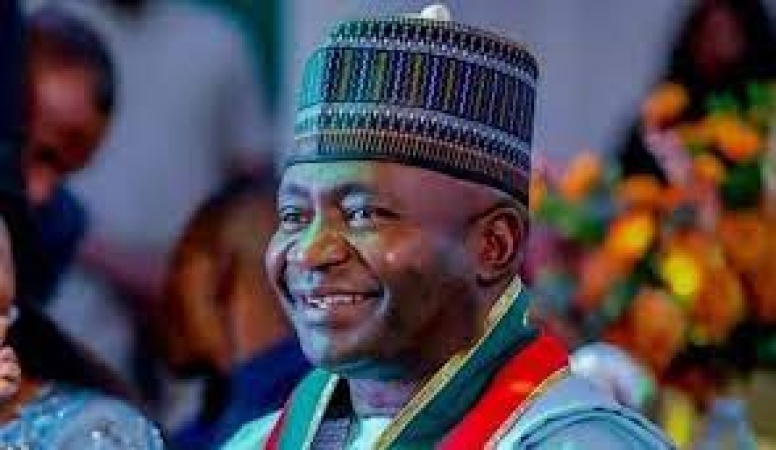
Defence minister, Gen Musa
By ABDULRAZAQ MAGAJI
When President Bola Tinubu nominated General Christopher Musa as Nigeria’s next Minister of Defence, many Nigerians welcomed the decision with cautious optimism. Musa, a battle-tested officer who was served as Chief of Defence Staff of the Armed Forces, is widely respected for his experience in counterterrorism and his deep understanding of Nigeria’s security landscape. His appointment appeared to signal a renewed seriousness in tackling the country’s worsening insecurity.
Yet, beneath the optimism lies a sobering reality that, no matter how competent, patriotic, and determined General Musa may be, politics and politicians will stand as his biggest obstacles. If proof for this is needed, it is in the realisation that Nigeria’s insecurity is not merely a military or policing problem; it is deeply political, and rooted in the interplay of vested interests, patronage networks, corruption, and the prioritisation of political survival over national stability.
Over the years, insecurity in Nigeria has evolved into a thriving ecosystem that benefits powerful actors. Kidnappers and bandits have financiers; armed groups have political patrons; oil thieves operate with the backing of political and military insiders. Equally disturbing is that Billions of Naira budgeted annually for defence and security leak through opaque procurement systems, inflated contracts, and unaccountable expenditures. General Musa may hope to reform this, but powerful and highly placed individuals who benefit from the present chaos will resist any attempt to introduce transparency, professionalism, or efficiency. When insecurity becomes profitable, peace becomes the least on the shopping list of those who feed off national chaos and instability.
It is uncharitable to say politicians do not demand solutions to insecurity. They do, but the solution they craze are instant, not long-term institutional reforms. In essence, politicians desire results but, for obvious reasons, not the kind of reforms that produce results. Soon, General Musa will discover, to his chargrin, that a defence minister who insists on discipline, merit-based postings and accountability will inevitably clash with political powerbrokers who want their allies protected, favoured, or unfavourably rewarded. He will discover too that every military posting has political implications, every procurement decision attracts lobbyists, and every attempt at internal clean-up threaten to upstage the applecart of entrenched interests.
The world over, insecurity thrives when governance fails. In the case of Nigeria, poor policing, unemployment, weak justice institutions, widespread poverty, and the collapse of local government administration all create fertile ground for violence. But instead of addressing these foundational issues, politicians routinely push the burden onto the military and, by extension, the Defence Minister. General Musa will face pressure to deliver results in an environment where socio-economic factors are beyond his control. For instance, he will be expected to tackle crime and criminality without corresponding investments in key areas such as education, youth development, policing reform, rural infrastructure and allied sectors under political leadership.
In a country where ethnic and regional politics often undermine national security decisions, security decisions are often filtered through ethnic, sectional, or religious lenses. Any serious operation risks being interpreted as targeting a particular ethnic or religious group. Politicians exploit these sentiments for cheap political capital by misrepresenting g security interventions as oppression or favoritism. For a Defence Minister who must make hard decisions such as as reshuffling commanders, intensifying operations, or deploying special forces, the entrenched weaponisation of identity will create obstacles. Every move could be met with accusations, petitions, and pressure campaigns from politicians seeking to ‘protect’ their constituencies or interests.
Several studies on insecurity have shown that banditry and insurgency are often enabled by political actors. It is a secret of the marketplace that some bandits and other criminals elements are on the payroll of politicians. Regularly, politicians either hobnob with bandits, negotiate directly with them, pay them for political support, or use them as local enforcers. Others benefits come from crisis zones where elections can be manipulated or opposition suppressed. The incoming Defence Minister may attempt to dismantle these networks, but doing so threatens powerful actors who will protect their interests vigorously. Without political backing for such bold reforms, any attempt to upstage the alliance between politicians and bandits may be doomed.
Nigeria’s insecurity is not exclusively a military problem. What it largely requires is political courage, something often in short supply. From farmer-herder clashes to separatist agitations, oil bunkering, and urban crime, many issues require policy reforms, justice, economic development, and sincere dialogue. Increased militarisation plays a secondary role in resolving political issues. Yet, politicians often choose the easier path by deploying the military. This creates unrealistic expectations for a Defence Minister while ignoring the governance failures fueling the crisis.
For decades, political interference in security appointments has undermined effectiveness. Competence is often secondary to loyalty, patronage, or ethnic balancing. General Musa may want to surround himself with the best hands, but political actors will insist on installing their allies. In this regard, General Musa may the hamstrung by political appointments that will threaten to limit his autonomy. Without control over the appointment of key aides, even the most determined Defence Minister will struggle to implement a cohesive and effective security strategy.
Ultimately, General Musa will be judged by his results and not the obstacles he is likely to face in office. The public will want fewer kidnappings, safer highways, peaceful rural communities, and a decline in terrorism. Yet, the very political actors who publicly demand these outcomes are the ones who privately frustrate them.
General Musa’s military pedigree is not in doubt. His experience in fighting Boko Haram and leading joint operations gives him an advantage over many predecessors. But unless Nigeria’s political leadership is willing to confront vested interests, dismantle corruption networks, end political interference, and support institutional reforms, his efforts may amount to motion without movement.
Nigeria does not suffer from a shortage of capable hands. What it suffers from is lack of political courage and, unless that changes, insecurity will remain Nigeria’s most stubborn enemy….and politics will remain its greatest enablers.
•Magaji magaji778@gmail.com writes from Abuja. He can also be reached via +234-803-697-9133.