Updating your news feed...

NEWS EXPRESS is Nigeria’s leading online newspaper. Published by Africa’s international award-winning journalist, Mr. Isaac Umunna, NEWS EXPRESS is Nigeria’s first truly professional online daily newspaper. It is published from Lagos, Nigeria’s economic and media hub, and has a provision for occasional special print editions. Thanks to our vast network of sources and dedicated team of professional journalists and contributors spread across Nigeria and overseas, NEWS EXPRESS has become synonymous with newsbreaks and exclusive stories from around the world.



















Loading banners
Loading banners...

Over 2,000 students kidnapped, 800 schools shut in northern Nigeria
The serial abduction of Nigerian schoolchildren and teachers by armed bandits has raised questions about the status of the Safe School Initiative (SSI) and why the government halted implementation of the scheme despite billions donated for its funding.
The Initiative, unveiled in the wake of the 2014 abduction of over 300 schoolgirls in Chibok, Borno State, aimed at promoting safety in Nigerian schools and rebuilding infrastructure, especially in the North-East.
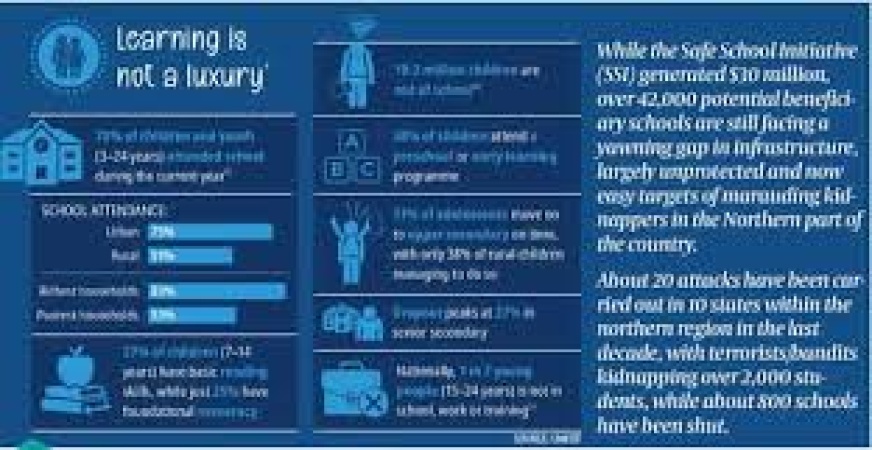
While the Initiative generated a total of $30 million, over 42,000 potential beneficiary schools are still facing a yawning gap in infrastructure, largely unprotected and now easy targets of marauding kidnappers in the Northern part of the country.
Recall that the SSI was launched by a coalition of Nigerian business leaders, working with Gordon Brown, the former British Prime Minister and United Nations Special Envoy for Global Education, as well as the global business coalition for education, and World at School. But despite the huge funds, attacks on schools have continued.
The SSI has a history of financial donations. In August 2014, for instance, the Presidential Committee on North-East Intervention raised about N80 billion, and in the same year received a donation of $1.5 million from Norway, $1 million from the African Development Bank (AfDB), $50,000 from the AfDB President and £1 million from the British government.
In 2015, Switzerland and the United States pulled in $8 million and $2 million, respectively, Qatar $2 million, and the Nigerian business community $10 million.
Yet, in the last decade, bandits and terrorist groups have disrupted the Nigerian education system, kidnapping over 2,000 students, while about 800 schools have been shut in the northern region.
Findings showed that about 20 attacks have been carried out in 10 states, located around the northern region of Nigeria in the last decade, Save the Children, a non-governmental organisation, has said.
Schools still unsafe
According to reports, as of 2020, at least $30 million had been raised for the SSI. In March of that year, the government reported that over 2,000 students, mostly from states in the North-East ravaged by the Boko Haram insurgency, were benefitting from the SSI, supervised by the presidential committee on North-East initiative (PCNI) across 43 schools in the region
In late 2022, the National Coordinator of the scheme, Halima Illiya, said as a result of repeated attacks on schools, the government had designed a three-year national plan on financing the initiative from 2023 to 2026.
The plan was developed to guide government investment in strengthening school security infrastructure, improving emergency preparedness, and reducing risks to students and teachers.
It proposed to spend N32.58 billion in 2023, N36.98 billion in 2024, N37.15 billion in 2025 and N38.03 billion in 2026.
Illiya explained that the initiative, expected to get underway in 18 states considered very high-risk, would initially cover 48 schools from each of the states.
Besides, data from the National Financing Plan also showed that more than 42,000 primary and secondary schools across northern Nigeria were without perimeter fencing, leaving them vulnerable to security breaches.
The plan revealed that 4,270 secondary schools in 21 northern states and the Federal Capital Territory (FCT) were unfenced.
Bauchi has the highest number of unfenced secondary schools with 574, followed by Benue with 447, Kano with 500, Adamawa with 379, and Jigawa with 269.
Other states with significant numbers include Kogi (296), Kebbi (203), Kaduna (164), Plateau (159), Gombe (161), and Katsina (145).
The FCT has 77, while Sokoto, Nasarawa, Kwara, Taraba, Niger, Borno, Yobe, and Zamfara also suffer a similar fate.
The situation is more difficult at the primary school level, where 38,684 schools across the region lack perimeter fencing.
Abductors on the prowl
zweek, 303 students and teachers were kidnapped at St. Mary’s school in Niger State, days after gunmen targeted the Government Girls Comprehensive Secondary School in the neighbouring Kebbi State’s Maga town and abducted 25 schoolgirls.
On February 25, 2014, 59 boys were killed at the Federal Government College of Buni Yadi in Yobe State. Twenty-four buildings on the school’s premises were razed. Boko Haram said they were responsible for the attack.
On the night of April 14, 2014, 276 female students were kidnapped from Government Girls Secondary School in the town of Chibok in Borno State. Boko Haram claimed responsibility.
On February 29, 2016, Babington Macaulay Junior Seminary, a school on the outskirts of Lagos, was thrown into pandemonium when some schoolchildren were abducted.
A few months later, precisely October 6, 2016, at 7:30 am, some armed men stormed Igbonla Model College in Epe and kidnapped the school’s vice principal, a teacher, and four pupils, during the school’s general assembly morning devotion.
On January 13, 2017, pupils of the Nigerian Tulip International College (formerly Nigerian Turkish International College), Isheri, Ogun State, were the next school to be attacked by armed kidnappers. Through its waters, the gang of kidnappers dug a hole through the school’s fence and gained entry from the back of the NTIC. Upon entry, they fired shots into the air and took away three pupils and five employees of the institution.
On February 19, 2018, 110 schoolgirls aged between 11 and 19 years were kidnapped from their school, Government Girls’ Science and Technical College (GGSTC) in Dapchi, Yobe State. The abductors were identified as Boko Haram. While being held hostage, some of the girls died, and others were later rescued, leaving Leah Sharibu, a Christian child, who had not been rescued.
On December 11, 2020, more than 303 students of Government Science Secondary School, Kankara, Katsina, were kidnapped by gunmen. Also, on December 19, another 80 Islamic school students in Dandume, Kastina, were kidnapped. These children were later rescued by the security operatives.
Gunmen raided the Government Science College Kagara, Shiroro Local Government Area of Niger State, on February 17, capturing 27 students and teachers in the school.
Some days later, on February 26, about 317 schoolgirls from the Government Girls Science Secondary School in Jangebe, Zamfara State.
The following month, on March 11, 39 students were kidnapped by gunmen in the Federal College of Forestry Mechanisation, Afaka, Igabi LGA, Kaduna State.
Another attack took place on May 30 at an Islamic school in Niger State, with armed men abducting about 100 students. The next month, on June 17, over 96 students and eight teachers were abducted by bandits at Federal Government College, Birnin Yauri, Kebbi State .
In July, bandits kidnapped over 153 students of Bethel Baptist High School in Damishi town of Chikun local government area in Kaduna.
In January 2023, six people were abducted at the Local Government Education Authority Primary School, Alwaza, in Doma, Nasarawa State. In September, 24 students were reportedly kidnapped from their hostel in Sabon Gida, Zamfara State.
On January 30, 2024, gunmen abducted six pupils and three teachers of a private school in Emure, headquarters of Emure Local Government Area of Ekiti State.
Also, on March 8, gunmen abducted about 287 children in Kaduna state from the Local Education Authority (LEA) Primary and Junior Secondary School, Kuriga, in Chikun Local Government Area of Kaduna State.
Some days later, another 15 students were kidnapped from a school in Gada, Sokoto, and 87 were kidnapped in Kaduna.
Kunle Ayeni, a legal practitioner and public analyst, in an interview, wondered if any school benefited from the Safe School Initiative.
He said: “Let me not pretend to even know how many schools were ever touched at all, let alone what the components of such safety were meant to be.
These repeated attacks on schools have sparked concerns over the perceived abandonment of the SSI, which was designed to enhance security in schools across the country, beginning with the north, where acts of banditry and terrorism have been notable.
Despite the initial substantial support and funding by the global community, the initiative has faced challenges in implementation and has seen a decline in momentum over the years.
Analysts identified bureaucracy, weak monitoring and political turnover as key factors that stalled the initiative.
A major structural flaw, according to stakeholders, has been the lack of clarity on institutional responsibility.
The National Safe Schools Response Coordination Centre, created under the 2023–2026 plan, is led by the Nigeria Security and Civil Defence Corps (NSCDC), but the Nigeria Police Force retains constitutional authority over internal security.
State governments oversee school infrastructure and are expected to provide local inputs. The military usually intervenes during mass abductions, while communities are asked to supply intelligence.
This overlap has produced gaps and confusion, highlighting the absence of real-time reporting systems and slow deployment, which in turn enables attacks that can last for hours without interception.
Already, the Federal Government and some northern states have ordered a shutdown of academic activities over rising insecurity and abduction of pupils.
While the federal government closed 41 Unity Schools, governors of Kwara, Plateau, Niger, Benue, and Katsina, as well as the Federal Capital Territory (FCT), have also shut down schools in their respective states.
Findings showed that academic activities had been grounded in parts of the north as communities grappled with escalating attacks.
In a statement shortly after the attack, the Secretary to the Niger State Government, Abubakar Usman, stated that the government had ordered the temporary closure of all boarding schools in the Niger North Senatorial District as a precautionary measure.
Similarly, the Kwara State government shut schools across four local government areas: Isin, Irepodun, Ifelodun and Ekiti, amid rising insecurity in the affected communities.
The Plateau State government has also announced the immediate closure of basic schools across the state due to security concerns.
In the same vein, the Katsina State government has ordered the immediate closure of all public schools across the state following escalating security threats and banditry attacks reported in several communities.
The state Commissioner for Basic and Secondary Education, Yusuf Jibia, said the measure became necessary to safeguard students and teachers as security agencies implement a new state-wide school safety strategy.
Similarly, the Chairman of the Nigeria Union of Teachers (NUT) in Benue State, Akuma Terna, stated that approximately 50 public schools had been shut in the state.
Parents and other international organisations have stressed that school safety must shift from rhetoric to action.
They argued that if structural loopholes, funding leakages and political neglect persist, the cycle of fear, abduction and abandoned classrooms may again define the future of an entire generation
A non-governmental organisation, Education for All, has demanded full accountability from SSI, following renewed attacks on schools in northern Nigeria.
The group lamented that despite more than $2 million reportedly committed to the programme since 2014, schools remain unsafe for learning.
Led by Emily Owoeye, the group raised serious concerns about the effectiveness of the SSI.
It said the SSI must provide a detailed public account of its operations, insisting that with over $20 million in donations and pledges, Nigerians deserve to know how the funds were used.
Security and education experts have also expressed concerns over the lack of tangible progress in fortifying schools, with some attributing this to shifting government priorities since 2015.
John Obunde, a security expert, expressed scepticism about the effectiveness of the SSI, citing concerns over its structural framework and implementation strategy.
He questioned the rationale behind entrusting the Ministry of Finance with oversight of the initiative, rather than the Ministry of Education, emphasising the need for the National Council on Education to formulate a comprehensive policy framework to guide the implementation of the initiative, involving both federal and state education ministries in its development.
Obunde highlighted the imbalance in the current arrangement, where the Ministry of Finance primarily handles financial aspects, while lacking the educational expertise necessary for effective programme execution.
He said such a setup predisposed the initiative to failure, contributing to its current challenges.
Charles Ude, a security analyst, said one key aspect of reinvigorating the SSI involves restructuring its governance framework to ensure effective coordination and implementation.
“This includes establishing clear lines of responsibility and accountability, with active involvement from relevant stakeholders.
By fostering synergy among these entities, the initiative can better address emerging threats and adapt to evolving security dynamics.
“Another critical component of revitalising the Safe School Initiative is the provision of adequate infrastructure and resources to support safety measures in educational institutions.
“This includes the construction of perimeter fencing, installation of security cameras, deployment of trained security personnel, and implementation of emergency response protocols.”
Ude added: “Community engagement plays a pivotal role in ensuring the success of the Safe School Initiative. By fostering partnerships between schools, local authorities, and community leaders, initiatives can be developed to raise awareness about the importance of school safety and security.”
President of the Association for Formidable Educational Development (AFED), Emmanuel Orji, highlighted measures needed to address the problem. According to him, there is an urgent need for improved physical security, including perimeter fencing, the installation of security cameras, and the use of metal detectors.
Besides, Orji advocated improved training for school staff on security procedures and threat identification.
“There should also be better community engagement, including working with parents and groups to improve awareness and reporting of suspicious activities,” he said.
The AFED president emphasised the need to address not only the consequences of insecurity, but also its underlying causes, including poverty, unemployment, and social exclusion. (GUARDIAN)