ADAD
ADAD
Updating your news feed...
NEWS EXPRESS is Nigeria’s leading online newspaper. Published by Africa’s international award-winning journalist, Mr. Isaac Umunna, NEWS EXPRESS is Nigeria’s first truly professional online daily newspaper. It is published from Lagos, Nigeria’s economic and media hub, and has a provision for occasional special print editions. Thanks to our vast network of sources and dedicated team of professional journalists and contributors spread across Nigeria and overseas, NEWS EXPRESS has become synonymous with newsbreaks and exclusive stories from around the world.











Loading banners
Loading banners...

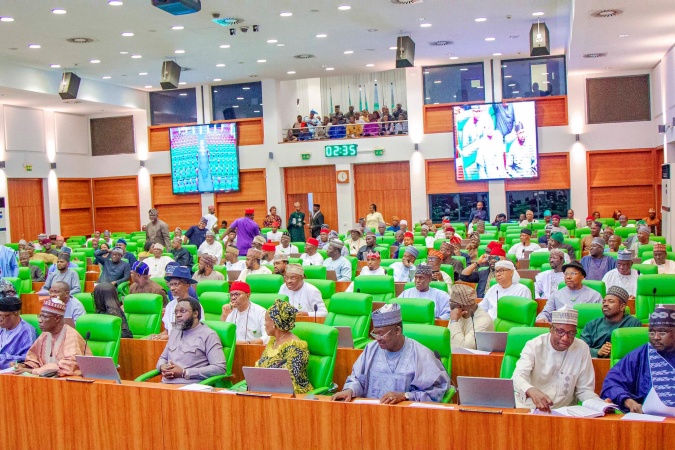
The House of Representatives at a plenary
Coming at a time when it has become obvious that the burden of the 36-state structure is not sustainable and many Nigerians are calling for pruning down the number of the federating units and going back to regional autonomy, the proposal to create an additional 31 states is both ridiculous and laughable. As far as they are concerned, the proposal, made public recently by the House of Representatives committee on the 1999 Constitution, is not likely to see the light of day.
Considering what Nigerians go through daily to put food on their tables, this development suggests that their representatives at the National Assembly are not in tune with the realities on the ground. If approved, it will increase the number of states to 67 and increase the resources needed to run the bureaucratic centres necessary in a state.
Besides, the agitation for more states has never yielded positive results even though it has been recurring. Nigeria operates a constitution that is considered rigid because the process of amending it is rigorous. Amendments require a two-thirds majority in both houses of the National Assembly, and approval by at least 24 of the 36 state legislatures. This high threshold makes it difficult to make changes. Since independence, in 1960, only the defunct Midwest State was created constitutionally; the present 36-state structure and the Federal Capital Territory (FCT) were created by military fiat.
The agitation for the creation of new states began with the arbitrary creation of 12 states in 1967 by the military regime led by Gen. Gowon, to frustrate the secessionist bid by the defunct Eastern Region under the leadership of Lieutenant-Colonel Chukwuemeka Odumegwu-Ojukwu. The new states were created despite the recommendations of the Willinks Commission 1957, which considered the state creation and the minority question. The panel had concluded that it would be counter-productive to create a new region out of the defunct Eastern Region because of the contiguity of the ethnic boundaries. The commission said it was both impractical and in the long run unsustainable.
The creation of new states was initially driven by the need to address the majority?s perceived domination of ethnic minority communities. Later, the underlying principle for demanding new states changed. The underlying reason for such agitations now centres on the belief that additional states will translate to an enhanced share of the federal revenue and opportunities in federal public service, which is shared based on equality.
Since 1967, the number of states has been altered from 12 to 19 in 1976; to 21 in 1987; 30 in 1991; and 36 in 1996. The agitation has not abated. This does not come as a surprise to discerning observers. Experts say the proponents of the new states are not considering the people?s interest, but are merely looking for avenues for a bigger chunk of the national cake. The import of the proposal for more states is that the country is yet to wake up from its slumber and the elite class is still fiddling, while the country is on the verge of collapse.
Human rights lawyer, social critic and political activist, Monday Ubani said there is no justification for creating new states where many existing ones are not viable.
Ubani, a former Second Vice President of the Nigerian Bar Association (NBA), said: ?Apart from the Southeast that requires one more state to balance the federation, any other agitation for state creation is selfish because it runs counter to current developments in the country. The motive behind the current agitation for more states is not a good one. Except for the Southeast, which ought to be given one more state, to keep it on par with the other regions, we do not need more states.
?Fortunately, the other areas where we require constitutional amendments are receiving attention from the committees mandated to scrutinise some constitutional provisions. These include the administration of justice generally, local government autonomy, revenue generation and sharing, creating a proper federal structure to strengthen the states and local governments and fiscal policies such as granting states derivative formulas for all mineral resources in their domain.
?The above are issues that deserve constitutional amendments, not the creation of states where such proposals have not met the constitutional requirements. Most existing states are not viable, so asking for new states is not in the country?s interest. It doesn?t make sense to ask for more states when many existing ones do not meet their financial obligations. Some of them ought to be merged to make them more viable.?
Politician and founding National Chairman of the All Progressives Grand Alliance (APGA), Chief Chekwas Okorie described the idea of creating new states as nonsensical. He said: ?Nothing can be more absurd than that. I heard about it in the news and I find it exceedingly stupid. I understand it is a private member?s bill. Whoever proposed it is so idle he doesn?t know what to do with his time. How can anybody in his right senses propose so many additional states, in a situation where many existing states cannot pay the new minimum wage? And you now want to create new bureaucratic centres. Can you imagine where you have 31 states added, with all the paraphernalia needed in a state, including state lawmakers, federal lawmakers, and governors to run it?
?What the House probably did was to follow due process and give it a fair hearing. I hope it is not presented for Second Reading. I was so incensed when I heard about the proposal. It makes me so angry; of all the legislative work that can be done to improve our situation, this is the only thing that appeals to the lawmaker who proposed it??
Okorie said anyone who calls himself a federal lawmaker should be more concerned about making laws to ensure that the country?s elections meet international standards. He added: ?Of all the problems bedevilling the country today, it is annoying that state creation is what is considered a priority by the proponent of this bill; not even one or two states but 31 new states.?
The APGA chieftain said the Electoral Act 2022 needs an amendment. His words: ?We must consider amending the law to ensure that for anyone to emerge as the president, he must secure at least 51 per cent of the votes cast. This is what is done in most multiparty democracies. It would end the current winner-takes-all situation because no single political party can muster that; it would require an alliance of different groups and ethnic nationalities during the run-off election stage. For someone to win that election, he must have campaigned vigorously across the country and convinced people across ethnic groups and religions.
?That?s number one. Number two; Nigeria has reached a stage where the results of elections are transmitted from polling units to a central portal. This would check the excesses of the numerous collation centres where results are manipulated. Another amendment that could be considered is having all the elections in one day. With the introduction of technology, there is no reason why we cannot have all the elections in one day. Besides, the election does not necessarily have to be on a Saturday; it could happen on a working day of the week and people can vote and go to work.?
Former Deputy National Chairman of the People?s Democratic (PDP), Chief Bode George, said the proposal was needless. He urged stakeholders to revisit the commendations of the 2014 National Conference. He said: ?We should take a closer look at the whole constitution; we can tweak some aspects of it with the recommendations of the 2014 conference. It takes care of the fears of inequality being raised by some geopolitical zones; not this jamboree they are brandishing.
?More important than state creation, is the devolution of power to the sub-nationals. Let there be devolution of power to the states. Our brand of federalism, which over-concentrates power in the centre, is not good for us as a nation. Each state should be empowered to deliver in its space. This is what obtains where we copied our democracy from.?
The vice presidential candidate of the New Nigerian Peoples Party (NNPP) in the last general election, Mr. Ladipo Johnson also agrees Nigeria does not need a new state now. He said the country should ensure efficient administration of the existing states. He said: ?I just think that it is ludicrous in the current circumstances we find ourselves in. Already we have seen that governance is too expensive.
?The presidential system of government we are running has proved too expensive. Most of our governments are wasteful. Some states that are already not viable without federal government grants, you want to break them further into smaller units? For what purpose? I don?t understand. Is it to have more governors, special assistants (SAs), and commissioners? It doesn?t make sense to me.
?We should run the existing states efficiently first. If that is done, there will be no need to create any state. If powers are devolved to the states and they are doing well, people wouldn?t even care about the religion or the ethnicity of the person in government.?
He said the proposal should be in abeyance and allow Nigerians to discuss it looking at all indices.
The Managing Partner of KYC Chambers, Mr Oluwole Kehinde, said the request is ridiculous and unnecessarily over-ambitious. However, he said some states? proposals may be considered based on population. He said: ?Oyo and Lagos states based on population are good to go. But, proposing new states for Kogi and Ijesha is premature.
?Some states have the land mass, but can they survive? This proposal is ludicrous. Many of these states cannot survive without allocation from the Federal Government. That means they are not viable. The only thing existing in most of those states is governance. The moment you remove the government, what is left? Nothing!
?States should remain as they are and improve on themselves first. It?s quite unfortunate that people are looking at political interest more than the economic and social value of the states.?
There have been several unsuccessful attempts to review the 1999 Constitution. Other than the first, second, and third alterations enacted during the Sixth Assembly (2007 to 2011), no significant amendment has been made. The Seventh Assembly (2011 to 2015) also undertook a constitution review process, but it ran into a logjam, despite the huge amount of resources deployed into it. The efforts represented the first genuine participatory process in constitution-making since the country?s return to civil rule in 1999, with public hearings held across the six geo-political zones at both constituency and zonal levels. The Eighth Assembly led by Senator Bukola Saraki and Yakubu Dogara, also attempted to review the constitution but did not achieve much.
The Southeast has been asking for an additional state to bring the number of states in the zone at par with other zones. The Southeast has only five states while the others have six states. The Northwest has seven states. Unfortunately, most states do not generate enough revenue to sustain and add to the national purse. Rather, they rely solely on monthly allocations from the Federation Account, for salaries and allowances of political office holders, without investing in their economies. Against this background, the current brand of federalism has been aptly described as ?feeding bottle? federalism.
Nigeria was more focused and tilted towards development when it had four regions in the ?60s and 12 states in the ?70s. In 1965, when the country had four regions its economy was at par with Brazil, Malaysia and Indonesia. These countries still maintain the same structures, while Nigeria?s federating units have increased to 36 on the pretext of development. (The Nation)