ADAD

Updating your news feed...
NEWS EXPRESS is Nigeria’s leading online newspaper. Published by Africa’s international award-winning journalist, Mr. Isaac Umunna, NEWS EXPRESS is Nigeria’s first truly professional online daily newspaper. It is published from Lagos, Nigeria’s economic and media hub, and has a provision for occasional special print editions. Thanks to our vast network of sources and dedicated team of professional journalists and contributors spread across Nigeria and overseas, NEWS EXPRESS has become synonymous with newsbreaks and exclusive stories from around the world.






.webp)






.webp)








Loading banners
Loading banners...

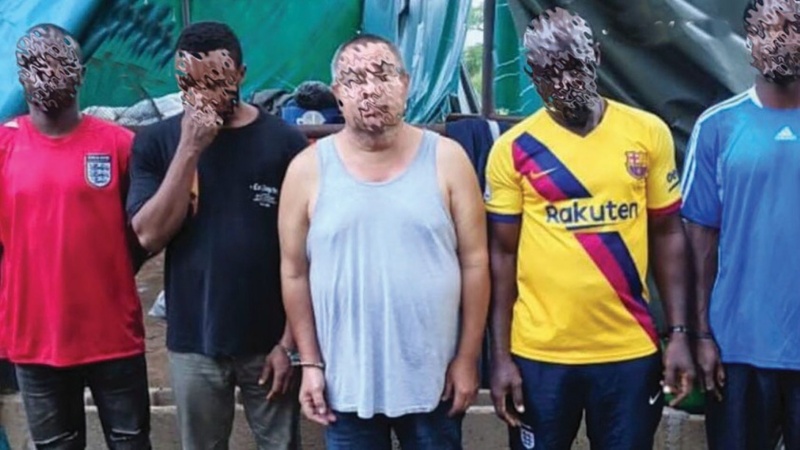
Suspects from NDLEA raid at Oyo meth lab
On Wednesday, November 25, 2026, the Chairman of the National Drug Law Enforcement Agency (NDLEA), Brig. Gen. Mohammed Buba Marwa (retd), confirmed the discovery of an industrial-scale methamphetamine laboratory in Enugu State.
The operation, described by the agency as one of its most carefully planned intelligence-led investigations, followed seven months of work spanning several countries. It led to the arrest of a 63-year-old Nigerian businessman, Chuks Ezeike, popularly known as “Over Size,” and five Mexican nationals alleged to be specialists in
industrial
methamphetamine production.
NDLEA said it recovered 1,512 kilogrammes of methamphetamine, either finished or in production, with an estimated street value of N303.9 billion, equivalent to $226.8 million. It also seized 6.68 tonnes of precursor and essential chemicals, as well as industrial equipment used in the illicit trade.bbc+2
The disclosure did not come as a complete shock. Nigeria’s economic pressures have pushed many citizens into despair, making illicit drugs and the quick money surrounding them increasingly attractive to vulnerable people. But the scale and sophistication of the Enugu laboratory confirmed a more troubling reality: drug production is becoming industrialised on Nigerian soil.
From transit route to production base
For years, Nigeria was largely seen as a transit corridor for cocaine, heroin and other narcotics moving between South America, Asia, Europe and North America. It was also a significant consumer market for cannabis, codeine-based syrups, tramadol and other substances. That picture is, however, changing.
The NDLEA says transnational cartels are now seeking to turn parts of Nigeria into a manufacturing hub for synthetic drugs, particularly methamphetamine. The agency believes foreign syndicates are moving production closer to African and European markets while taking advantage of porous borders, weak regulatory oversight and the availability of dual-use industrial chemicals.
The Enugu investigation traced the network from Mexico through Colombia, France and the Republic of Benin before operatives moved on targets in Lagos and Enugu. The agency identified Ezeike as a specialist in setting up illicit methamphetamine laboratories and alleged that he worked with Oscar Ramos-Cardenas, a Mexican suspected of involvement in large-scale methamphetamine production.
The suspects were allegedly brought into Nigeria using forged Argentine, Colombian and Chilean passports. The laboratory was located behind San Savanna Oil Company Limited, along the Abakaliki Expressway in Emene, Enugu.
The discovery suggests that the threat is no longer limited to smuggling finished drugs through airports, seaports and land borders. It now includes the transfer of technical knowledge, chemical supplies, production equipment and illicit manufacturing capacity into remote Nigerian communities.
A dangerous chemistry
Methamphetamine, commonly known as meth, crystal meth or “mkpuru mmiri” in parts of southeastern Nigeria, is a highly addictive stimulant. Its production requires precursor chemicals and industrial processes that can pose serious risks to workers, nearby residents and the environment.
At the Enugu facility, NDLEA said it recovered chemicals and equipment used in methamphetamine production. In earlier raids, the agency listed materials including phenyl-2-propanone (P2P), phenylacetic acid, caustic soda, sulphuric acid, tartaric acid, thioglycolic acid and ethyl phenylacetate.
It also recovered reactor pots, distillation units, fabricated mixers, condensers and industrial dehydrator machines used to dry methamphetamine crystals.
These are not ordinary household items. They are components of a clandestine chemical industry. Their presence in forests, factories, warehouses and residential areas creates risks far beyond drug trafficking.
NDLEA’s Director of Media and Advocacy, Femi Babafemi, warned that laboratories using toxic and flammable chemicals can contaminate air and water. He said communities near such facilities may breathe polluted air and drink contaminated water, while the drugs produced eventually return to those same communities and damage young people.
The danger, therefore, is not only criminal. It is public health, environmental and security-related.
The arrest of five Mexican nationals in Enugu has drawn attention to the growing presence of foreign expertise in Nigeria’s synthetic-drug economy.
NDLEA alleges that the Mexican suspects were recruited as production specialists. Their alleged role was not simply to traffic drugs, but to teach local collaborators the technical process of manufacturing methamphetamine at industrial scale. This is a major shift.
In the past, foreign cartels often used Nigerian networks as couriers, financiers or distributors. The current pattern, according to the agency, involves foreign “cooks” entering the country to establish laboratories, train local operatives and oversee production.
Babafemi said the transfer of technical expertise to Nigerians is a serious threat. He described those behind the laboratories as organised transnational syndicates that have deliberately moved production closer to new markets and brought in foreign specialists to train local collaborators.
“If we allow that to take root, Nigeria would have more than a trafficking problem,” he said. “We would have home-grown production capacity, cheap high-potency meth flooding our communities, and toxic chemical waste poisoning our soil and groundwater.”
The NDLEA says it is aware that some cartel operatives are departing Mexico for Nigeria. It claims some have been turned back, while others have attempted to re-enter through the Republic of Benin.
Whether or not every allegation is ultimately established in court, the pattern of arrests and laboratory discoveries points to a growingtransnational operation. It also raises urgent questions about border control, immigration screening, chemical tracking and intelligence sharing.
A trail of laboratories
The Enugu bust is not an isolated case. In May 2026, NDLEA operatives raided a laboratory in Abidagba Forest, Ijebu East Local Government Area of Ogun State. The agency said the operation yielded drugs and chemicals valued at more than N480 billion and led to the arrest of three Mexican nationals and seven Nigerian collaborators.
The suspects were later arraigned before the Federal High Court in Lagos on an 11-count charge bordering on the operation of a clandestine laboratory and the production of 2,419.48 kilogrammes of methamphetamine.
In June 2026, the agency said it dismantled another industrial-scale laboratory in Tapa Forest, Ibarapa North, Oyo State. A Mexican expert was arrested at the facility.
That investigation reportedly led operatives to Arturo Carrera Loaiza, a 56-year-old Mexican national arrested on August 19, 2026, while attempting to leave Nigeria through the Lagos airport. His arrest led to the discovery of chemicals and equipment linked to an industrial-scale laboratory in Ebonyi State.
The Oyo facility was said to contain large quantities of P2P, a controlled precursor used in methamphetamine production. Operatives also recovered crystalline substances undergoing processing, drums of phenylacetic acid, caustic soda, sulphuric acid, tartaric acid, thioglycolic acid, ethyl phenylacetate, aluminium foil and other industrial chemicals.
The sequence of discoveries suggests a network rather than isolated criminal incidents. The same alleged financiers, recruiters, chemists, transporters and local collaborators appear to have been linked to facilities in different states.
A long-running problem
The current wave of laboratory discoveries did not begin in 2026.
Before 2021, the United Nations Office on Drugs and Crime (UNODC) said the NDLEA dismantled 18 clandestine methamphetamine laboratories across Nigeria. One of the most significant was a Sinaloa Cartel-linked “super lab” discovered in Asaba, Delta State, in 2016.
Under the National Drug Control Master Plan (NDCMP) 2021–2025, international drug-monitoring data tracked total discoveries to roughly 25 laboratories. These included twin busts in Lagos and Anambra states in July 2022 and another facility in Ikeja, Lagos, in June 2023.
The recent discoveries in Ogun, Oyo, Ebonyi and Enugu therefore represent an escalation rather than a completely new phenomenon.
What has changed is the scale, the level of foreign involvement and the apparent intention to establish sustainable production capacity within Nigeria.
Drug cartels are investing billions of naira in laboratories, chemicals, equipment, logistics and human networks. Their objective, according to NDLEA, is to flood Nigerian and international markets with synthetic drugs while using the country as both a production centre and a transit route.
The economics of illicit drugs
The scale of the alleged operations reveals the financial power behind illicit narcotics.
A laboratory capable of producing more than 1.5 tonnes of methamphetamine is not a small-scale criminal venture. It requires capital, secure premises, imported or diverted chemicals, technical expertise, storage, transportation, distribution networks and protection.
The NDLEA says cartels exploit poverty and unemployment to recruit local partners. They offer quick money to landowners, transporters, labourers and youths who may not fully understand the risks involved.
This creates a difficult enforcement problem.
In communities where legitimate opportunities are scarce, the promise of cash can be powerful. A landowner may lease a remote property without asking too many questions. A transporter may move drums and equipment without knowing their destination. A young person may accept work as a labourer, driver, guard or messenger.
The result is an ecosystem in which ordinary people become unwilling or uninformed participants in a dangerous trade.
Babafemi acknowledged the challenge.
“It is a genuine challenge, and we will not pretend otherwise,” he said. “Cartels exploit poverty and unemployment. They offer quick money to landowners, transporters, labourers and youths who often don’t fully understand what they are getting into.”
He argued, however, that any livelihood built on methamphetamine is a “death trap.”
The NDLEA’s response includes prosecuting persons who lease land, shelter laboratories, move chemicals or provide cover for criminal operations. The agency also says it is pursuing asset forfeiture, financial investigations and collaboration with other security agencies.
Chemicals hiding in plain sight
One of the most difficult aspects of the crisis is the movement of precursor chemicals through legitimate trade channels.
Precursor chemicals are substances that have lawful industrial, pharmaceutical or commercial uses but can also be used to produce illicit drugs. They may enter Nigeria as industrial solvents, laboratory reagents, manufacturing inputs or materials for oil-sector operations.
Once in the country, they can be diverted to clandestine laboratories.
NDLEA says its Directorate of Forensic and Chemical Monitoring works with port authorities, the Nigeria Customs Service, the National Agency for Food and Drug Administration and Control (NAFDAC), importers and international partners to track suspicious consignments.
The agency says it scrutinises import permits, end-user declarations and unusual purchasing patterns. It also shares intelligence with foreign partners on suspicious shipments before they arrive in Nigeria.
But enforcement alone may not be enough.
Experts argue that Nigeria needs stronger digital tracking of the importation, warehousing and sale of dual-use chemicals. Importers, distributors and warehouse operators should be required to know who buys their products, for what purpose and where the materials are ultimately delivered.
The absence of such controls creates room for criminal networks to exploit legitimate commerce.
Mental health expert and Associate Professor of Educational Psychology at the University of Calabar, Dr Achi Ndifon Bekomson, said cutting off the precursor supply chain would make industrial methamphetamine production more difficult.
She recommended real-time digital tracking of imported, stored and locally sold dual-use industrial solvents and pharmaceutical precursors. She also called for strict “Know Your Customer” rules for chemical importers and criminal liability where supplies are diverted to clandestine laboratories.
Forests as factories
The choice of remote forests and isolated industrial locations is deliberate.
Laboratories in Abidagba Forest in Ogun State, Tapa Forest in Oyo State and facilities in Ebonyi and Enugu were reportedly concealed away from major population centres. Such locations reduce the chance of detection, allow space for chemical storage and processing, and make surveillance more difficult.
But they also create risks for nearby communities.
A clandestine laboratory can release toxic fumes, pollute water sources, cause fires or explosions, and expose workers and residents to dangerous chemicals. The environmental damage may last long after the laboratory is dismantled.
NDLEA says it is strengthening surveillance and tactical capacity to reach such locations. It says the discoveries in Ogun, Oyo and Ebonyi resulted from months of intelligence work, surveillance and operational planning.
The agency also says it works with the military, police, Department of State Services (DSS), Nigeria Security and Civil Defence Corps (NSCDC), Nigeria Immigration Service (NIS) and other security agencies where necessary.
Still, Nigeria’s vast territory, dense forests, poorly governed corridors and limited surveillance capacity remain major challenges.
Babafemi admitted that more investment is needed in surveillance technology, mobility, forensic capacity and manpower. He said the NDLEA is grateful for support from the Federal Government and international partners, but stressed that the agency needs continued resources to confront an evolving threat.
The human cost
Beyond seizures, arrests and billion-naira valuations, the greatest danger is the potential impact on public health.
Methamphetamine is associated with addiction, psychosis, violence, paranoia, insomnia, severe weight loss, cardiovascular problems and long-term mental health disorders. Cheap, high-purity methamphetamine in communities with limited treatment services could overwhelm an already fragile health system.
Bekomson warned that Nigeria may be on the verge of a “catastrophic mental health and security emergency” if the spread of cheap methamphetamine is not checked.
She said the accessibility and affordability of high-purity methamphetamine could overwhelm psychiatric facilities, destroy young people and affect future generations.
Her concern reflects a wider problem: Nigeria’s drug-treatment infrastructure is inadequate for the scale of potential demand.
The NDLEA says it has established more than 30 functional rehabilitation centres under its current leadership. But the Assistant Commander General of Narcotics and Director of Seaports Operations, Mrs Ibinabo Archie-Abia, said the facilities cannot admit everyone who needs treatment at the same time.
She attributed the gap to Nigeria’s large population and the inadequate number of trained counsellors across federal and state health institutions, the NDLEA and other organisations.
“Nigeria is a very big population,” she said. “The last I saw for the 2025 population statistics, we are about 230 million persons. And the number of counsellors, both in the Federal Ministry of Health, the state ministries, NDLEA and other associations, shows that the ratio is not adequate.”
Archie-Abia said the NDLEA’s rehabilitation centres are among the cheapest treatment options available because they are government-backed. She said some state governments also support the centres.
She called for stronger partnerships with state governments to expand rehabilitation services. The agency has also engaged governors’ wives and first ladies to support its programmes.
According to her, almost 80 per cent of NDLEA officers have been trained as counsellors. People seeking assistance can access counselling services at the agency’s state and area commands.
Why young people use drugs
The rise in synthetic-drug production cannot be separated from the factors driving demand.
Archie-Abia identified peer pressure, family challenges, academic failure, health conditions and social-media influence as major contributors to drug abuse among young people.
Some young people turn to drugs because of pressure from peers. Others are exposed to substance abuse through unresolved family problems or a lack of stability at home.
Academic setbacks can also push young people towards substances as they seek escape, confidence or a sense of achievement. People experiencing severe pain or recovering from accidents may develop dependence after prolonged use of pain-relieving medication.
Social media adds another layer of risk. The NDLEA official expressed concern that drug use is sometimes glamorised online through attractive street names and misleading portrayals of substance abuse.
The easy availability of illicit substances in streets, schools and public places further worsens the problem.
The agency says it combines demand-reduction strategies, including public education and sensitisation, with supply-side enforcement. Its War Against Drug Abuse (WADA) programme takes prevention messages to primary schools and other institutions.
Between January 2021 and October 2026, the NDLEA said it carried out 18,293 WADA advocacy activities in schools, reaching 6,349,225 participants.
But prevention must go beyond slogans. Families, schools, religious institutions, community leaders and health workers need practical tools to identify early signs of substance abuse and refer affected persons for help.
Archie-Abia urged parents to recognise when their children are struggling rather than deny the problem. She advised families to seek professional assistance and avoid stigmatising those affected.
Arrests, seizures and convictions
The NDLEA says its response to the evolving narcotics landscape has produced significant results.
Between January 2021 and October 2026, the agency said it arrested 98,426 suspects, including 257 alleged drug barons. It also reported seizing 15,952,890.22 kilogrammes of illicit substances.
The agency said 17,103 suspects were convicted during the period, while 55,265 persons were counselled and rehabilitated. It also said it destroyed 2,128.99 hectares of cannabis farms. These figures reflect a major enforcement effort. They also show the scale of the challenge.
Arrests and convictions alone cannot dismantle an industry that is increasingly organised, financed and technically sophisticated. The NDLEA itself acknowledges that enforcement must be supported by financial investigations, community engagement, alternative livelihoods and stronger treatment services.
Babafemi said the agency is pursuing the money behind the networks.
“We go after the money,” he said. “We trace and seize assets, because taking away the proceeds removes the incentive.”
He said several local collaborators are already standing trial.
The agency’s message is that anyone who leases land, shelters a laboratory, moves chemicals or provides cover for drug production is a collaborator under the law and risks prosecution and forfeiture of property.
Corruption and political protection
No discussion of organised crime in Nigeria can ignore the risk of corruption and political protection.
Bekomson argued that drug proceeds can become an irresistible source of political funding in a heavily monetised political system. She said political office holders who finance syndicates or accept laundered money may provide top-down immunity for criminal networks.
She alleged that such influence can be used to secure regulatory waivers for front companies, stall investigations and shield key drug barons from prosecution.
These are serious allegations. They require evidence, due process and independent investigation. But they highlight an important institutional vulnerability.
If criminal networks can buy protection, obtain regulatory cover or frustrate investigations, enforcement will remain incomplete.
Bekomson recommended closer collaboration between anti-corruption agencies, including the Economic and Financial Crimes Commission (EFCC) and the Independent Corrupt Practices and Other Related Offences Commission (ICPC), and the NDLEA’s financial intelligence units.
She said investigators should examine politically exposed persons and sudden “business moguls” whose lifestyles, real-estate portfolios or political donations exceed their documented legitimate income.
Her argument is blunt: until political godfathers, uniformed enablers and traditional gatekeepers face the same legal consequences as street-level dealers, Nigeria will remain vulnerable to transnational criminal networks.
What must change
The Enugu discovery should be treated as more than another headline-grabbing drug bust.
It is evidence that Nigeria faces a structural threat: the possible emergence of domestic industrial capacity for synthetic-drug production, supported by foreign expertise and financed by transnational criminal networks.
Stakeholders note that addressing it will require action on several fronts, including stronger border control, improved monitoring of shipping containers, industrial glassware, ventilation equipment and bulk chemical consignments at seaports and airports, digital tracking of precursor chemicals from importation through warehousing, distribution and final sale, and strict accountability for chemical importers, distributors, warehouse operators and end users.
Other recommendations include faster investigation and prosecution of financiers and technical collaborators, asset forfeiture and financial investigations targeting the proceeds of drug trafficking, greater investment in surveillance technology, forensic capacity, mobility and personnel, expanded community-based drug treatment, detoxification and psychiatric rehabilitation services, as well as stronger collaboration among NDLEA, Customs, NAFDAC, Immigration, police, DSS, NSCDC, EFCC, ICPC, state governments and international partners.
The NDLEA says its Alternative Development Programme, described as the first in Africa to offer alternative livelihoods to communities involved in illicit drug cultivation, has begun as a pilot project in three cannabis-growing communities in Ondo State. The agency says seven more states are lined up for the initiative.
Such programmes may be essential if enforcement is to succeed. Communities need legitimate sources of income. Without them, criminal networks will continue to exploit poverty, unemployment and desperation. (The Guardian)