ADAD

Updating your news feed...
NEWS EXPRESS is Nigeria’s leading online newspaper. Published by Africa’s international award-winning journalist, Mr. Isaac Umunna, NEWS EXPRESS is Nigeria’s first truly professional online daily newspaper. It is published from Lagos, Nigeria’s economic and media hub, and has a provision for occasional special print editions. Thanks to our vast network of sources and dedicated team of professional journalists and contributors spread across Nigeria and overseas, NEWS EXPRESS has become synonymous with newsbreaks and exclusive stories from around the world.





















Loading banners
Loading banners...

By BONIFACE AKARAH
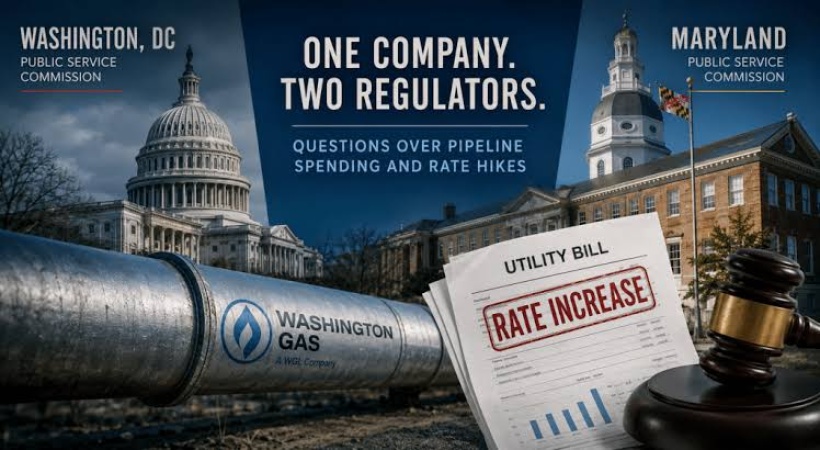
The Office of People’s Counsel (OPC) in Maryland, United States, has asked state regulators to block Washington Gas from imposing a special surcharge on customers for its proposed 2027 gas pipe replacement projects until the company demonstrates compliance with a law designed to protect consumers from costly infrastructure spending.
The consumer advocacy office, in a motion filed with the Maryland Public Service Commission (PSC) on Monday, November 16, argued that Washington Gas should not receive special surcharge treatment for the proposed projects without first satisfying requirements introduced by the 2025 Next Generation Energy Act (NGEA).
The amendments, which took effect on June 1, 2025, require gas utilities seeking surcharge recovery under the Strategic Infrastructure Development and Enhancement (STRIDE) programme to demonstrate that proposed projects benefit customers and that alternatives to infrastructure replacement have been properly considered.
OPC said Washington Gas had already been receiving surcharge treatment for its 2026 projects without the commission determining whether the company had complied with the amended law. It is also appealing the commission’s decision to allow the 2026 projects to proceed without first establishing compliance.
People’s Counsel David S. Lapp accused the commission of delaying enforcement of the new legal requirements while allowing the utility’s infrastructure projects to continue.
“More than a year has passed since the PSC first ordered Washington Gas to justify how its ongoing STRIDE plan complies with the NGEA,” Lapp said.
“But instead of enforcing that order, the PSC established a rulemaking proceeding for NGEA compliance while allowing WGL’s STRIDE projects to move forward anyway. The law does not allow another year of projects to go into the surcharge as if the NGEA did not exist.”
STRIDE is a programme established by Maryland lawmakers in 2013 to allow gas utilities to recover the costs of replacing pipes and other infrastructure through special charges on customers’ bills, rather than waiting for conventional rate proceedings to establish that the expenditure was prudent.
OPC argued that the surcharge arrangement allows Washington Gas to recover infrastructure costs without first undergoing the usual process of demonstrating that the investments were prudent and that the facilities were actually in use and beneficial to customers.
To underline the need for stricter regulatory oversight, the office cited a report by the National Association of Regulatory Utility Commissioners (NARUC), which described STRIDE-like programmes across the United States as costly and called on regulators to consider measures to minimise their impact on consumers.
It also referenced a report by the Future of Heat Initiative, which found no statistically detectable change in the rate of gas safety incidents attributable to state infrastructure replacement programmes such as STRIDE.
The report further indicated that pipe replacement does not directly address the leading causes of significant gas safety incidents, particularly excavation and other external damage, including vehicle collisions and vandalism.
OPC maintained that rejecting the proposed 2027 projects would not compromise public safety, arguing that Washington Gas remains legally obligated to provide safe and reliable service regardless of whether it receives special surcharge treatment under STRIDE.
The office said the 2025 NGEA specifically reaffirmed that the programme does not relieve gas companies of their statutory responsibility to make improvements necessary to ensure the safety of their systems.
Lapp said the surcharge arrangement was contributing to rising utility bills and financial hardship for Maryland residents.
“The special surcharge treatment gas utilities receive under STRIDE is driving up utility rates and causing hardship for many Marylanders,” he said.
“In passing the NGEA, the General Assembly wanted to make sure that costly spending on replacing pipes benefits customers and is assessed against alternatives. The PSC should move expeditiously to enforce compliance.”
OPC also warned that declining residential and commercial gas consumption, driven by competition from more efficient electric technologies, health and safety concerns and climate policies, could leave fewer customers bearing the costs of maintaining an increasingly expensive gas distribution network.
The office said its research had highlighted the growing financial risks associated with gas infrastructure spending, particularly where long-term costs could exceed the benefits to consumers.