ADAD
Updating your news feed...

NEWS EXPRESS is Nigeria’s leading online newspaper. Published by Africa’s international award-winning journalist, Mr. Isaac Umunna, NEWS EXPRESS is Nigeria’s first truly professional online daily newspaper. It is published from Lagos, Nigeria’s economic and media hub, and has a provision for occasional special print editions. Thanks to our vast network of sources and dedicated team of professional journalists and contributors spread across Nigeria and overseas, NEWS EXPRESS has become synonymous with newsbreaks and exclusive stories from around the world.










.webp)








Loading banners
Loading banners...

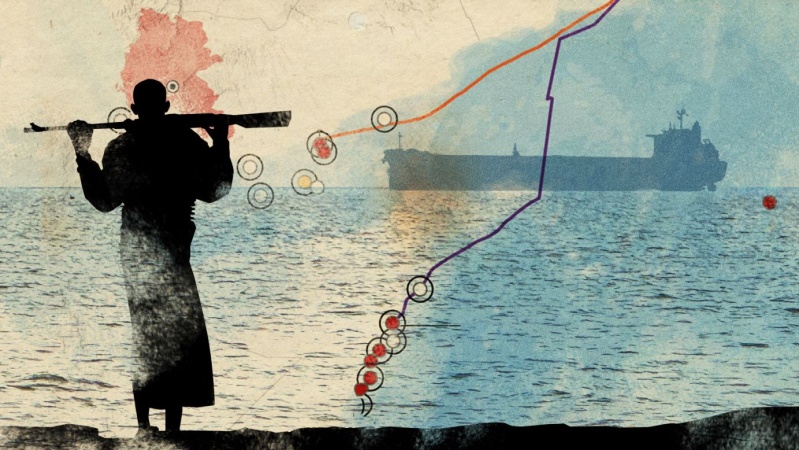
A knock at second engineer Syed Hussain Yousuf’s cabin door.
“Pirate attack.”
Gun shots.
Three minutes later, a dozen pirates were aboard the Honour 25. They showed their guns to the diesel tanker’s crew. Everyone to the bridge.
It was the afternoon of April 21. For five months, most of the 17 crew would remain confined to that space, no more than 50 feet long, seated, leaving only when escorted to the bathroom.
Somali piracy is back.
A scourge that emerged more than 30 years ago – and grew into an $18 billion criminal enterprise by the 2010s – had been mostly wiped out. But economic calamity combined with opportunity, particularly from the Iran war, has emboldened Somalia’s pirates to return to the seas in search of multimillion-dollar ransom payments.
America’s Navy is focused elsewhere, away from the Somali coast toward a war in the Persian Gulf. Houthi attacks in the Red Sea and Gulf of Aden have rerouted oil tanker traffic close to Somalia. Surging fuel prices have made their cargo lucrative targets.
And Somalis have become desperate. Surging fuel and food costs and a reliance on disrupted exports from Gulf nations have derailed Somalia’s fragile economic recovery this year.
All of that came to a head aboard the dilapidated Honour 25, where a monthslong standoff came to a violent end last month.
Five crew members didn’t make it out alive.
Diesel costs have nearly doubled during the war. Attacks on vessels in and around the Red Sea and Persian Gulf have sent insurance costs surging.
That has forced oil and shipping companies into difficult but pragmatic choices. Deep-pocketed companies are rerouting traffic around Africa’s Cape of Good Hope, adding weeks and millions of dollars in fuel costs to their routes to avoid Houthis and Somali pirates, who are terrorizing ships transiting through the Red Sea and the Gulf of Aden. But smaller outfits with tighter budgets or sketchy safety records are cutting corners to save money. Some are risking the perilous trip through the Bab-al-Mandeb strait. A few are sailing closer to Somalia to avoid Houthis off the coast of Yemen.
The Honour 25 was on its way from Shinas Port in Oman to supply Somalia’s capital, Mogadishu, with 2,700 tons of diesel.

Yasir Khan on the MT Honour before it was hijacked.
Crewmember Yassir Khan knew the job was unsafe. It was the Pakistani crew’s second trip to Mogadishu this year. The first, in January, went smoothly.
But the ship was rusted and its engine and generators faulty, Khan said. And it lacked standard anti-piracy security protocols.
“No guards. No barbed wires. No nothing,” he said.
Since 2008, no ship with armed guards has been successfully attacked, said Tim Walker, maritime project leader at the Institute for Security Studies, Africa.
“The ships being hijacked aren’t carrying guards to deter pirates,” Walker said. “And those ship owners are likelier to disappear before the ransom is paid.”
The shots started ringing out after 2 pm.
Khan looked out from his porthole. A half dozen Somali pirates, some with AK-47s, were firing at the bulkhead.
He ran from the engine room. He knocked on the cabin doors.
“Lock the doors!”
The Honour 25 had been in the Gulf of Aden at the time of the attack. The pirates, arriving in two small boats, quickly seized control and stopped the engine.
The first three days were filled with threats. Guns pointed at the crews’ heads. Instructions to sit. No talking. Shots fired in the air.
The crew begged the pirates to stop shooting, Khan said.
“It has 2,700 tons of diesel,” Khan said. “If you fire a gun, it can make a spark, and it will explode the ship.”
More boats came with more pirates – three dozen, all Somali. Yousuf (the Honour 25 engineer) estimates they were in their late 20s to late 40s. They took on assignments – the pump room, the engine room, the forecastle, the bridge.
The crew were directed to take the ship to the coastal fishing village Durdura. Two nautical miles off the coast, they dropped anchor.
The starting ransom: $7 million.
It took the pirates time to figure out where to direct their demand. The crew had been told the Honour 25 belonged to a Somali named Osman Shire Quud. But his name was nowhere on the ship’s blueprints.
Eventually the pirates tracked down the ship’s management company: Wharf Chartering, which did not respond to requests for comment. After a series of calls, the company bargained down the ransom to $1 million, Yousuf said.
At first, crewmembers were able to call home to Pakistan once a week for five minutes. Then once every two weeks. Then once a month. The calls stopped in July.
The hostages’ families mounted a pressure campaign, protesting outside government offices in Karachi, Melbourne and London to attract attention to the Honour 25 crew’s plight.
Wharf Chartering made repeated promises of a rescue.
“So we were just waiting,” said Khan’s wife, Mahwish. “And we kept waiting for five and a half months.”
Somali piracy emerged in the early 1990s after the government collapsed. Locals formed militias to protect coastal waters from illegal fishing and dumping.
Gradually, the militias began hijacking ships. Somali pirates attacked 1,000 vessels and collected more than $400 million in ransom payments between 2005 and 2012, according to Matthew Reisener, senior national security adviser at the Center for Maritime Strategy. Authorities reported 237 piracy incidents in 2011 alone. One particularly harrowing hijacking – and subsequent rescue by US Navy SEALs – inspired a Hollywood movie starring Tom Hanks.
Somali pirates cost the global economy about $18 billion a year, according to a 2013 World Bank report. Western governments took action. The forces of NATO, the EU and the US-led Combined Maritime Task Force curtailed piracy for a decade, with just two successful reported hijackings between 2013 and 2023. The US Navy assumed a leading role in the multilateral, 47-nation operation.
The rebound started in late 2023, when authorities reported the first successful hijacking of a merchant vessel by Somali pirates since 2017.
It picked up steam following the war in Iran, which devastated Somalia’s already reeling economy.
Different authorities have distinct ways of tracking piracy. But incidents of boarding, armed robberies, hijacking or other piracy are the most in a decade and a half, according to the EU Naval Force’s Operation ATALANTA.
Drought has devastated Somalia’s food supply. War drove up energy costs and the price of nearly everything: Somali imports some 90% of its essential goods. And it has struggled to sell its exports to its biggest customer, Saudi Arabia, during the war.
“Need, not just opportunity, is driving the spike in piracy,” noted Reisener.
The Somali pirates arrived at the Honour 25 emaciated. They devoured the food meant for the Honour 25’s crew. They looted clothing and bedding.
“They took everything to eat from the provision store,” said Yousuf. “Everything our cook used to cook for us.”

Second engineer Syed Hussain Yousuf at his home in Karachi after being released.
The pirates told the crew they were poor and from a collection of various locations across the country. Some from Bosaso, some from elsewhere. Some were related to one another.
After a month, the food on the Honour 25 ran out.
“They were so hungry,” said Khan. “Very thin, very tall. They are nothing. You could only slap him, and he would fall down. But he had a gun, so he was strong.”
Driven by hunger, the pirates sailed through an opening the war in Iran blew wide open.
A redistribution of naval assets to the Persian Gulf and Bab al-Mandeb strait had diverted resources away from counter-piracy patrols. Increased Houthi activity in the Gulf of Aden has pushed some ships closer to the Somalian coast.
And oil tankers, which can hold hundreds of thousands or even millions of barrels of oil, have become hugely valuable as oil prices have soared to over $100 in recent months.
Pirates’ recent successes in obtaining multimillion-dollar ransoms for oil tankers have inspired even more pirates, argued analysts at Castor Vali, an Africa-focused risk management company. Some ransom demands have surged as high as $10 million.
“It’s more lucrative to attack now,” said Walker. “For one activity, pirates can get a very large payout – even a couple million dollars.”
At one point this summer, six vessels had been hijacked simultaneously with 90 crew members held hostage, according to Operation ATALANTA.
“Where there is instability, the bad boys and the pirates – they use it,” Vice Admiral Ignacio Villanueva, Commander of Operation Atalanta, told CNN.
The European Union continues to run Operation Atalanta, but its counter-piracy footprint pales in comparison to what the international community, led by the United States, had collectively deployed to the Somalia coast over the past decade and a half, Reisener said.
“As long as Iran and the Houthis continue to threaten maritime commerce, America and its regional partners will remain primarily focused on those threats, allowing piracy to flourish,” he said.
Many smaller ships and tankers have taken on the risk of traveling through the dangerous waters to avoid the enormous fuel cost and significant delays associated with navigating around the entire continent of Africa.
Houthi activity off the coast of Yemen has brought some of those ships closer to the coast of Somalia – and within the sights of pirates. But Somali pirates have been venturing outside their traditional territory. The oil tanker MT Eureka, for example, was hijacked by Somali pirates on April 22 less than three nautical miles from an oil terminal off the coast of Yemen, 200 miles away from Somalia.
And the pirates are more sophisticated now than during their 2010s peak. Some are using GPS and satellite devices used to track commercial vessels.
Maritime security experts aren’t sure where the pirates are getting their funding. The Houthis are a possibility. Authorities from the semi-autonomous Somali Puntland region tie piracy to the Al Shabaab, which could be funding their efforts. Pirates’ families could be pooling resources.
The pirates that attacked the Honour 25 didn’t have sophisticated equipment. But they were able to restock the ship. When the tanker’s food was exhausted, suppliers started bringing rice, daal, tomatoes and potatoes. Some sugar. A bit of oil. They sometimes brought goats or lambs aboard for slaughter.
And they chewed lots of khat – a popular stimulant. The tough, tobacco-like greens grow readily in Somalia.
“They ate khat all the time. Somebody asked how much it cost. He said one bundle was $60,” said Yousuf. “Somebody invested in these pirates.”
Five months is a long time for anyone to stay on an oil tanker – it was grueling for the pirates, too, even though they could walk about the ship and would, on a rotating basis, return home for short stretches, particularly around holidays. Even pirates need a vacation.
But the grim mood began to lift in mid-September. A deal had purportedly been struck to pay the ransom.
“They said the negotiation was finished and the deal was final. The $1 million would be coming, and they were happy,” Yousuf said. “They also wanted to go.”
In mid-September, the ship was taken to Garacad, another coastal port city. The pirates told the crew the ship owner’s hired negotiator had demanded a physical fitness test for the crew. The crew were allowed to shave and cut their hair.
“We were very happy,” Khan said.
They didn’t know a different plan to free them had already been hatched.
Authorities from Puntland region strongly object to ransom payments.
The Puntland government often refuses vessel owners from using airspace to helicopter cash to hijacked vessels.
The Puntland Maritime Police Force, a Coast Guard like operation, has ramped up its counter-piracy efforts in recent weeks.
On September 25, the Puntland Maritime Police launched an operation to free the crew of the Sibu 1, an oil tanker captured off the coast of Yemen on August 20 that was carrying 20 crew members.
The police killed one pirate, injured 5 and took the remaining 41 into custody. The entire crew, most of whom were from India, were set free.
A call came into the Honour 25 shortly after the Sibu 1 operation.
“Their pirates told our pirates this ship is coming to you also,” Khan recalled. “Be aware.”
The pirates lifted anchor and set sail back to Durdura. Three days later, on September 28, they arrived and dropped anchor.
The crew went to sleep for their last night in captivity.
Their sleep ended suddenly at 2 am. The pirates had seen a light. A ship was approaching.
The crew were arranged around the center of the deck in a human shield.
The pirates pointed their guns at the crew’s heads for two hours.
It was a false alarm. The terrorized crewmembers were sent back to their bunks.
They were roused again at 7 am. Another ship was approaching. It was the Puntland police.
A dozen of the crew were taken to the ship’s catwalk in the middle of the deck. The pirates took off their shirts and tied their hands to the ship’s railing behind their backs. Khan was among them.

Yasir Khan in the black pants while being tied up by pirates before the shoot out.
Yousuf was led down to the engine room. He started the engine. Then he was taken back on deck and saw the crew tied up on the catwalk.
Gunfire. Lots of it. Flying right over the crew’s heads. A half hour of gunfire.
An Indonesian boy named Fiki, part of the Honour 25 crew, was operating the crane, helping the fleeing pirates get the lifeboats down into the sea.
A pirate named Arab angrily shouted at his comrades that were trying to flee. He shot Fiki in the feet. He approached the tied-up crew. He reloaded his AK-47 and held down the trigger.
“He put on the burst,” said Khan. “He was just shooting like crazy.”
First, he hit second officer Kashif Umer in the head and backside. Umer was dead. Then a stray bullet hit another pirate in the jaw.
That pirate loaded his gun and shot back at Arab. The pirate-on-pirate gunfight went on for 10 minutes. And the tied-up, screaming, praying crew were caught in the middle.
Khan was shot in the thigh. Some caught bullet fragments. Four more were shot dead.
“I saw too much blood on the ship,” Khan said. “I never saw such a kind of bloodbath.”
The captain began lowering the lifeboats with the crane. Yousuf called to the attacking ship.
“Please stop the firing. They’ve already killed five persons. If you don’t stop, they’ll kill all of us.”
The firing stopped.
The pirates went down on the boats and they took off.
A small boat approached. Seven police boarded the Honour.
The ship was too damaged to make the journey to the shore, so the maritime police towed it to a nearby port so the crew could receive medical treatment.
Three hours passed. A boat came. The injured were loaded and carried off to a hospital.
Another day.
The boat returned, and the crew of the Honour 25 carried away their dead. (CNN)