Updating your news feed...
NEWS EXPRESS is Nigeria’s leading online newspaper. Published by Africa’s international award-winning journalist, Mr. Isaac Umunna, NEWS EXPRESS is Nigeria’s first truly professional online daily newspaper. It is published from Lagos, Nigeria’s economic and media hub, and has a provision for occasional special print editions. Thanks to our vast network of sources and dedicated team of professional journalists and contributors spread across Nigeria and overseas, NEWS EXPRESS has become synonymous with newsbreaks and exclusive stories from around the world.


















Loading banners
Loading banners...

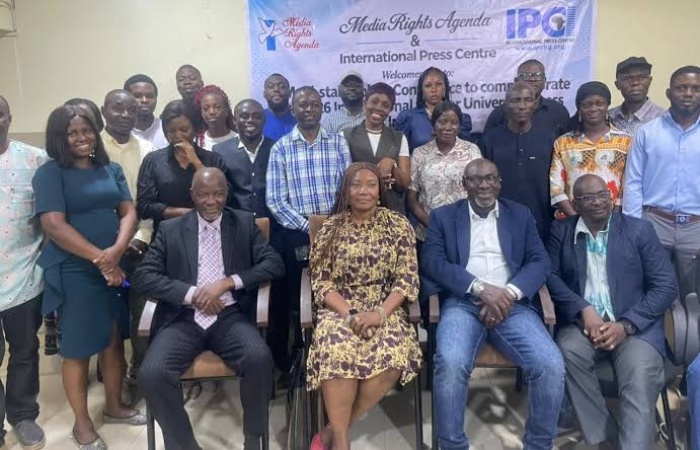
Participants at the 2026 IDUAI observance
By BONIFACE AKARAH
Fifteen years after Nigeria enacted the Freedom of Information (FOI) Act, poor compliance by public institutions and a persistent culture of secrecy are creating information gaps that make it harder for citizens and journalists to distinguish facts from misinformation and disinformation, a multi-stakeholder conference in Lagos has warned.
The warning was contained in a communiqué issued at the close of a conference organised by Media Rights Agenda (MRA) and the International Press Centre (IPC) on September 28, 2026, to commemorate the International Day for Universal Access to Information (IDUAI) 2026. The conference, themed “Freedom of Information in the Age of Disinformation: Why Transparency Matters More Than Ever,” brought together journalists, civil society representatives, lawyers and other stakeholders.
Participants observed that despite the FOI Act being in force for more than 15 years, compliance across the three levels of government remained largely poor, with many public institutions allegedly refusing to respond to information requests, denying requests without legitimate reasons and failing to proactively publish information required by law.
“There appears to be a high degree of ignorance of the provisions of the FOI Act among public officials and members of the public, which continues to hinder usage of the Law and its effective implementation,” the participants said, adding that a pervasive culture of secrecy had made public officials unwilling to disclose even information that posed little or no legitimate sensitivity.
They also identified delays in responding to FOI requests as a major obstacle, particularly when information is required for investigative journalism, public-interest reporting, civic monitoring and other time-sensitive activities.
According to the communiqué, “The frequent absence of timely, reliable information from public institutions creates an information gap that can make it more difficult for citizens, journalists, and other stakeholders to verify claims and distinguish accurate information from misinformation and disinformation.”
The conference further warned that the growing volume and speed of information circulating through digital platforms had made access to authoritative and verifiable information increasingly important to public discourse and accountability. It said information disorder was undermining public trust in government, the media and the wider information environment.
In his welcome address, IPC Executive Director Lanre Arogundade said combating disinformation could not simply be reduced to asking citizens to verify facts, stressing that public institutions also had a responsibility to make credible information available and explain their decisions clearly.
The participants consequently resolved to make more strategic use of the FOI Act in investigative reporting, civic monitoring, research and advocacy, while strengthening collaboration between the media, legal practitioners and civil society organisations.
They also resolved to pursue legal remedies, including litigation where necessary, particularly in cases involving wrongful denial of information requests.
The conference called on governments at all levels to demonstrate stronger commitment to implementing the FOI Act and urged public institutions to establish dedicated FOI desks staffed by trained personnel and proactively publish information in line with Sections 2(3) and 2(4) of the law.
It also called for improved record-keeping and information management systems to ensure that requested information could be identified and accessed promptly.
The participants specifically urged the Attorney-General of the Federation to exercise his oversight responsibilities more rigorously by issuing appropriate directives against officials and institutions that persistently and wilfully violate the Act, including those that wrongfully deny information requests.
They equally called on the judiciary to give expedited hearings and judgments in FOI cases, arguing that delays could undermine the relevance of information eventually disclosed through litigation.
The National Orientation Agency was urged to intensify public enlightenment on the right of access to information, particularly at the grassroots, while media and civil society organisations were encouraged to strengthen cooperation in documenting cases of wrongful denial, delay and other barriers to accessing public information.
The conference also highlighted the gender dimension of access to information, urging stakeholders to address barriers faced by women and other marginalised groups.
In a final call, the participants said “all stakeholders, particularly public institutions, the media, and civil society organisations,” should prioritise transparency and proactive disclosure of accurate information as a critical means of combating misinformation and disinformation and protecting information integrity.
They reaffirmed that access to information remained central to transparency, accountability, public participation and democratic governance, particularly in an information environment increasingly affected by misinformation and disinformation.