
Updating your news feed...
NEWS EXPRESS is Nigeria’s leading online newspaper. Published by Africa’s international award-winning journalist, Mr. Isaac Umunna, NEWS EXPRESS is Nigeria’s first truly professional online daily newspaper. It is published from Lagos, Nigeria’s economic and media hub, and has a provision for occasional special print editions. Thanks to our vast network of sources and dedicated team of professional journalists and contributors spread across Nigeria and overseas, NEWS EXPRESS has become synonymous with newsbreaks and exclusive stories from around the world.












Loading banners
Loading banners...

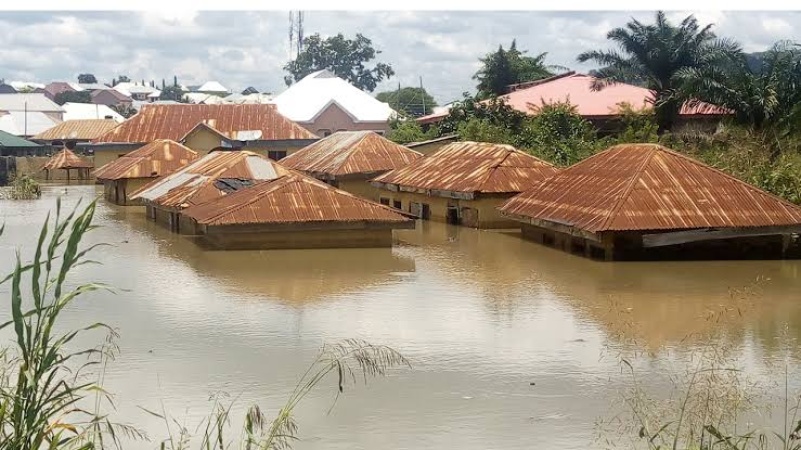
Houses submerged in flood
Stakeholders have decried the devastating impact of erosion and flooding on communities in Kogi, Nasarawa and Niger, with residents calling for urgent and sustained government intervention to protect lives, homes and livelihoods.
A survey conducted by the News Agency of Nigeria (NAN) in selected erosion- and flood-prone communities across the three states showed that expanding gullies and floodwaters had destroyed roads, damaged houses, fences and other infrastructure, displaced residents and disrupted farming and other socio-economic activities.
The survey also revealed that although governments and development partners had commenced various erosion-control and environmental interventions in some affected areas, several communities remained exposed to serious risks.
Residents therefore called for the expansion and sustenance of interventions, as well as stronger preventive measures to address the causes of erosion and flooding.
In Kogi, particularly in Idah and Egbe, residents said erosion had progressively destroyed sections of roads and buildings, while forcing some people to abandon their homes.
In Idah Local Government Area, residents of the settlement behind the Government Technical College, stretching towards Oga Memorial Grammar School in Igalaogba Ward, said erosion had worsened over the years, affecting homes, fences and access roads.
Mrs Hadizat Umoru, a resident, said the erosion had damaged buildings and fences around her residence, while some residents could no longer access their homes because of the expanding gully.
“It has damaged many things around my house, of which some buildings and fences have been affected.
“Some people can no longer gain entry into their houses because the erosion has eaten up everywhere.
“Even in front of my house, we cannot pass by bike or car. It is very bad,” she said.
Umoru said the problem had persisted for about five years and worsened annually, forcing some residents to relocate, while those unable to afford relocation had been compelled to occupy only parts of their houses.
She said residents occasionally contributed money and effort to repair or protect portions of the affected roads, adding that she was not aware of any government intervention to control the erosion in the area.
She attributed the problem partly to the construction of the Idah-Ajaka Road, alleging that its drainage system was inadequate to effectively control the flow of water.
Similarly, Mr Jibrin James, a businessman and resident, said erosion had severely affected homes and access roads in the community.
James said residents had previously contributed to repair a section of the major access road after erosion almost cut it off.
He said officials of the World Bank had visited the area twice to assess the extent of the erosion, including through the use of drone cameras, but remedial work had yet to commence.
According to him, the erosion had continued to deepen, destroying houses and fences and forcing several residents to abandon their homes.
“Currently, it has gone beyond prevention. What we can say now is for proper drainage to be made to allow passage of water.
“The water has made its own way already and there is no way to block water that is flowing. The only way out is to make a passage for free flow,” he said.
Another resident, Mr Salif Musa, a civil servant, said residents had resorted to filling cement bags with sand in an effort to slow the spread of the erosion.
In Egbe, Mr Ayokunle Gbadebo-Olajide, a civil engineer and resident, called for proactive measures to address recurring erosion and flooding.
Gbadebo-Olajide said Egbe, surrounded by mountains and hills, was highly vulnerable to erosion and flooding, particularly during the rainy season.
He said the major road linking the town with neighbouring communities was often affected, disrupting the movement of farm produce and cutting off access to smaller communities.
According to him, erosion and flooding had also washed away streets, exposed building foundations and caused some houses to collapse, thereby disrupting economic activities.
He attributed the recurring problem to inadequate proactive measures, limited funding and the construction of buildings on natural watercourses and flood paths.
Gbadebo-Olajide recalled that a community project supported by a bank had previously constructed a deep drainage system along a section of Egbe, successfully controlling erosion, protecting houses and reclaiming land lost to gullies.
He urged governments and other stakeholders to replicate such interventions in other affected communities.
Meanwhile, Mr Bode Adeyemi, Chairman, Forum of Special Advisers to Gov. Ahmed Ododo and Special Adviser to the governor on Energy Matters, said the state government had made significant interventions in erosion control and other sectors.
Adeyemi said the governor’s interventions were evident across the 21 Local Government Areas, particularly in efforts to address erosion and landslides.
He said ongoing erosion-control projects in Kabba and other parts of the state were life-saving and impactful.
Adeyemi said the state government had reaffirmed its commitment to the Nigeria Erosion and Watershed Management Project (NEWMAP) and the European Investment Bank (EIB)-supported intervention aimed at addressing erosion, flooding and environmental degradation.
He commended President Bola Tinubu for his commitment to environmental sustainability and protection of livelihoods, describing the NEWMAP-EIB intervention as a landmark initiative.
“Erosion and watershed degradation are not abstract problems; they are lived realities for millions of Nigerians.
“They wash away farmlands and roads, displace families and weaken food security. Through NEWMAP, we see a pathway to resilience and sustainable development,” he said.
Adeyemi noted that Kogi’s location at the confluence of the Rivers Niger and Benue made the state particularly vulnerable to flooding and erosion, which continued to threaten farmlands, homes, schools and health facilities.
He urged residents to complement government efforts through tree planting, proper waste disposal and collective protection of watersheds.
In Nasarawa, residents of communities affected by gully erosion commended the state government and development partners for ongoing interventions but appealed for their extension to other erosion-prone areas.
Mallam Suleiman Abdullahi of Doma Local Government Area said the intervention had saved homes, farmlands and roads previously threatened by erosion.
“We are grateful to the government for coming to our aid because before now, roads leading to many houses were washed away and it was very difficult to access our houses but this work has given us hope again,” he said.
Also speaking, Mrs Grace Ezekiel of Angwan Nungu, Lafia, said while the ongoing interventions were commendable, several communities were still battling devastating erosion that had cut off roads and destroyed livelihoods.
“We appreciate what has been done in some areas. But places like Ombi One, Bukan Sidi and others in Lafia are still suffering from gully erosion.
“We are begging the government to expand the project to those areas too,” she appealed.
Responding, Princess Margaret Elayo, Commissioner for Environment, Natural Resources and Mining, said the Gov. Abdullahi Sule-led administration had invested significantly in erosion control.
She said the government had constructed drainage systems and undertaken other erosion-control activities to mitigate further degradation of the soil surface.
Elayo explained that the government, through the Agro-Climatic Resilience in Semi-Arid Landscapes (ACReSAL) project, had carried out several erosion-control activities in Local Government Areas severely affected by erosion.
She said ACReSAL, a World Bank-assisted project, was focused on controlling erosion and using water resources to promote climate-smart agriculture and livelihoods.
According to her, the government had awarded an N10 billion erosion-control contract in Lafia, Doma and Toto Local Government Areas, while efforts were underway to extend the intervention to other affected communities.
She said the projects included drainage construction, gully stabilisation and rehabilitation of degraded lands to prevent further land loss.
Elayo added that ACReSAL was compensating persons affected by the projects, with N2.4 billion paid to beneficiaries in Lafia and Doma and N744 million paid in Toto.
She assured that environmental protection remained one of the top priorities of the Sule administration.
In Niger, the recent collapse of the Yinti Bridge in Katcha Local Government Area has cut off several farming communities from Katcha market and other parts of the state.
A resident, Mallam Baba Yinti, said the bridge was a major link connecting several farming communities to markets in Katcha town.
“The collapse has sparked concerns. This bridge has been neglected by the government over the years,” he said.
Residents and community stakeholders, however, said the collapse should not be blamed entirely on recent flooding, insisting that the bridge was already in a deplorable and dangerous condition before floodwaters worsened the situation.
Another resident, Mr Yahaya Abubakar, described the Yinti Bridge as a critical link connecting Katcha, the Local Government headquarters, and surrounding farming communities to other parts of Niger and the country.
“Its collapse has effectively disrupted movement in and out of the area, raising fears over the impact on residents, farmers and the transportation of agricultural produce. Though there is an old bridge that we are using now but that one is not also in a good condition,” he said.
According to him, the deteriorating condition of the bridge had been visible for some time, raising concerns over why necessary inspections, repairs and rehabilitation were not carried out before the structure reached a critical stage.
The residents maintained that while flooding might have triggered or accelerated the collapse, years of neglect and failure to address the deteriorating infrastructure had contributed significantly to the situation.
They said the development was particularly worrisome because Katcha was predominantly a farming area, adding that the damaged road network could make it difficult for farmers to transport produce to markets and obtain essential goods and services.
They called on the Niger State Government and relevant authorities to urgently restore access to Katcha, assess the extent of the damage and provide a durable solution to the infrastructure challenge.
Dr Ibrahim Hussaini, Director of Information and Linkages, Niger State Emergency Management Agency (NSEMA), said the agency played an advisory role to government and communities on impending disasters, including erosion.
“We carry out hazard identification and risk assessment, as well as sensitisation in collaboration with relevant agencies on the need for people to avoid activities that can lead to erosion,” he said.
Hussaini said attention had shifted from disaster response to proactive strategies, particularly mitigation, prevention and general disaster management.
He assured that NSEMA would sustain its awareness campaigns to prevent erosion and continue to provide support to affected communities. (NAN)




