
Updating your news feed...
NEWS EXPRESS is Nigeria’s leading online newspaper. Published by Africa’s international award-winning journalist, Mr. Isaac Umunna, NEWS EXPRESS is Nigeria’s first truly professional online daily newspaper. It is published from Lagos, Nigeria’s economic and media hub, and has a provision for occasional special print editions. Thanks to our vast network of sources and dedicated team of professional journalists and contributors spread across Nigeria and overseas, NEWS EXPRESS has become synonymous with newsbreaks and exclusive stories from around the world.





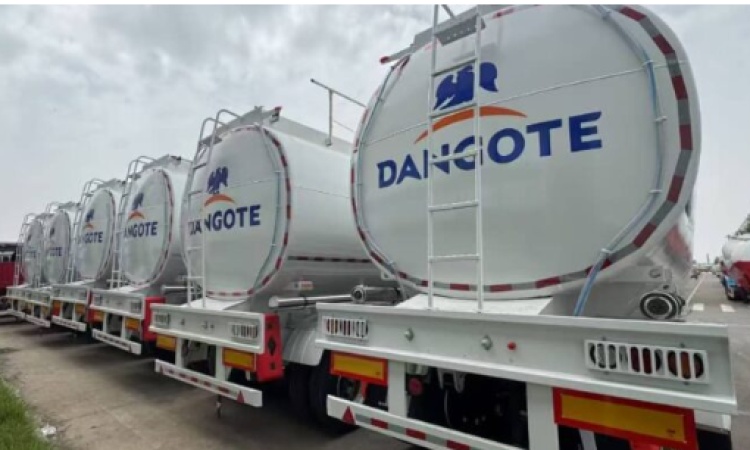

















Dangote Refinery fuel trucks
The Dangote Petroleum Refinery and Petrochemicals now owes approximately N7.9 trillion ($.67 billion) after cutting its secured debt by about N798 billion ($570 million) in the first half of 2026, as the 700,000-barrel-per-day facility ramped up production and strengthened cash generation ahead of its planned Initial Public Offering (IPO).
According to the company’s prospectus, its total debt fell from $6.24 billion at the end of December 2025 to $5.67 billion by the end of June 2026, representing a reduction of $570 million, equivalent to about N798 billion at an exchange rate of N1,400 to the dollar.
The debt reduction comes as the refinery has moved into full-scale commercial operations, with stronger sales and refining margins significantly improving its financial position.
The company’s net debt-to-earnings before interest, tax, depreciation and amortisation ratio stood at 0.27 times at the end of June, according to the prospectus, with the company expecting the ratio to decline further as operations stabilise and cash-flow generation improves.
The improvement in the refinery’s financial position comes ahead of the September 14 opening of its proposed IPO, through which it plans to offer 4.1 billion new shares at N525 each.
But despite the planned share sale, Africa’s largest refinery will remain overwhelmingly controlled by its founder, Aliko Dangote, with his beneficial ownership projected to decline only marginally to 84.34 per cent if the offer is fully subscribed. Bloomberg, Nairametrics and Reuters first extracted the figures.
The prospectus showed that Dangote currently has a disclosed beneficial interest of 87.27 per cent through Dangote Oil Refining Company Limited (DORCL), Dangote Industries Limited (DIL), Greenview International Corporation and a beneficial interest in Salamad Ventures Limited.
The refinery currently has 120.13 billion issued and fully paid ordinary shares. DORCL holds 65.835 per cent, DIL 14.904 per cent, Greenview 6.496 per cent, Nigerian National Petroleum Company Limited (NNPC) 6.815 per cent, while other shareholders account for 5.950 per cent.
Because the IPO involves the issuance of new shares rather than a sell-down by existing shareholders, Dangote’s beneficial interest would remain above 84 per cent after the transaction.
NNPC Limited’s stake would also be diluted only marginally, from 6.815 per cent to about 6.59 per cent. The ownership structure underscores Dangote’s stated objective of using the IPO to widen participation in the refinery rather than relinquish control.
Speaking with journalists in Lagos after an IPO-related signing event, Dangote said the share offering was not primarily intended to raise funds, arguing that the refinery had strong cash generation and had already accessed bonds and private placements.
He also disclosed that strategic investors, including Abu Dhabi National Oil Company (ADNOC), had expressed interest in investing in the refinery, but declined to provide details because of non-disclosure agreements.
The refinery is also taking advantage of disruptions in global petroleum-product markets caused by the continuing conflict involving the United States and Iran.
The refinery is currently operating at its full 700,000 barrels per day capacity and is maximising production of diesel and aviation fuel for the European market, where supplies from the Middle East have been severely disrupted.
David Bird, Chief Executive Officer of Dangote Petroleum Refinery and Petrochemicals, said the facility was “running flat out” at 700,000 barrels per day and had the flexibility to adjust its output depending on market conditions.
“Right now we’re very much maximising our diesel, but the jet is still extremely significant from a yield perspective,” Bird said.
Bloomberg reported that the premium for diesel over crude had risen to its highest level in at least 15 years, making the refinery’s ability to alter its product mix particularly valuable.
Bird said the company remained “extremely bullish” about refining margins over the medium term, although a prolonged Iran conflict could eventually weaken demand and create broader economic consequences.
Despite the unusually strong refining margins generated by the crisis, Dangote said the refinery’s long-term financial projections were not based on the current geopolitical disruption.
“Our own basis of calculation is based on normal days,” he said, stressing that the company had begun preparations for the IPO long before the Middle East crisis. According to him, temporary disruptions could not provide the basis for a business expected to operate for decades.
Besides, Dangote’s proposed 700,000-barrel-per-day refinery in Lamu, Kenya, could face major difficulties securing adequate crude supplies because Kenya currently has no commercial-scale oil production, Reuters reported.
The proposed facility, expected to cost between $15 billion and $16 billion, is scheduled for groundbreaking later this month and is targeted for completion in 2030.
The project has evolved rapidly, with Tanzania initially considered before the company shifted its attention to Mombasa and subsequently Lamu, where the refinery is now expected to be located within the Lamu Port-South Sudan-Ethiopia Transport (LAPSSET) special economic zone.
Dangote Industries Executive Vice-President, Devakumar Edwin, however told Reuters that the company did not see regulatory, financing or feedstock challenges that it could not overcome.
But Brendon Verster, Senior Economist at Oxford Economics, warned that failure to resolve the challenges could leave the project as “a very expensive white elephant.”
One of the biggest concerns is the availability and transportation of crude.
Kenyan President William Ruto’s Chief Economic Adviser has said the refinery could potentially secure up to 600,000 barrels of crude daily from East Africa, including Kenya, Uganda and South Sudan.
However, Reuters reported that none of the potential sources is straightforward. Kenya has proven oil reserves but has struggled for years to commence commercial production, while Uganda’s crude is transported through the East African Crude Oil Pipeline to Tanzania.
South Sudan’s oil exports currently pass through Sudan and have been disrupted by insecurity. A proposed pipeline linking South Sudan and Kenya’s Lokichar Basin to Lamu also remains a distant prospect.
Lagos-based oil and gas lawyer Maximillian Ezeude told Reuters that the situation could leave the refinery dependent on the international seaborne crude market. “That leaves the coastal facility dependent on a volatile international seaborne market,” he said.
The infrastructure at Lamu could compound the problem, with the port currently lacking operational oil-storage terminals.
The LAPSSET project envisages storage capacity of between one million and 1.5 million barrels and marine loading facilities capable of handling Suezmax vessels, but Reuters reported that much of the infrastructure remains unbuilt.
There are also environmental concerns, with the proposed refinery located about 10 kilometres from Lamu Old Town, a UNESCO World Heritage site. Greenpeace Africa has called for the project to be halted over concerns about habitat destruction and marine degradation.
Kenyan authorities, however, see the project as a means of reducing the country’s dependence on imported petroleum products. Kenya spent about $4 billion on petroleum products in 2025, making them the country’s largest import.
Meanwhile, Brent crude crossed the $100-per-barrel threshold yesterday for the first time in months as the US-Iran conflict intensified and concerns over the security of the Strait of Hormuz increased.
The international benchmark briefly breached $100 before slipping back below the threshold, while West Texas Intermediate (WTI) crude traded around $95 per barrel.
Brent remained about 40 per cent above pre-war levels, although still below its early-war peak of about $120.
The latest price surge followed the announcement by the US military that it had destroyed five Iranian oil tankers on Tuesday after Iranian forces attempted to attack a US Navy warship with ballistic missiles.
The vessels destroyed were Kivik, Charminar, Horizon 1, Riesco and Derya, with the latter struck near Kharg Island in the Strait of Hormuz.
Iran subsequently launched missiles towards US targets in Jordan, with Jordan’s military saying its air defence systems intercepted 18 ballistic missiles, while two others fell in uninhabited areas without causing casualties.
The US also imposed fresh sanctions on elements of Iran’s aviation industry as Washington continued efforts to squeeze Tehran economically.
The Strait of Hormuz remains central to the confrontation because about one-fifth of global oil supplies passed through the waterway before the war. (Adapted from a THISDAY report)





