ADAD
ADADUpdating your news feed...

NEWS EXPRESS is Nigeria’s leading online newspaper. Published by Africa’s international award-winning journalist, Mr. Isaac Umunna, NEWS EXPRESS is Nigeria’s first truly professional online daily newspaper. It is published from Lagos, Nigeria’s economic and media hub, and has a provision for occasional special print editions. Thanks to our vast network of sources and dedicated team of professional journalists and contributors spread across Nigeria and overseas, NEWS EXPRESS has become synonymous with newsbreaks and exclusive stories from around the world.





Loading banners
Loading banners...

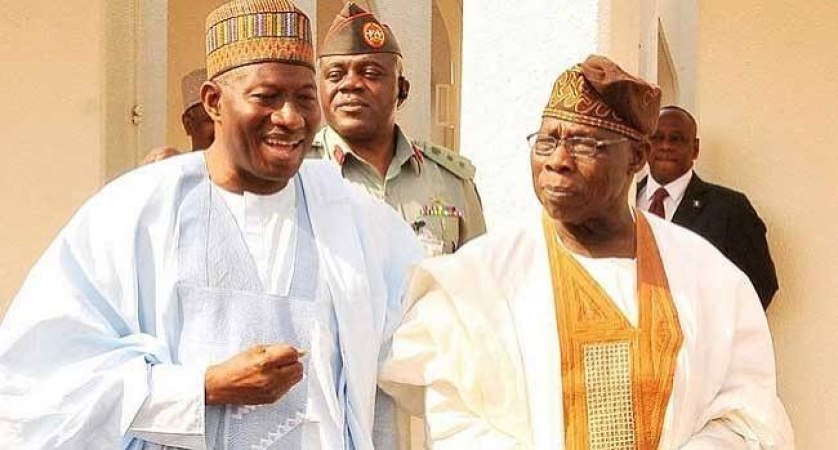
Former Nigerian Presidents Olusegun Obasanjo and Goodluck Jonathan
Former Presidents Olusegun Obasanjo and Goodluck Jonathan, and the Nigeria Democratic Congress (NDC) presidential candidate, Peter Obi, yesterday called for reforms that will foster democracy and protect the judiciary.
They said the reforms should also strengthen the electoral processes, defend democratic institutions, halt political interference and fortify governance structures across Africa.
The leaders spoke at the yearly Goodluck Jonathan Foundation Democracy Dialogue held at the International Conference Centre in Bauchi, capital of Bauchi State, to mark the 11th anniversary of the Goodluck Ebele Jonathan Foundation.
The event, with the theme: “Beyond Elections: Can Political Parties and the Judiciary Save African Democracy?” and co-hosted by Governor Bala Mohammed and Dr. Jonathan, was witnessed by the President of the Court of Appeal, Justice Monica Dongban-Mensem, former Vice President Namadi Sambo, Bayelsa State Governor Douye Diri, judges, lawmakers, constitutional experts and civil society leaders from across the continent.
Liberal democracy unsuitable, says Obasanjo
Obasanjo said the Western liberal democracy inherited by many African countries was ill-suited to African realities because it has encouraged a winner-takes-all political culture.
He said: “The democracy we practise has no African context and no African content. If you try to use what is not meant for you to serve your purpose, it is like a dress for which you are not measured. It will not fit and it will not serve your purpose.”
Obasanjo said the first-past-the-post electoral system had deepened political divisions across the continent, urging African countries to develop democratic systems rooted in their own history, culture and values.
He added: “Call it democracy if you like, or call it African democracy, but it must have African context and African content.”
The former president also said that Nigeria’s diversity should be protected rather than exploited.
He said: “Nigeria is what it is because of our diversity. Remove diversity from Nigeria and you will probably have the Republic of Oduduwa or the Republic of Danfodio, but that will not be Nigeria.”
Jonathan: Nigeria needs to restructure
Jonathan, who co-chaired the dialogue, called for a national debate on the restructuring of governance architecture, saying that the concentration of powers in the presidency had weakened democracy and accountability.
He said: “Probably, we need to go back to the pre-independence and early independence days of having a parliamentary system where powers are shared.
“In Nigeria today, one person has almost all the powers. We need to have more conversations on the structure of leadership in our governance and what model will best suit our unique circumstances.”
Jonathan also criticised the culture of election litigation, describing it as unusual compared with many African democracies where elections are largely settled at the ballot box.
He added: “The Nigerian situation is extremely different from most other African countries. The kind of election litigations we experience here is uncommon.”
Jonathan warned that public confidence in political judgments had declined, adding that highly controversial electoral disputes should, in some cases, be returned to the electorate.
He stressed: “In some highly controversial cases, it is better for the election to go back to the people.”
‘Courts and judiciary in crisis’
Obi warned that Nigeria was facing a deepening crisis of electoral integrity and judicial credibility, lamenting that the standards that once characterised the country’s judiciar have been eroded.
He said: “I was in court for three years challenging my election. Five judges that I never met gave judgment in my favour. It cannot happen in Nigeria today.”
He accused sections of the political and legal establishment of undermining democracy.
Obi said: “We have a crisis. Professors are now aiding illiterates to rig elections. Lawmakers have removed forgery as an offence in electoral matters. Senior Advocates of Nigeria are defending forgery, and religious leaders are praying for criminal politicians for blessings.”
Justice Dongban-Mensem called for stronger democratic institutions, constitutionalism and judicial independence, saying they are essential pillars for consolidating democracy across Africa.
Justice Dongban-Mensem, who was represented by Justice Mistura Bolaji, said the dialogue was exceptionally timely in view of the continent’s political, technological and socio-economic challenges.
She said: “The strength of democratic governance is at all times anchored in strong and robust institutions, dedicated adherence to constitutionalism, respect for the rule of law, and an enduring commitment to justice, accountability and the peaceful resolution of disputes.”
The jurist described the judiciary as the impartial interpreter of the law, the guardian of the constitutional order and the protector of the rights and liberties of citizens.
She said political parties are the primary vehicle for democratic participation, political representation and leadership development, while both institutions share a responsibility for preserving democratic legitimacy.
Justice Dongban-Mensem added: Their respective constitutional mandates, though distinct, converge in the shared responsibility of preserving democratic legitimacy and sustaining public confidence in governance.”
The judge commended Jonathan for sustaining the Goodluck Jonathan Foundation Democracy Dialogue, describing it as a respected continental platform for democratic reflection and policy engagement.
She added: “Through this important initiative, the foundation continues to make profound contributions to Africa’s democratic development by promoting peaceful transitions, accountable governance, credible elections and the strengthening of resilient institutions.”
On true federalism I stand, says Diri
Diri called for true federalism and constitutional reforms that would allow states to harness their resources, reduce dependence on federal allocations and promote balanced national development.
He said Nigeria needed to correct some of its structural imbalances to make the country beneficial to its citizens.
Citing Bayelsa as a case study, the governor said the injustice in resource exploitation, particularly crude oil, and the attendant lopsidedness in national revenue distribution, had continued for decades.
Diri faulted a situation where the state with only eight local government areas had revenue from its resources shared in Abuja to states without oil but had more local governments.
He said there is a relationship between resource exploitation and insecurity in the country, noting that the mining of gold in some states in the north had been followed by heightened insecurity in those states.
Diri said: “To my mind, democracy is built on three pillars – justice, equity, and fairness. And I believe that we missed the road of democracy in Nigeria long ago because there is no justice. There is injustice where Oloibiri, the oil community in Bayelsa that made Nigeria a commercial oil producing country, remains a shadow of itself.
“It is ironical that at the end of every month, all our states go to Abuja to share oil money. I do not think that is what democracy is all about. For instance, Southern Ijaw, an oil-rich local government area in my state that brings so much money to Nigeria, had no road access for more than 60 years until I invited former President Obasanjo, who graciously came to inaugurate a project there.
“This local government also had no access to its headquarters until recently that my administration constructed a 630-meter bridge across a river to the place.
“Also, to my mind, there is total injustice where my state has just eight local government areas. Some other states have 40 or more. But, the resources from my state are shared to those local government areas from my eight. No matter who becomes president, this injustice and unfairness continue. Resources are being expropriated.
“Today, there is gold in Zamfara and other northern states. And what do we experience? Insecurity. Most of the insecurity has been traced to the discovery of gold in that far north.
“So, my dear leaders, my conclusion is that for democracy to thrive in Nigeria, there must be true federalism. Until we begin to practice federalism, we will have some pseudo-democratic, pseudo-autocratic, and sometimes even a tyrannical government in this country.”
Sen. Bala Mohammed said democracy cannot be sustained by elections alone, adding that accountable political parties and an independent judiciary are critical to protecting democratic governance.
He commended Jonathan for his commitment to peacebuilding, the rule of law and institutional strengthening across West Africa.
Mohammed said: “Your Excellency, former President Jonathan, your unwavering commitment to peacebuilding, the rule of law and institutional strengthening across West Africa remains an inspiration to all of us.”
The governor said the dialogue has become a beacon of hope for democratic governance on the continent and a forum for advancing discussions on institutional reforms, peace and political stability.
Mohammed noted that the event resonated with the democratic legacy of Nigeria’s founding leaders, including the first Prime Minister, Sir Abubakar Tafawa Balewa.
He also acknowledged the contributions of Obasanjo to national unity and democratic development.
He said bringing the dialogue to Bauchi was a recognition of the state’s ongoing efforts at promoting peace, inclusive growth and political stability within the sub-region.
The governor said democracy must be understood beyond electoral rituals.
Mohammed added: “The theme shifts focus from the ballot box to the institutional pillars required to safeguard what is sacred.
“Democracy needs more than election ritual. It requires ideological, accountable political parties and an independent, reliable judiciary that safeguards the rule of law and public trust.”
He warned that democratic systems across Africa were increasingly being challenged by socio-economic pressures, technological disruptions and security threats.
Mohammed said: “Across our continent, democracy is tested by socio-economic pressures, technological disruption and security complexities.
“Yet gatherings like this remind us that the ultimate solution for democracy is more democracy—deepened by dialogue, sustained by strong institutions and validated by tangible governance dividends for our citizens.” Professor of Development Studies at the University of Nairobi, Kenya, Prof. Karuti Kanyinga, urged African governments to depoliticise the judiciary, warning that courts had increasingly become political battlegrounds.
He said: “We turn the judiciary into another political battlefield. We are asking the judiciary to arbitrate disputes that we have been unable to resolve politically.”
Kanyinga said judges across Africa are subjected to intimidation, political pressure and bribery, adding that justice had become commercialised in many countries.
“The courts across the continent have become commodified,” he said.
He urged governments to protect judges from political interference and strengthen judicial independence as a foundation for democratic governance.
Kayingba said: “We need to start thinking very carefully about what can be done in society to protect our courts and our judges from intimidation by politicians and make them as independent as they should be.”
The dialogue was attended by former Senate President Anyim Pius Anyim, former Plateau State Governor Jonah Jang, retired Supreme Court Justice Amina Augie, Ghana’s National Democratic Congress Chairman Johnson Asiedu Nketia, former ECOWAS Commission President Kadre Desire Ouedraogo, and former Resident Electoral Commissioner Mike Igini.
Bauchi Emirate confers Jigon title on Jonathan
Before the commencement of the event, Jonathan was installed as the ‘Jigon Bauchi’ by the Bauchi Emirate Council in recognition of his contributions to democracy, peace and national unity in Nigeria.
The title was conferred by the Emir of Bauchi, Dr. Rilwanu Sulaiman Adamu, during a colourful turbaning ceremony held at the Emir’s Palace in Bauchi.
Mohammed thanked the Emir for honouring Jonathan, saying the recognition reflected the former president’s enduring role in promoting democratic governance and peaceful coexistence across the country.
He said Jonathan’s leadership and commitment to national stability had earned him respect beyond political and regional boundaries.
Jonathan expressed gratitude to the Emir and the people of Bauchi State for the honour, describing the title as a privilege he would cherish.
He said: “I deeply appreciate this honour and the confidence reposed in me by the Bauchi Emirate. I will respect the customs and traditions of the Emirate Council and uphold the values associated with this title.”
The Emir described Jonathan as a leader whose conduct in public office and dedication to peace had remained exemplary. (The Nation)