Updating your news feed...
NEWS EXPRESS is Nigeria’s leading online newspaper. Published by Africa’s international award-winning journalist, Mr. Isaac Umunna, NEWS EXPRESS is Nigeria’s first truly professional online daily newspaper. It is published from Lagos, Nigeria’s economic and media hub, and has a provision for occasional special print editions. Thanks to our vast network of sources and dedicated team of professional journalists and contributors spread across Nigeria and overseas, NEWS EXPRESS has become synonymous with newsbreaks and exclusive stories from around the world.


















.webp)







Loading banners
Loading banners...

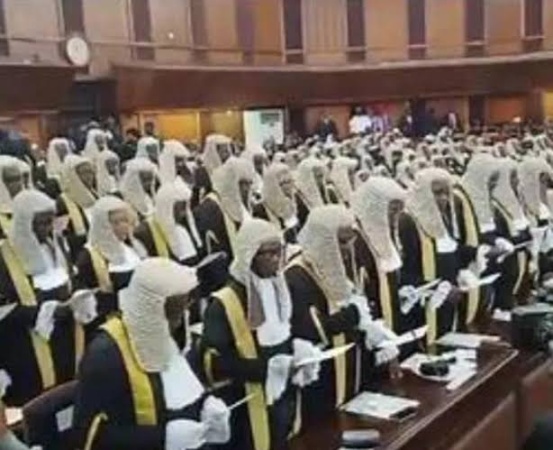
PHOTO OF LAWYERS
Recent judgment of the Court of Appeal setting aside an earlier ruling by the Federal High Court ordering the deregistration of the African Democratic Congress, ADC, and four other political parties has once again raised concerns over how court judgments are sometimes deployed in ways critics say frustrate the rule of law and undermine the democratic process.
The latest example came on Tuesday when the Court of Appeal delivered one of its strongest judicial rebukes in recent history, overturning the judgment of Justice Peter Lifu of the Federal High Court, Abuja, in the suit seeking the deregistration of ADC and four other political parties.
The appellate court’s verdict, which firmly faulted the trial judge’s handling of the case, has been widely viewed as a significant reaffirmation of judicial discipline and adherence to due process. It also reignited debate over the implications of conflicting court decisions, particularly in politically sensitive matters where such rulings could alter the nation’s democratic landscape.
The courtroom is often described as the last hope of the common man.
Yet, there are occasions when judgments delivered by lower courts have themselves come under severe attack from superior courts.
In such cases, the Court of Appeal and the Supreme Court have not merely set aside decisions; they have openly criticised the reasoning, conduct and approach of the judges who delivered them.
Over the years, Nigeria’s appellate courts have repeatedly warned that justice is not achieved simply by delivering a judgment.
Rather, it is attained when judges faithfully apply the law, respect judicial precedents and remain within the limits of their constitutional powers.
The latest example happened last week when the Court of Appeal delivered one of its strongest rebukes in recent judicial history against Justice Peter Lifu of the Federal High Court, Abuja.
ADC deregistration case
The Court of Appeal’s judgment in the suit seeking deregistration of ADC and four other political parties stands as one of the strongest judicial rebukes in recent years.
In a unanimous decision delivered on July 28, 2026, the appellate court not only nullified the judgment of the Federal High Court but also criticised the conduct of the trial judge, Justice Peter Lifu, for disregarding a subsisting order of the court.
Lifu had, on June 15, 2026, ordered the Independent National Electoral Commission, INEC, to deregister ADC, Action Alliance, AA, Action Peoples Party, APP, Accord Party and Zenith Labour Party, ZLP, holding that they had failed to satisfy the constitutional requirements for continued registration.
He also restrained INEC from recognising the parties or accepting candidates nominated by them for the 2027 general elections.
However, the Court of Appeal held that the judgment was a nullity because it was founded on an incompetent suit filed by the National Forum of Former Legislators (NFFL), a body that lacked the legal capacity to institute the action.
Justice Lifu
Delivering the lead judgment, Justice Abba Mohammed held that the trial court wrongly assumed jurisdiction, ignored uncontroverted evidence showing that the affected parties had won elective offices, and failed to properly evaluate the evidence before it.
The appellate court further held that Justice Lifu acted in defiance of its earlier order directing him to stay proceedings pending the determination of the appeal.
Describing his conduct as “a form of judicial impertinence,” the court recalled the Supreme Court’s warning that a judge who deliberately disregards the order of a superior court is “unfit for the bench,” adding that such conduct amounts to “judicial rascality.”
Setting aside the Federal High Court’s decision in its entirety, the Court of Appeal restored the legal status of the five political parties, holding that they remain duly registered under the Constitution and the Electoral Act.
The judgment reaffirmed the supremacy of judicial hierarchy, stressing that no lower court has the authority to ignore or sidestep the orders of a superior court.
Plateau election
Similarly, the Supreme Court delivered one of its strongest corrections of an appellate decision when, in 2024, it overturned the Court of Appeal’s judgment sacking Plateau State Governor Caleb Mutfwang who had been elected on the platform of the Peoples Democratic Party, PDP. The Court of Appeal had nullified the governor’s election on the grounds that the PDP lacked a valid party structure to sponsor him.
But in a unanimous judgment on January 12, 2024, the Supreme Court held that the appellate court had ventured into matters completely outside its jurisdiction.
Delivering the lead judgment, Justice Emmanuel Agim ruled that the nomination of candidates and the conduct of party congresses are internal affairs of political parties which cannot be challenged by rival political parties in an election petition.
Describing the proceedings that culminated in the Court of Appeal’s decision as “a clear abuse of court process,” Justice Agim restored Mutfwang’s election and reaffirmed that only an aspirant who participated in a party’s primary has the legal standing to challenge its nomination process.
He further expressed concern over the implications of the appellate court’s reasoning, warning that “the legal profession should wake up or it will render itself irrelevant in the eyes of the people with this type of judgment from the Appeal Court.”
The apex court’s decision not only reinstated Mutfwang but also effectively dismantled the legal foundation upon which several PDP lawmakers had earlier lost their seats.
The judgment has since become a leading authority on the limits of judicial intervention in the internal affairs of political parties and a reminder that courts must remain within the bounds of their constitutional jurisdiction.
Kano governorship appeal
In this case, the Supreme Court delivered another scathing assessment of a lower court judgment when it restored the election of Kano State Governor Abba Kabir Yusuf, setting aside the concurrent decisions of the Election Petition Tribunal and the Court of Appeal, which had nullified his victory.
The lower courts had deducted over 165,000 votes from Yusuf’s on the grounds that the ballot papers were not stamped or signed by the Independent National Electoral Commission (INEC), a decision that handed victory to the APC candidate.
However, in a unanimous judgment delivered on January 12, 2024, the Supreme Court held that both courts had fundamentally erred in law.
Delivering the lead judgment, Justice John Okoro declared that “the law and natural justice were turned upside down” by the tribunal and the Court of Appeal in arriving at what he described as an “unjust and unfair decision.”
He added that “miscarriage of justice in the way and manner the petition was handled was manifest,” before setting aside the two judgments and restoring Yusuf as the duly elected governor.
The decision reinforced the principle that election petitions must be determined strictly in accordance with the Electoral Act and admissible evidence, not on assumptions or technical interpretations unsupported by law.
It also underscored the Supreme Court’s readiness to correct lower court decisions where the application of the law results in a clear miscarriage of justice.
Amaechi VS INEC
Perhaps no election case better illustrates judicial correction than Amaechi VS INEC.
Before the 2007 governorship election in Rivers State, the PDP substituted Rotimi Amaechi with Celestine Omehia after Amaechi had emerged from the party primary.
Although Omehia won the election, Amaechi challenged the substitution, arguing that it violated the Electoral Act. Both the Federal High Court and the Court of Appeal failed to give him the relief he sought.
The matter eventually reached the Supreme Court. In a landmark judgment delivered by Justice Aloysius Katsina-Alu, the apex court held that the PDP acted illegally by replacing Amaechi without lawful justification.
More importantly, the court declared that elections are won by political parties under the Nigerian constitutional framework then in force and that since the PDP won the election, the rightful beneficiary was Amaechi, who had been unlawfully excluded.
The Supreme Court consequently removed Omehia from office and ordered that Amaechi be sworn in as Governor of Rivers State.
The judgment fundamentally changed Nigerian electoral jurisprudence. It also served as a correction of the earlier decisions that failed to protect the rights of a candidate validly nominated by his political party.
That case is still regarded in the legal circle as one of the boldest demonstrations of the Supreme Court’s willingness to overturn lower court decisions that fail to uphold constitutional principles.
Ladoja VS INEC
The impeachment of former Oyo State Governor Rashidi Ladoja also produced a major judicial rebuke.
In January 2006, members of the Oyo State House of Assembly loyal to the late Chief Lamidi Adedibu purportedly impeached Ladoja.
The impeachment proceedings were conducted by only a fraction of the lawmakers, contrary to the constitutional requirement. While the political crisis persisted, questions arose over whether the impeachment complied with Section 188 of the Constitution.
When the dispute reached the Supreme Court, the apex court held that the constitutional procedure for removing a governor had been flagrantly violated. The court ruled that the impeachment was unconstitutional, null and void because the mandatory constitutional requirements had not been observed.
The Supreme Court restored Ladoja to office, stressing that constitutional safeguards were designed to prevent arbitrary removal of elected officials.
Although the decision focused on constitutional interpretation, it also sent a powerful message to lower courts handling politically sensitive disputes that courts must insist on strict compliance with constitutional provisions instead of validating actions tainted by procedural irregularities.
The judgment remains one of Nigeria’s leading authorities on constitutional supremacy and due process.
CSOs, lawyers
Given that judicial interference with the electoral process is becoming a norm, there are worries about its negative impact on the rule of law.
Some senior lawyers and Civil Society Organizations, CSOs, told Sunday Vanguard that the trend must be stopped, while judges found enabling such should be sanctioned by the National Judicial Council (NJC).
Speaking extensively on the matter, they cautioned that the judiciary shouldn’t be weaponised against any segment of Nigerians.
A human rights lawyer, Idris Faro, said the judiciary should protect the Constitution, because it remains the ground norm of the land and should always be rightly interpreted liberally.
He said: “In the hierarchy of courts, a Judge of the High Court of the states or Federal High Court is bound by the decision of the Court of Appeal.
“The Court of Appeal is bound by the decision of the Supreme Court. Where the appellate court makes an order staying the proceedings of a High Court, the judge of the High Court is duty bound to stay proceedings in his court. “Where he fails to do so, it amounts to judicial rascality. The Court of Appeal was right to hold so.
“The NJC is the body that recommends legal practitioners for appointment as judges and disciplines them. NJC acts upon petitions submitted to it and sanctions any judicial officer who is guilty of misconduct.
“A judge cannot be disciplined for erroneous judgment. He can only be disciplined for misconduct like in this case where the order of the court above was disobeyed.
“Judges of our superior courts who adjudicate on constitutional matters must always remember that the Constitution is the ground norm of the land and must always be interpreted liberally.
“All statutes derive validity from the Constitution. So when determining the rights of individuals and entities, a liberal interpretation of the provisions of the Constitution must be adopted.
“This has been the approach of the Supreme Court for years.
Non-juristic
“Democracy is a concept that allows people of divergent views or political leanings to associate and form political parties.
“Granted that the law provides for registration of political parties, it is antithetical to democratic norms to deregister any party for failing to win an election.
“Political parties around the world endlessly woo the electorate and the fact that they lose today doesn’t mean they cannot win later. An unserious party will eventually die a natural death.
“The judgment of the Court of Appeal, to my mind, is sound. A non-juristic person cannot maintain an action in court. The Association of Former Legislators was found to be a non-juristic person. It is not a natural person and does not have the legal personality granted by law.”
Superior orders
Another human rights lawyer, Toluwa Odekhe, noted: “The underlying legal point is uncontroversial and well settled: once an appellate court issues a stay of proceedings, a trial judge has no discretion to proceed regardless of his own view of the merits.
“This is not a matter of political preference; it is the ordinary operation of the hierarchy of courts, which exists precisely so that the judicial system speaks with one voice rather than several competing ones.
“What should be done urgently is for the National Judicial Council (NJC) to investigate where a judge is publicly found by an appellate court to have defied a subsisting stay order, that is a disciplinary matter, not merely a legal one to be corrected on appeal.
“The NJC’s disciplinary process exists for exactly this scenario, and prompt, transparent action, rather than silence, is what restores public confidence.
“Faster appellate mechanisms for pre-election matters: A good part of the disorder in cases like this stems from the compressed timelines around elections colliding with ordinary litigation timelines.
“Nigeria’s courts have periodically called for expedited hearing rules for election and pre-election disputes; this episode strengthens that case.
“Clearer consequences for disobedience of stay orders, potentially including mandatory referral to the NJC as a matter of course, not judicial discretion, whenever an appellate court makes a finding of this kind.
“I strongly recommend to judges on the sanctity of judgments because under a democratic dispensation, a few principles bear repeating: Obedience to superior orders is not optional. A trial judge who disagrees with a stay order may say so in writing and let the appellate process correct it, but proceeding regardless undermines the very idea of an appellate hierarchy.
Optional
“Judgments affecting political contestation carry special weight. Where a ruling can determine who appears on a ballot, judges should be acutely conscious that the judiciary’s legitimacy depends on being seen as adjudicating disputes rather than settling them, a concern several public figures have raised in this case, cautioning that political contests should be won at the ballot box and not in court.
“Reasoned, evidence-based rulings: The appellate court found that the trial court had failed to properly evaluate the evidence before it, a reminder that judgments, especially ones with far-reaching consequences, must be anchored in a careful evaluation of the record, not expedited conclusions.
“Judicial restraint and humility: Respect for precedent and for the decisions of superior courts is not a constraint on judicial independence; it is what judicial independence is for: an independent judiciary that still operates as a coherent system, not as isolated actors each pursuing their own view of justice”.
Nullification
Another lawyer and human rights advocate, Patrick Onoja, described the decision of the Court of Appeal as correct, necessary and timely, while he recommended on how to best purge the judiciary.
Onoja said: “My view is that the Court of Appeal decision was correct, necessary, and timely. Here’s why in three clear points: It protected the hierarchy of courts.
“May 22 stay order was in place from the Appeal Court itself. For the Federal High Court to still deliver judgment on June 15 was a direct breach of judicial discipline.
“If lower courts can ignore higher courts, then the entire system collapses. The Appeal Court had to step in and say ‘this cannot stand.’
“Calling it ‘judicial impertinence’ and ‘judicial rascality’ was harsh, but it reflects Supreme Court precedent on the same conduct.
“It protected democratic space. Deregistering ADC and four other parties is not a small administrative matter. “Under Section 40 of the 1999 Constitution, freedom of association includes forming and belonging to political parties. To remove parties on the eve of 2027 based on an incompetent suit sets a dangerous precedent.
“The Appeal Court restored those parties and forced everyone back to due process.
“It sent a signal on accountability – By using such strong language and nullifying the judgment in its entirety, the Appeal Court told judges, lawyers, and litigants: Stay orders are not suggestions. Jurisdiction matters and political cases will be scrutinized strictly.
“The caveat: While the decision was right, the fact that we got here at all is the problem. The judiciary must now follow up. The NJC needs to investigate, and the CJN should issue clear practice directions so no judge tries this again.
Rascality
“The Court of Appeal’s use of ‘judicial rascality’ is strong language, but it was not used in a vacuum. Legal basis for the phrase, that term comes directly from Supreme Court precedent.
“The Supreme Court has used ‘judicial rascality’ to describe situations where a lower court judge acts in defiance of superior court orders or proceeds without jurisdiction.
“So the Appeal Court was applying existing judicial doctrine, not inventing new insults.
“Substantively correct: The conduct described meets the legal definition the Supreme Court gave for ‘judicial rascality’ — proceeding despite a stay and lack of jurisdiction.
“Institutionally necessary: The judiciary polices itself through words like this. If appellate courts stay silent, disobedience becomes normal. “
However, he said, “Words alone are not enough. For sanctity to be preserved, the NJC should now take up any petition and make a determination. That completes the loop from condemnation to accountability.
“The risk of strong language must always be tied to clear law and facts; otherwise it can be seen as personal.
“In this case, the Appeal Court cited authority and tied it to specific acts, so it remains within judicial bounds”.
He also advised what should be done urgently to end this trend in the judicial system, especially in lower courts that are found wanton in ignoring superior court orders and giving consequential judgments without jurisdiction.
Onoja added that the system needs urgent and practical action, and not just speeches.
Meanwhile, he recommended: “Before you write a single paragraph, ask: ‘Do I have the power to hear this?’
“In the ADC case, the Appeal Court found the suit was incompetent. When courts take matters they have no jurisdiction over, especially political ones, it looks like the judiciary is being used as a political tool. Sanctity starts with restraint.
“Obey the hierarchy without exception: A stay order from the Court of Appeal or Supreme Court is not advice. It is a command until set aside.
Reforms
Meanwhile, a renowned civil society organization, International Press Centre, IPC, tasked the judiciary to begin the reform to restore confidence in Nigerians from its own system.
The Executive Director, IPC, Lanre Arogundade, said: “Fundamentally speaking, the reform can only come from within the judicial system itself, with the judiciary deciding if it wants to err on the side of the law or make pronouncements that tend to defer to vested political interests.
“The appellate system exists precisely to ensure that mistakes are reviewed and corrected in accordance with the law.
“At the same time, the circumstances leading to such strong judicial criticism should serve as an opportunity for institutional reflection within the judiciary.
“The focus should not merely be on correcting individual judgments but on preventing avoidable inconsistencies that undermine public confidence.
“Ultimately, Nigerians expect a judiciary that is impartial, competent, predictable, and courageous enough to uphold justice without fear or favour.
“Judicial pronouncements should inspire confidence, promote constitutional order, and reinforce the credibility of democratic institutions.
“As Nigeria prepares for future electoral contests and other politically significant disputes, the judiciary must remain above partisan considerations and continue to demonstrate that justice is administered according to law, not according to political expediency or external influence.” (Sunday Vanguard)