Updating your news feed...
NEWS EXPRESS is Nigeria’s leading online newspaper. Published by Africa’s international award-winning journalist, Mr. Isaac Umunna, NEWS EXPRESS is Nigeria’s first truly professional online daily newspaper. It is published from Lagos, Nigeria’s economic and media hub, and has a provision for occasional special print editions. Thanks to our vast network of sources and dedicated team of professional journalists and contributors spread across Nigeria and overseas, NEWS EXPRESS has become synonymous with newsbreaks and exclusive stories from around the world.




















Loading banners
Loading banners...

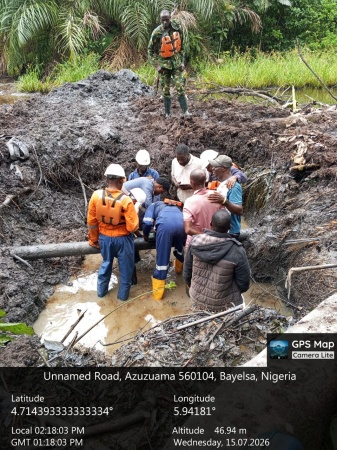
Site of the oil spill in Azuzuama community of Bayelsa State
The joint investigation on an oil spill at Azuzuama community in Southern Ijaw Local Government Area of Bayelsa has triggered a dispute with residents disputing and rejecting the Joint Investigation Visit (JIV) outcome.
JIV is a statutory investigation that probes the cause, estimated spill volume and impacted area, forming the basis of compensation after spill incidents.
The JIV convened by the operator, consists of Representatives of the operating oil firm, regulators, host community and State Ministry of Environment.
The spill occurred on June 25 along Oando’s six-inch Azuzuama-Tebidaba flowline.
A field report by Environmental Conservation Agriculture and Rural Development (ECARD) said the conclusion that the June 2026 spill discharged large volumes of crude into the community was caused by ‘induced corrosion’ irked the host community.
The divergent views held by the regulators, operator and representatives of the host community has therefore rendered the JIV inconclusive.
Engr. Reuben Enai, Director of Petroleum and Pollution, Bayelsa Ministry of Environment, who participated in the joint investigation said that the rupture resulted from induced corrosion.
Enai explained that visual examination of the crude delivery pipeline shows burn marks on the pipeline coating suggesting acid had been deliberately applied, causing corrosion at the top section of the pipe.
He argued that natural corrosion could not have produced damage at the 12 o’clock (top) position of the pipeline.
However, the host community leaders insist the spill resulted from equipment failure and corrosion, rejecting Oando’s conclusion that it was caused by induced corrosion linked to sabotage.
The disagreement persisted despite several JIVs involving Oando, the National Oil Spill Detection and Response Agency (NOSDRA), Bayelsa Ministry of Environment and community representatives.
ECARD, an environmental protection focused group said the latest inspection on July 15 still failed to secure consensus, leaving the official cause of the spill disputed.
Azuzuama Community Development Committee Chairman, Angasei Perediseghebofa, said visible rust on the exposed pipeline indicated corrosion.
He alleged that testing devices introduced by Oando malfunctioned during inspections, preventing a credible determination of the spill’s cause.
The committee’s Vice Chairman, Uyabara Boneghen, questioned the reliability of the testing equipment after it reportedly produced identical readings at different locations.
Boneghen also pointed to a second leak beneath a platform in the river, saying bubbling gas raised additional environmental concerns that remain uninvestigated.
The latest spill has revived painful memories of the July 9, 2015 tragedy at the same Azuzuama pipeline corridor.
A total of 14 people, including personnel from NOSDRA and the Bayelsa State Ministry of Environment, were killed during a Joint Investigation Visit and pipeline repair after an explosion engulfed the site.
The disaster remains one of the deadliest pipeline-related incidents in the Niger Delta and continues to influence community distrust during spill investigations.
ECARD urged Oando to immediately contain the spill, clean up contaminated areas and repair the underwater leak to prevent further environmental damage.
The organisation also called for a separate investigation into the underwater leak, warning that prolonged hydrocarbon discharge could worsen pollution of the community’s aquatic ecosystem.