ADAD
ADAD
Updating your news feed...
NEWS EXPRESS is Nigeria’s leading online newspaper. Published by Africa’s international award-winning journalist, Mr. Isaac Umunna, NEWS EXPRESS is Nigeria’s first truly professional online daily newspaper. It is published from Lagos, Nigeria’s economic and media hub, and has a provision for occasional special print editions. Thanks to our vast network of sources and dedicated team of professional journalists and contributors spread across Nigeria and overseas, NEWS EXPRESS has become synonymous with newsbreaks and exclusive stories from around the world.







Loading banners
Loading banners...

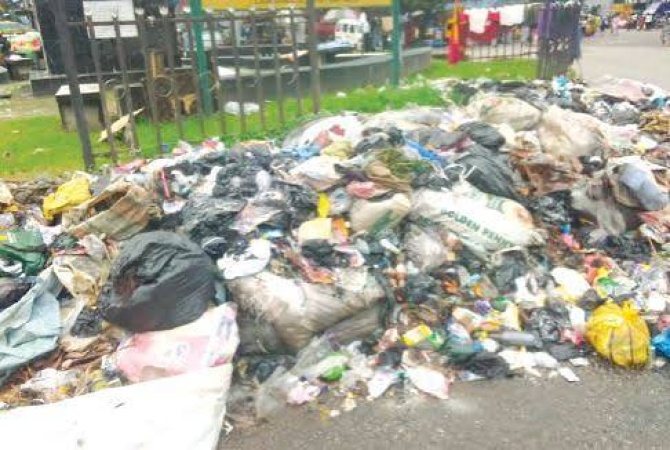
Heaps of refuse in Lagos
“Lagos is gradually going back to reclaim the number one spot as the dirtiest state in Africa. Everywhere is now dirty and smelling.” The lament by Joseph Akpan, a trader at Ikotun Market in the Igando-Ikotun Local Council Development Area (LCDA), captures the growing frustration of many residents as heaps of refuse continue to pile up across Nigeria’s commercial capital.
These are definitely not the best of times to live in Lagos. Besides grappling with persistent flooding caused by heavy downpours across the metropolis, residents are now contending with a worsening waste management crisis. Many say they are finding it increasingly difficult to dispose of their refuse properly, while the city’s once-prized aesthetics are steadily being destroyed.
Unfortunately, no area appears to be spared. From Iyana Ipaja and Agege to Ikeja, the state capital, and the streets of Lagos Island, refuse is being indiscriminately dumped in public spaces. Meanwhile, the once-ubiquitous Private Sector Participation (PSP) waste disposal trucks appear to be disappearing from the roads.
To discerning observers, Africa’s leading commercial hub is increasingly struggling with a growing waste management crisis. Across the state, from major highways and busy markets to residential streets and public medians, heaps of uncollected refuse have become a common and disturbing sight.
Accompanying the growing mountains of waste is a persistent stench hanging heavily in the air, raising concerns among residents about the environmental, health and aesthetic consequences of a city gradually losing its battle against filth.
“Everywhere is now dirty and smelling. The market here is filled with refuse and stench. Traders inhale polluted air every day. The air we breathe is polluted by the smell from heaps of refuse and filth,” said Joseph Akpan, a trader at Ikotun Market in the Igando-Ikotun LCDA.
Like Akpan, many residents believe the worsening situation presents a troubling contradiction in a state that prides itself as Africa’s leading megacity. Across several local government areas and LCDAs, refuse spills onto major roads, blocks drainage channels and encroaches on public spaces despite repeated assurances from government agencies that measures are being taken to address the challenge.
As complaints mount, residents are increasingly questioning whether the state’s existing waste management framework can cope with the demands of a rapidly growing population and the rising volume of waste generated daily.
Just recently, the state government, in an effort to rid Lagos of refuse, inaugurated a task force to enforce environmental laws alongside a specialised “Waste Police” unit to monitor roads, bus stops and motor parks.
The government also established a 24-hour surveillance task force and revived the monthly environmental sanitation exercise as part of efforts to clear mounting refuse and prosecute offenders.
Many residents, however, believe that despite the government’s renewed enforcement measures aimed at restoring environmental sanity and ensuring a cleaner and healthier state, heaps of refuse have continued to grow, raising health concerns, environmental hazards and fresh questions about the effectiveness of the state’s waste management system.
For Eyiwumi Akinwalere, a student who lives around Onike-Iwaya, government is merely playing to the gallery because many of its recent pronouncements on environmental laws are difficult to enforce.
“How equipped are these men of the Waste Police to carry out 24-hour monitoring? Just recently in my area, many residents seized the opportunity of Tuesday’s rains to empty their refuse into nearby canals. How could the Waste Police have monitored that when they are not omnipresent? The people who should have seen and acted appeared unconcerned, so what are we talking about?” she asked.
She argued that people often resort to self-help when they have very limited options for disposing of their waste.
“In fact, that is why you see refuse on road medians. Many people would ordinarily have preferred to wait for PSP operators, but since they are no longer as active as they used to be, what do you expect them to do? Live with the refuse?” she asked.
Commenting on the development, the chairman of a Community Development Committee (CDC) in the Akinola area of Aboru, Agbado Oke-Odo LCDA, who requested anonymity, said government should ensure that PSP operators resume effective service.
“For the past few weeks, we’ve hardly seen them, whereas the agreement is that they should come at least twice a week. In that situation, how are residents expected to dispose of their refuse?” he asked.
Public health warning
Chairman of the Nigerian Medical Association (NMA), Lagos State chapter, Dr Babajide Kehinde Sa’eed, warned that prolonged exposure to air pollution caused by stench from refuse dumps and decomposing waste could trigger respiratory illnesses and other health complications.
Sa’eed accused Governor Babajide Sanwo-Olu of neglecting environmental and public health concerns, alleging that politics had taken precedence over governance.
“Heaps of refuse are a common sight across Lagos State. In fact, the entire atmosphere is foul-smelling. If you go to Mushin, Oshodi and along major roads, the story is the same. The consequence is air pollution, which can cause breathing difficulties, respiratory infections, pneumonia and other diseases.
“It can also lead to flooding due to blocked drainage channels, creating conditions for outbreaks of cholera, diarrhoea and other water-borne diseases.
“This is a health hazard that the Lagos State Government must urgently address. If nothing is done, a major public health crisis may occur. Conditions such as asthma could also be be aggravated. The government has not shown sufficient concern for the health and wellbeing of residents,” he said.
Sa’eed appealed to Governor Sanwo-Olu and relevant agencies, including the Lagos Waste Management Authority (LAWMA), to ensure a cleaner and healthier environment across the state.
He added: “Governor Babajide Sanwo-Olu started well, but in recent months there has been a noticeable decline in attention to health and environmental issues. The Ministry of Environment, Ministry of Health and LAWMA are not doing enough.
“My suggestion to the governor is to immediately direct LAWMA to clear the heaps of refuse across the state. If this situation continues, there could be an outbreak of cholera, with hospitals and healthcare facilities becoming overstretched. This can be prevented if the relevant agencies rise to their responsibilities.
“The governor should refocus on governance and ensure Lagos does not regress to the conditions of the 1980s, 1990s and early 2000s, when the state was notorious for poor environmental sanitation.”
Dumpsite challenges hampering operations
Another CDC chairman in Agbado Oke-Odo LCDA, Ernest Kasumu, attributed part of the problem to challenges at waste disposal sites.
“The issue has become very serious. We recently held a meeting with PSP operators in the LCDA and discovered that access to dumpsites remains a major challenge.
“Operators often find that disposal sites are either closed or have damaged infrastructure. Many are now forced to travel to Ewu-Elepe in Ikorodu or Mowo in Badagry to dispose of waste, resulting in additional operational costs.
“The government is trying, but more should have been done to plan ahead. As the population grows, waste generation is increasing daily. We need to explore more sustainable waste management solutions, including recycling and waste-to-energy initiatives.”
Kasumu also identified poor road infrastructure in some communities as another challenge facing waste collection operators.
“In Agbado Oke-Odo, many roads are in poor condition, making it difficult for waste collection trucks to access certain areas. This discourages operators and increases maintenance costs.
“Nobody supports indiscriminate dumping of refuse on road medians. I recently passed through Mushin and was shocked at the volume of waste from Challenge to Moshalashi Bus Stop. It was an eyesore.
“The issue is not the absence of waste collectors. The real challenge is inadequate dumpsite capacity. The Ile-Epo dumpsite has reached capacity and is closed, while trucks queue for long hours at Olusosun waiting to offload waste.
“I am not saying the government is doing nothing, but more needs to be done urgently. We must avoid a public health emergency.”
Corroborating Kasumu’s position, a PSP operator, who also requested anonymity, told Saturday Tribune that, besides having limited disposal sites, operators have been unable to work effectively in some parts of the metropolis because many roads have become inaccessible.
“The roads are in terrible condition, especially with the rains. Nobody likes it this way, but what do we do?” he asked.
LAWMA assures residents
Meanwhile, the Lagos Waste Management Authority (LAWMA) has assured residents that comprehensive measures are being implemented to improve waste evacuation across the state.
Speaking on ongoing interventions, LAWMA Managing Director and Chief Executive Officer, Dr Muyiwa Gbadegesin, acknowledged operational challenges affecting waste evacuation in some parts of Lagos but said immediate, medium-term and long-term solutions were already being deployed.
Gbadegesin disclosed that the authority had revived and optimised the use of Transfer Loading Stations (TLSs) across the state to facilitate faster evacuation of waste while infrastructure upgrades continue.
He said the Lagos State Government is supporting the acquisition of additional waste collection vehicles by PSP operators.
According to him, the planned deployment of 100 Compressed Natural Gas (CNG)-powered compactor trucks will significantly boost evacuation capacity, while 10 new compactors donated by the Lagos State Lottery and Gaming Board have already been deployed.
The LAWMA boss also said the government had intensified enforcement against indiscriminate waste disposal and other environmental violations.
He disclosed that a coordinated Waste Police initiative involving transport unions, community groups and other stakeholders had been established to improve environmental compliance and discourage illegal dumping.
Gbadegesin further revealed that the government was exploring inter-state collaborations to strengthen waste disposal infrastructure and improve operational flexibility.
He highlighted the ongoing construction of new Transfer Loading Stations at Olusosun and Solous III, noting that the facilities would collectively divert up to 4,000 tonnes of waste daily to recycling and treatment centres upon completion.
According to him, the development will reduce pressure on disposal sites, support the state’s circular economy objectives and advance broader efforts to modernise waste management through increased investment in recycling, material recovery and other waste-to-resource initiatives.
Gbadegesin urged residents to continue patronising approved PSP operators, avoid indiscriminate waste disposal and support government efforts to maintain a cleaner and healthier environment.
He reassured Lagosians that the current operational challenges were being actively addressed and that service delivery would improve as the various interventions take effect.
Many residents, however, continue to wait with bated breath, hoping the state government will match its promises with visible action. They believe reversing the waste management crisis is essential if Lagos is to realise its ambition of becoming a true megacity smart city. (Saturday Tribune)