ADAD
ADAD
Updating your news feed...
NEWS EXPRESS is Nigeria’s leading online newspaper. Published by Africa’s international award-winning journalist, Mr. Isaac Umunna, NEWS EXPRESS is Nigeria’s first truly professional online daily newspaper. It is published from Lagos, Nigeria’s economic and media hub, and has a provision for occasional special print editions. Thanks to our vast network of sources and dedicated team of professional journalists and contributors spread across Nigeria and overseas, NEWS EXPRESS has become synonymous with newsbreaks and exclusive stories from around the world.

















Loading banners
Loading banners...

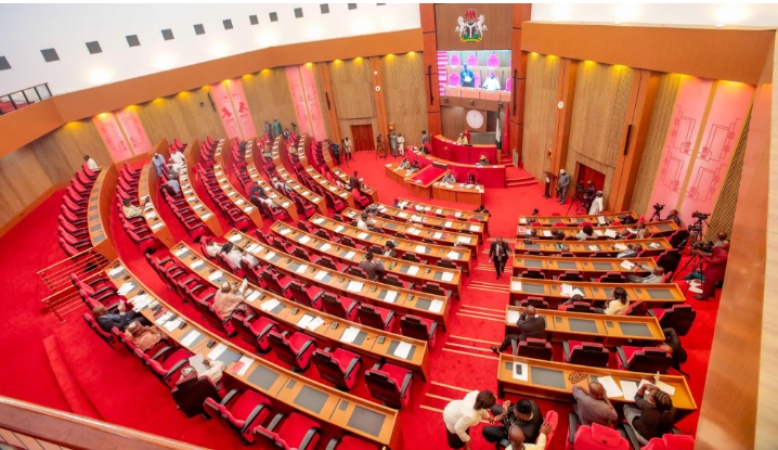
The Electoral Act Amendment Bill and the Tax Reforms Bill arguably remain the most controversial pieces of legislation in the life of the 10th Senate, which marks its third anniversary this month.
Our correspondents observe that as of Wednesday, April 29, 2026, the 10th Senate had passed over 100 bills since its inauguration in June 2023.
A breakdown of data obtained from the Senate Bills Dashboard indicates that 38 other bills are awaiting a third reading, while 453 have passed through the second reading.
To many Nigerians, the record of the 10th Senate under the leadership of Senate President Godswill Akpabio remains a subject of intense debate.
While some citizens believe the legislative activities over the past three years rank among the worst in the history of the nation’s parliament, others argue that the period has been successfully dominated by a productive mix of economic reforms and governance initiatives.
Senate Leader Opeyemi Bamidele told journalists on Tuesday that the current Senate had recently passed through a turbulent time in the court of public opinion.
According to him, one of the most challenging moments for the upper chamber was when controversies surrounding suspensions and disciplinary matters dominated public discourse, overshadowing its legislative accomplishments.
“At a time when a senator publicly described the 10th Senate as the worst in Nigeria’s history, media attention became focused on controversies rather than the work we were doing. That was a regrettable period because it distracted attention from our core responsibilities,” the Senate Leader said.
He added, however, that the chamber had recorded substantial achievements in partnership with the executive arm of government, particularly in efforts geared toward stabilizing the economy.
Supporters point to major legislative “reforms” and a growing list of laws signed by President Bola Tinubu. Conversely, critics argue over how these actions have impacted the country’s democratic environment and its citizens, amid several other controversies and a growing perception of executive overrepresentation.
Questions also remain about the nature and impact of the cooperation between the executive and the legislature during the period under review.
Electoral, tax bills overshadow legislative year
Though there have been several politically sensitive proposals, the Electoral Act Amendment Bill emerged as the most politically consequential and controversial measure considered by the Senate during the period under review.
The bill generated intense debate before eventually receiving presidential assent in February 2026.
However, controversies surrounding the electronic transmission of results and other electoral reforms have continued to reverberate across the political landscape, dominating discussions within political circles, civil society organizations, and election monitoring groups.
The friction stems largely from debates over the electronic transmission of election results, the role of the Bimodal Voter Accreditation System (BVAS), and the legal framework governing the INEC Result Viewing Portal (IReV).
Nearly three years after the 2023 general elections, questions surrounding the credibility of result transmission remain unresolved. Consequently, every attempt to amend the Electoral Act is viewed through the lens of the upcoming 2027 elections.
For opposition parties and election reform advocates, the amendment process offers a crucial opportunity to address perceived loopholes exposed during the last electoral cycle.
For others, it has become a broader test of Nigeria’s commitment to transparent and credible elections.
Ultimately, the significance of the bill goes beyond mere legislative drafting; its real-world outcome could heavily influence public confidence in the electoral process and shape the political atmosphere heading into the next general elections.
The fiscal friction over tax reforms
If the Electoral Act Amendment represents the Senate’s most politically sensitive undertaking, the tax reform package stands as one of its most significant economic legislative activities.
After months of intense debate, consultations, and amendments, the Senate passed four tax reform bills that were later assented to by President Bola Tinubu.
The legislation seeks to simplify tax administration, harmonize revenue collection, and reduce multiple taxation.
Senate Leader Opeyemi Bamidele told journalists that the passage of the tax reform legislation, alongside the National Assembly’s support for economic stabilization, ranked among the most significant achievements of the 10th Senate.
He noted that the tax reform bills are transformative measures that will significantly enhance government revenue generation, especially from the non-oil sector.
“In the coming years, these laws will play a major role in strengthening Nigeria’s revenue base and supporting economic growth,” Bamidele said.
Daily Trust reports that the passage of the bills was preceded by one of the fiercest policy debates witnessed during the period under review.
Several northern governors, lawmakers, and interest groups raised stiff concerns over provisions relating to revenue sharing and Value Added Tax (VAT) distribution. These disagreements exposed longstanding tensions over fiscal federalism and the allocation of national resources.
Supporters argued that the reforms were necessary to modernize Nigeria’s tax system and improve revenue generation. On the other hand, critics like Oyelari Idowu, an Ilorin-based economist, warned that implementation challenges and regional disparities could undermine the intended benefits.
Regional commissions, constitutional amendments
Aside from tax and electoral matters, constitutional amendment proposals also occupied a prominent place on the Senate’s agenda.
Debates surrounding state police, local government autonomy, devolution of powers, and judicial reforms continued to attract widespread attention.
Although many of these proposals are still undergoing legislative processing, their implications could extend far beyond the current administration, impacting the future structure of Nigeria’s federal system and the balance of power between the federal government and the states.
The Senate also considered and passed a number of bills establishing regional development commissions. Proponents argued that these commissions would accelerate infrastructure development and address longstanding developmental gaps across various parts of the country. However, critics questioned whether the growing number of intervention agencies could lead to a duplication of functions and increased pressure on public finances, reflecting broader concerns about governance efficiency and institutional sustainability.
Taken together, the major legislative initiatives before the Senate reveal deeper national conversations about power, accountability, and resource control. As the country gradually shifts its attention toward the 2027 elections, the outcome of these legislative efforts will likely carry implications far beyond the National Assembly.
While the Senate’s record shows over 100 bills passed, the true measure of its impact may ultimately be determined not by the volume of legislation, but by how effectively these consequential measures address the immediate political, economic, and governance challenges confronting the nation.
What are the impacts of the bills?
Speaking on the issue, the National President of the Nigerian Political Science Association (NPSA), Professor Hassan Saliu, said the real issue is not whether collaboration exists between both arms of government, but what that collaboration actually produces for citizens.
According to him, there is nothing inherently problematic about a close working relationship between the executive and the legislature, especially within a political system where the ruling party commands a comfortable majority in the Senate.
However, he cautioned that the critical question remains whether such cooperation translates into improved welfare and meaningful policy outcomes for Nigerians.
“What matters is not the existence of collaboration, but what that collaboration is producing for the people,” Saliu noted, arguing that public attention has increasingly shifted from institutional friendliness to the real-life impact of governance decisions.
He further explained that legislative scrutiny should not be misinterpreted as hostility toward the executive.
In his view, the legislature retains full constitutional authority to interrogate proposals, demand clarification, and ensure accountability without being seen as antagonistic.
“The fact that lawmakers are asking questions does not mean they are fighting the executive. It is part of their constitutional duty,” he observed.
At the same time, he stressed that the executive must respect the principle of separation of powers by responding to legislative inquiries and providing adequate justification for policy proposals. Where this balance is not properly maintained, he warned, public perception can tilt toward the belief that legislative independence has been weakened, even when formal procedures appear intact.
On the issue of electoral reform, Professor Saliu viewed the controversy within a broader structural pattern in democratic politics. According to him, ruling parties naturally seek to shape electoral frameworks in line with their political interests once they hold a legislative majority. He maintained that this is not unique to the current administration but is a common feature of majority-driven political systems worldwide.
“If any party—be it the APC, PDP, or ADC—finds itself in that position, it will likely behave the same way,” he explained.
However, he warned that such dynamics must be balanced against the need to protect electoral credibility and public trust in democratic institutions. He further highlighted concerns around recent internal party primaries, noting that the quality of candidate selection directly influences the credibility of general elections.
Looking ahead to the 2027 general elections, Professor Saliu concluded with a call for national alertness:
“The ruling party has taken advantage of its numerical strength, which any party in power will do. But going forward, the conduct of all the parties regarding their recent primaries gives us a preview of the shape of the upcoming elections. We have to be watchful and vigilant so that the manipulations that produced the candidates do not repeat themselves in the general elections, because the character of the primaries does not give much hope.
That is why we must stress the importance of vigilance by the Independent National Electoral Commission (INEC) in safeguarding transparency and fairness across the entire electoral cycle.” (Daily Trust)