Updating your news feed...
NEWS EXPRESS is Nigeria’s leading online newspaper. Published by Africa’s international award-winning journalist, Mr. Isaac Umunna, NEWS EXPRESS is Nigeria’s first truly professional online daily newspaper. It is published from Lagos, Nigeria’s economic and media hub, and has a provision for occasional special print editions. Thanks to our vast network of sources and dedicated team of professional journalists and contributors spread across Nigeria and overseas, NEWS EXPRESS has become synonymous with newsbreaks and exclusive stories from around the world.





















Loading banners
Loading banners...

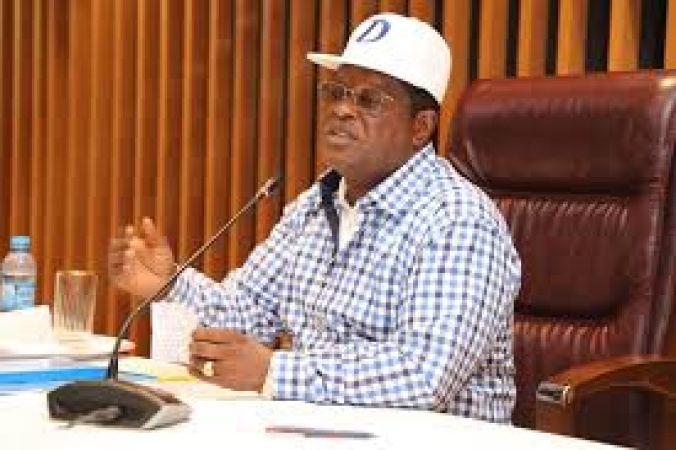
Minister of Works, David Umahi
The Federal Government has directed contractors handling legacy road projects across the country never to block vehicular access beyond 14 days under any circumstances.
It also warned contractors to stick to contractual terms in handling road projects, just as it issued a 72-hour ultimatum to GELD Construction Company to effectively utilise funds already released to it and demonstrate visible progress on the Abuja-Lokoja Expressway.
In the meantime, socio-political activist, Aisha Yesufu, has called for a law to compel all levels of government in Nigeria to settle contractors’ invoices within 30 days of project completion or service delivery.
In a post on her official social media page, Yesufu argued that delayed payments to contractors have continued to affect businesses, infrastructure development and job creation across the country.
She suggested that any payment outstanding beyond 30 days should attract mandatory interest calculated at the prevailing Central Bank of Nigeria Monetary Policy Rate plus an additional five per cent.
According to Yesufu, the proposed law would discourage the practice of using contractors as a source of unofficial credit for government projects.
Meanwhile, the Minister of Works, David Umahi, who gave the directive on road construction while inspecting ongoing road and bridge projects in Kogi and Edo States, indicted the ministry staff for failure to properly supervise the projects assigned to them.
He accused them of pampering contractors and issuing certificates arbitrarily, while the public lambasts him and President Bola Tinubu for ineptitude. He further accused them of such a level of inefficiency that they cannot defend projects assigned to them before the National Assembly.
Further expressing dissatisfaction with the pace of work on some sections of the Abuja-Lokoja dual carriageway and the dualisation of Obajana Junction-Benin road, Umahi asked contractors not to wait unnecessarily for the government’s release of funds.
Rather, he called on the Nigerian National Petroleum Company Limited (NNPCL) to pay the contractors handling projects to be funded by the company. He explained that due to funding constraints, the scope of one of the sections of the Abuja-Lokoja road was reduced from 49.28 kilometres to 28 kilometres, to concentrate available resources on the most critical portions.
Nevertheless, the minister commended Messrs JRB Construction Company for the quality and pace of work on its project, describing the company as a model of professionalism and commitment. According to him, “if everybody does his job accordingly, there will be no reason to shift the blame to Mr President.”
However, Umahi explained that a substantial percentage of Nigeria’s federal road network was in a terrible shape before the Tinubu administration came on board, but that efforts were being made to fix the decay.
The minister also visited the reconstruction of the existing pavement and completion of the additional carriageway on Section III of the Abuja–Lokoja Dual Carriageway, including works being executed by Trucrete Solutions Limited on the Koton Karfe–Abuja alignment.
On the ongoing dualisation of the Lokoja–Benin Road, the projects inspected included Section I, Obajana Junction-Okene, and Section II, covering the Okene–Auchi corridor across Kogi and Edo States.
He also assessed the progress of work on the flyover and interchange components of the project being executed by CCG Contractors, which are at approximately 80 per cent and 30 per cent completion, respectively. (The Guardian, excluding headline)