
Updating your news feed...
NEWS EXPRESS is Nigeria’s leading online newspaper. Published by Africa’s international award-winning journalist, Mr. Isaac Umunna, NEWS EXPRESS is Nigeria’s first truly professional online daily newspaper. It is published from Lagos, Nigeria’s economic and media hub, and has a provision for occasional special print editions. Thanks to our vast network of sources and dedicated team of professional journalists and contributors spread across Nigeria and overseas, NEWS EXPRESS has become synonymous with newsbreaks and exclusive stories from around the world.
Loading banners
Loading banners...

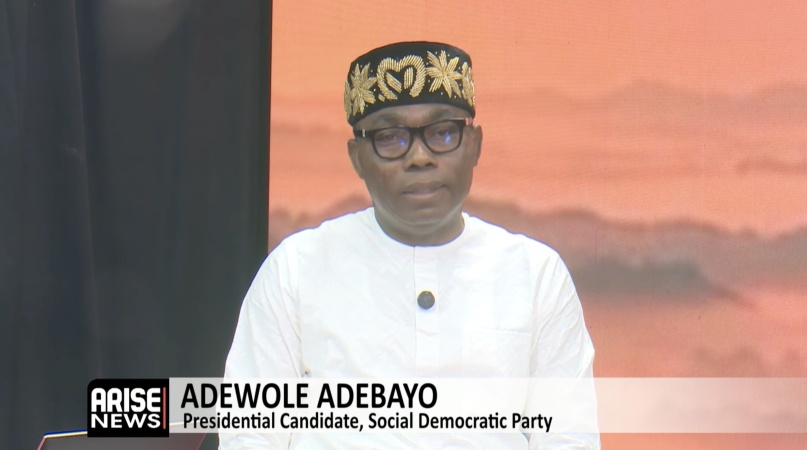
The presidential candidate for the Social Democratic Party, (SDP), Prince Adewole Adebayo, has dismissed proposals for a single six-year presidential term as a distraction from the country’s more pressing challenges, insisting that electoral integrity and effective governance should be Nigeria’s primary focus.
Speaking in an interview with ARISE NEWS on Wednesday,, Adebayo argued that the real issue confronting Nigeria is not the length of time elected officials spend in office, but whether leaders emerge through free, fair, and credible elections that truly reflect the will of the people.
Recall that Senate Leader, Opeyemi Bamidele recently disclosed plans to sponsor a bill seeking to introduce a single six-year tenure for presidents and governors, arguing that the proposal would enable elected officials to focus more on governance rather than re-election campaigns.
Adebayo said: “It’s a distraction. These are all idle talks. A six-year term, a four-year term—that’s not the problem. The problem is that you have to have a system that works. You have to have a political system where the voter decides the winner, where nobody watches INEC as if you are watching a secret society, and where political parties raise ideas and raise new people. So, my focus, as we are heading towards the future, is that we must, once and for all, kill the demon of rigged elections. We must, once and for all, allow the voter to vote. So, the issue of how long you stay in power and all of that is irrelevant; it’s what you do when you get there.
“I think the present system of four years—and if you are good enough, you go for another four years—is good enough if the people who are actually going to the government are going there only by winning a free, fair, and credible election. We should focus on that now,” he insisted.
Speaking on reports of parallel presidential candidates within the SDP, Adebayo dismissed the development as a familiar occurrence in party politics, insisting that the party remains united behind a single candidate.
“We are not bothered by that; it’s the normal staple. So, I think the burden is on INEC to try not to waste its time on that and to follow the law,” he maintained.
Adebayo also called for issue-based politics, urging political parties to compete on ideas and policy alternatives rather than internal disputes and identity-based considerations.
“What we can have is a set of political parties competing on a set of ideas, and the media moderating for all of us so that we can have equal hearing. Then, Nigerians can now decide to lay their bed the way they want to lay on it when the time comes.”
Reflecting on the 2023 presidential election, he maintained that many voters were distracted by debates surrounding the Muslim-Muslim ticket and other political controversies instead of scrutinising policy proposals. According to him, some of the economic and governance challenges currently facing the country stem from policies that were clearly outlined before the election but did not receive sufficient public attention.
“Because the agenda we are facing now—the consequences we are facing—were the agenda that President Tinubu presented last time, and people were focusing on a Muslim-Muslim ticket and other things that are not important. And they didn’t focus on those damaging proposals which we were telling them would leave you in a serious quagmire. And that has come to pass now, unfortunately,” he bemoaned.
He further argued that the country’s current electoral system does not always reflect the true will of the people, making it difficult to accurately measure the popularity of political parties and candidates.
“The thing that is bringing us back is the expectation that we will have free, fair, and credible elections, where people don’t buy votes, they don’t rig votes, and that at that time, you will know the relative strength of all political parties, where they are. The system we are running now does not give an honest person an ability to swear by any standard that the results you are getting represent the will of the people,” he explained.
According to him, growing public dissatisfaction with the status quo has increased the demand for alternative political platforms, with the SDP’s positions on security, the economy, infrastructure, welfare and democratic governance resonating with many Nigerians across the country.
“The demand for alternatives is rising every day. The need for alternatives is rising every day. The necessity for alternatives is rising every day. There is no aspect of our national life where the ideas that the SDP is promoting do not attract Nigerians. Our ideas on security, our idea on the economy, our idea on infrastructure, our idea on welfare, our idea on the state of democracy and ethics in governance—those are the ideas that Nigerians are interested in. And the SDP happens to be a party that is popular with Nigerian people. It’s because of the SDP that we have this June 12 Democracy Day, and we have grassroots support,” he said.
Addressing the fuel subsidy debate, Adebayo said its removal was a mistake, arguing that the real problem is the government’s failure to develop Nigeria’s domestic refining capacity and effectively manage the petroleum sector.
“The removal of the subsidy was a big mistake. But President Tinubu has gone on to now make even bigger mistakes over time. For three reasons: One, there was no subsidy to start with. We said that there was no subsidy. What they were doing by way of removal of subsidy was price adjustment for products that they did not produce. And the ability to produce those products rested in taking care of the four refineries that we have—two in Port Harcourt, one in Warri, and one in Kaduna. And the amount of money we were spending on turn-around maintenance was not accounted for,” he argued.
Adebayo outlined what he described as a three-step alternative to the current fuel subsidy policy, beginning with restoring Nigeria’s refineries in the short to medium term, insisting that they are capable of functioning if properly managed.
“So, what we had proposed was that we’ll have a three-step approach: We will make sure that the refineries work in the medium term because we’ve spent enough money. And many of them will work if the government wants them to work.
“That we will take our people—especially the vulnerable people, the low-income people, the energy-poor people—away from the need for petrol. Because when you have multimodal transportation, which you can get within six months, and workers use their employment card to take transport to work, they will not be forced to bother too much about the price of petrol.
“And lastly, that structurally, Nigeria is able to produce more refined products than we are consuming. And the net export balance will be used to make sure we have price stabilization,” he explained.
The SDP flag bearer reiterated his position that the government bears responsibility for the current security challenges in the country, including the rising incidents of kidnapping.
“Of course, the government is responsible for the kidnapping that is going on. I have evidence to prove that,” he alleged.
Adebayo further maintained that Nigeria’s security architecture is weakened by what he described as an over-centralisation of security priorities around protecting political office holders, alongside inefficiencies in coordination among security agencies.
“And there are three reasons why they don’t respond: One is lethargy. The fact that they are not serious, because the definition of security in Nigeria is regime safety, regime security. How to protect the President, Villa, Governor, a few senators, and businessmen. That’s all. Outside that, they don’t care.
“The second problem that they have is that if you go and ask the DSS, if you go and ask many of the security agencies, we are extremely competent in the area of gathering intelligence. But when you gather intelligence, you need it to be actioned by somebody. And if the people who are responsible for ordering security measures don’t have time, but I can tell you, interview security personnel. There are certain sensitive security personnel who don’t have access to even see the Commander-in-Chief, not to talk of discussing their security estimates.
“Thirdly, the structure of our law enforcement is that we’ve killed the police completely. When you see Nigerian police on the road, they’re just merely decorative because tasks which they can do, exercises which they can do, reconnaissance that they can do, is now being given to the military,” Adebayo said.
Alleging that the security crisis is worsened by misuse of security funds and systemic failures, Adebayo said the government has become an enabler of insecurity.
“The last part, which is the shame of it all, is that it is a lucrative business for those who are in government. That is where they spend their security votes, buy themselves houses abroad, Mercedes, and do everything.
“So, the government is responsible. I am not on the side of the terrorists. The terrorists deserve to go to prison; many of them deserve to die. The issue is that the government is an enabler—deliberately and carelessly enabling this situation,” he alleged.
Adebayo said that if elected president, he would rule out negotiations with bandits, insisting that the state cannot enter into any form of partnership with criminal groups or compromise its territorial integrity.
“No, please. As president, there’s no room for that. You can’t form a partnership with criminality. You cannot share your territorial integrity with bandits,” he stressed.
Adebayo argued that Nigeria’s insecurity is being worsened by what he described as excessive political interference in policing and security operations, insisting that security agencies should be allowed to function independently of political control.
“The issue is that the government has the bigger gun, but they don’t want to use it. They have the bigger intelligence gathering, but they don’t want to use it. Look at the Nigerian Police—you can underestimate them, but you underestimate them at your own peril because the Nigerian Police is extremely competent, but they are extremely subservient. Because the way our security architecture is done, politics trumps professionalism,” he stated.
Adebayo said that under his administration, the police and other law enforcement agencies would be freed from daily political control, with government limited to making laws while security institutions operate independently to enforce them.
“Under me, our police and our law enforcement would be purely free from daily government control. Our job is to pass laws for them to enforce, not to use politicians to control them. There is nowhere in the world where—and I’ve practiced in many countries, as you know—there’s none where the policemen are under political control. So, that level of independence is what you require. But here, the political class has swallowed the security professionals, so we need to decouple that,” he insisted.
Urging Nigerians to prioritise security above ethnicity and financial inducement when making electoral choices, Adebayo said only a government committed to protecting lives can effectively fulfil its constitutional duties.
“I want to let Nigerians know, there is no terrorist, there is no bandit, there is no kidnapper that is capable of overwhelming the government. The government just doesn’t care about taking care of you. You need to take care of yourself by making sure that immediately, you raise this demand loudly. When you have threats facing your community, don’t wait for it to happen; immediately start to draw the attention of the government. And when it’s time to vote, put your own security as number one. Don’t put ethnicity, don’t put money. Make sure that you can be alive. And the only way you can be alive is to have a government that wants to keep you alive and perform its function under the Constitution. And that’s why the SDP is available. That’s why we are all going around the country to know the communities,” Adebayo said.
Reiterating his position, Adebayo said meaningful political discourse requires data, analysis, and a strong understanding of how government systems operate, insisting that only those who understand governance realities are fit to lead.
“Insincere talk is not cheap. It’s senseless talk that is cheap. Sensible talk requires thinking, getting data, knowing what is happening, and knowing how government works. Anybody who wants to be in government and doesn’t know what’s going on in that government doesn’t deserve to be there. Let us understand that we need to have a conceptual understanding of our governance system,” he concluded. (Arise News)