
Updating your news feed...
NEWS EXPRESS is Nigeria’s leading online newspaper. Published by Africa’s international award-winning journalist, Mr. Isaac Umunna, NEWS EXPRESS is Nigeria’s first truly professional online daily newspaper. It is published from Lagos, Nigeria’s economic and media hub, and has a provision for occasional special print editions. Thanks to our vast network of sources and dedicated team of professional journalists and contributors spread across Nigeria and overseas, NEWS EXPRESS has become synonymous with newsbreaks and exclusive stories from around the world.



















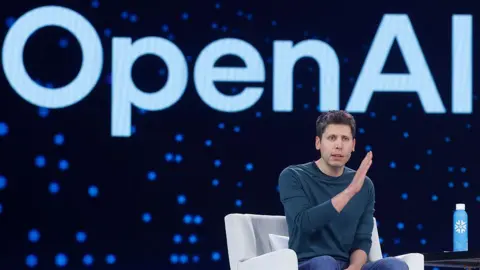
OpenAI, the company behind popular chatbot ChatGPT, has become the latest artificial intelligence (AI) giant to reveal plans to sell shares to the public through a stock listing.
Its decision had been expected for months, but the company's announcement comes exactly one week after rival AI firm Anthropic said it was planning to go public, too.
OpenAI said on Monday it had made a confidential filing with the US Securities and Exchange Commission to pursue an initial public offering (IPO) at some point in the future.
Its plans are the latest in a wave of heavyweight IPOs, alongside Anthropic and billionaire Elon Musk's rocket company, SpaceX, which is set to debut on the Nasdaq on Friday.
SpaceX is targeting a share price which would value the company at $1.75tn (£1.3tn).
Announcing its IPO plans on Monday, OpenAI said: "We have not decided on timing yet; it may be a while because there are things we want to do that are likely easier as a private company."
The three firms all have a "vast need for cash", said Sunil Krishnan from Aviva Investors, and "no-one wants to be last" in the game to go public, he told the BBC's Today programme.
He said that the firms are making huge investments in their AI infrastructure including on chips, and training their AI models, which all come at massive expense.
OpenAI and Anthropic, the maker of the chatbot Claude, are focused on AI work and have been fierce rivals essentially since Dario Amodei co-founded the latter company five years ago.
He did so after leaving OpenAI over disagreements with Sam Altman, the co-founder and chief executive of OpenAI.
Today, the companies compete for users, corporate customers, investors, and have in recent months been jockeying with private valuations inching toward $1tn.
OpenAI's most recent valuation from private investors came in at $852bn. Anthropic's most recent valuation hit $965bn.
The companies now will be competing as to who might debut on the public stock market first - as neither have said exactly when this could occur.
Investors are closely tracking the listings of these two generative AI firms, as their performance will help shape expectations for others to follow, said assistant professor Richard Crowley from the Singapore Management University.
"We might typically think of OpenAI and Anthropic as competitors, but the fate of their financing is intrinsically intertwined through the public's perception of the generative AI space," he said.
Last week, Altman said in an interview with CNBC that he was in no rush to take OpenAI public, and that he would do it "when it makes sense".
In its statement on Monday, OpenAI said it was revealing its IPO plans because "we expect it to leak".
The company noted that revealing its plans and its decision to go public "is a complicated set of tradeoffs".
Having filed the necessary paperwork for review with the SEC, the company says it now has "the option to go public sooner if that ends up being best".
By listing on the stock market, OpenAI will need to become more transparent about its financials and product pipeline.
IPO listings can also deter private funding and make deals slower or less appealing because companies must disclose more information, Crowley said.
For OpenAI, Anthropic and SpaceX, which also owns the controversial AI chatbot Grok, selling shares to the public is likely to give them billions of dollars in capital.
One of the most costly aspects of running an AI company is what is referred to as "compute," which typically describes the infrastructure and processing power required to build, train, test and then make available its offerings to the public, such as a chatbot.
OpenAI's compute costs are estimated to be over $100bn a year, while its revenue, the money it actually makes from its business, is a fraction of that.
SpaceX is also far from a profitable business.
Anthropic, however, has told investors that it expects to turn a profit in the first half of this year, as it says sales of its Claude product and related services have grown significantly. (BBC)





