Updating your news feed...

NEWS EXPRESS is Nigeria’s leading online newspaper. Published by Africa’s international award-winning journalist, Mr. Isaac Umunna, NEWS EXPRESS is Nigeria’s first truly professional online daily newspaper. It is published from Lagos, Nigeria’s economic and media hub, and has a provision for occasional special print editions. Thanks to our vast network of sources and dedicated team of professional journalists and contributors spread across Nigeria and overseas, NEWS EXPRESS has become synonymous with newsbreaks and exclusive stories from around the world.





















Loading banners
Loading banners...

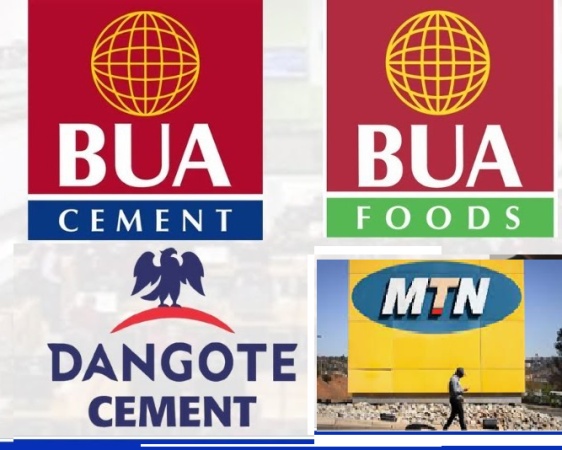
Dangote Cement, BUA Foods, MTN Nigeria and BUA Cement
Total annual revenue of Nigeria’s 10 largest publicly quoted companies increased by about N6.4 trillion as businesses continued to see considerable recovery on the back of improvement in macroeconomic environment.
Latest audits by the companies showed that total revenue rose from N18.53 trillion in 2024 to N24.92 trillion in 2025, in a broad growth that cut across manufacturing, telecommunications, oil and gas and financial services.
The data included latest financial statements of Dangote Cement Plc, BUA Foods Plc, MTN Nigeria Communications Plc, BUA Cement Plc, Aradel Plc, Seplat Energy Plc, Lafarge Africa Plc, Zenith Bank International Plc, Guaranty Trust Holding Company and Geregu Power Plc.
The reports for the year ended December 31, 2025 indicated that growing sales provided headroom for significant improvement in profitability for most companies, despite cost pressures.
Experts were unanimous that improved corporate performance was a major driver of the bullish sentiment at the Nigerian stock market, where investors have seen about N132 trillion capital gains in the three years of President Bola Ahmed Tinubu’s administration.
A breakdown showed that Dangote Cement’s turnover rose from N3.58 trillion in 2024 to N4.308 trillion in 2025. BUA Foods recorded group revenue of N1.77 trillion in 2025 as against N1.53 trillion in 2024. MTN Nigeria Communications saw its top-line expanding from N3.36 trillion in 2024 to N5.20 trillion in 2025. BUA Cement recorded total turnover of N1.18 trillion in 2025 as against N876.47 billion in 2024.
Also, Aradel grew its revenue from N581.15 billion to N697.30 billion. Seplat Energy’s gross income quadrupled from N1.65 trillion to N4.14 trillion. Lafarge Africa saw a major surge in sales in 2025 with total turnover rising by 53 per cent to a record of N1.1 trillion as against N696.8 billion in 2024. Zenith Bank’s gross earnings closed 2025 at N4.19 trillion compared with N3.971 trillion. Guaranty Trust Holdings Company saw a marginal increase from N2.148 trillion to N2.150 trillion. Geregu Power recorded a turnover of N184.94 billion in 2025 as against N137.13 billion in 2024.
Experts said macroeconomic reforms initiated by the Tinubu administration have delivered a stable operating environment, providing corporates with a strong basis to plan and execute their business development strategies.
Chief Executive Officer, Centre for the Promotion of Private Enterprise (CPPE), Dr Muda Yusuf said there was growing evidence that the reforms embarked upon by the Tinubu government have delivered important stabilisation outcomes, which impacted on corporate performance and stock market returns.
“External reserves have improved significantly, with gross reserves approaching the $50 billion threshold. The balance of trade has remained in surplus, investor confidence has strengthened and exchange rate volatility has moderated considerably since last year.
“The economy experienced 11 consecutive months of disinflation from early 2025 through February 2026, reflecting the positive impact of macroeconomic stabilization measures. However, this disinflation trajectory was disrupted in March 2026 by the outbreak of the Iran–U.S.–Israel conflict, which triggered a sharp surge in global crude oil prices, elevated domestic energy and transportation costs, and reignited inflationary pressures across the economy,” Yusuf said.
According to him, the discontinuation of Ways and Means financing has also contributed to improved monetary discipline and macroeconomic stability while exposing the structural weaknesses of public finance management.
He added that reduced dependence on imported petroleum products has strengthened foreign exchange conservation, improved energy security and contributed to exchange rate stability.
Chief Executive Officer, Sofunix Investment and Communications, Mr. Sola Oni, said that President Bola Tinubu’s administration has had a largely positive impact on Nigeria’s capital market, driven by major economic reforms such as fuel subsidy removal, foreign exchange market liberalization, banking recapitalization, and fiscal restructuring.
According to him, these policies improved investor confidence, boosted activity on the Nigerian Exchange Limited (NGX), and attracted renewed interest from both local and foreign institutional investors.
Managing Director, APT Securities and Funds Limited, Alhaji Kasumu Kurfi said that many of the reforms introduced under the current administration are likely to continue regardless of future political developments.
According to him, nobody is likely to reverse policies that have improved market confidence, strengthened institutions, and attracted investment. The direction from here is forward.
Providing a context to the confidence-building, Yusuf pointed out that while the adjustment pains remain, a fair assessment of the Tinubu administration’s first three years required a proper understanding of the economic realities that confronted the government at inception.
The administration assumed office at a time when the economy was facing profound macroeconomic, fiscal and foreign exchange vulnerabilities.
“The foreign exchange market was characterized by acute illiquidity, multiple exchange rates, pervasive arbitrage and declining investor confidence. Net external reserves had reportedly fallen below $5 billion, trade finance obligations were under pressure and Nigeria’s credibility in the international trading system weakened considerably.
“Fiscal conditions were equally challenging. Ways and Means financing had become deeply entrenched, effectively institutionalizing monetary financing of fiscal deficits. At the same time, the fuel subsidy regime had evolved into a major channel of fiscal leakage, corruption and economic distortion. The economy was approaching a tipping point as the fiscal, monetary and structural foundations of the prevailing model became increasingly unsustainable. Against this backdrop, the immediate task of the administration was to restore macroeconomic stability, rebuild investor confidence and avert a potentially deeper economic crisis. Growth acceleration could only follow once the foundations of stability had been secured,” Yusuf said.
He said the two transformative reforms that became the pillars of economic stabilisation were fuel subsidy removal and exchange rate unification.
He noted that the removal of fuel subsidy was arguably the most consequential fiscal reform undertaken by the administration as the subsidy regime had become a major drain on public finances, encouraging smuggling, arbitrage and rent-seeking while crowding out productive public investment.
According to him, the reform halted a significant source of fiscal hemorrhage and created the foundation for a more transparent and sustainable downstream petroleum sector.
He said: “Similarly, exchange rate unification addressed one of the most distortionary features of the Nigerian economy. The multiple exchange rate system had created extensive arbitrage opportunities, weakened transparency and discouraged investment. (The Nation)