ADAD
ADADUpdating your news feed...

NEWS EXPRESS is Nigeria’s leading online newspaper. Published by Africa’s international award-winning journalist, Mr. Isaac Umunna, NEWS EXPRESS is Nigeria’s first truly professional online daily newspaper. It is published from Lagos, Nigeria’s economic and media hub, and has a provision for occasional special print editions. Thanks to our vast network of sources and dedicated team of professional journalists and contributors spread across Nigeria and overseas, NEWS EXPRESS has become synonymous with newsbreaks and exclusive stories from around the world.











Loading banners
Loading banners...

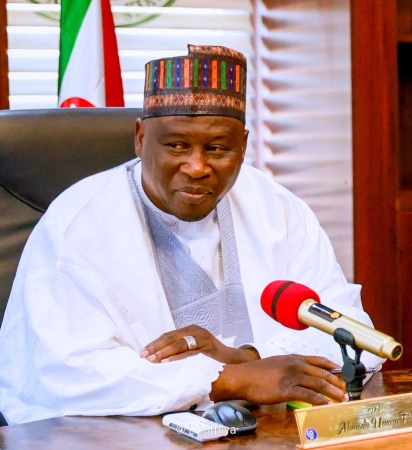
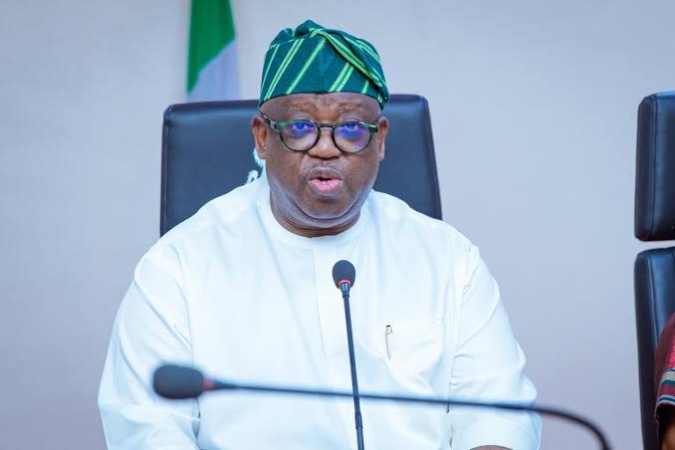
Adamawa State Gov Ahmadu Fintiri
The outcome of the All Progressives Congress (APC) governorship primary in Adamawa State shocked many party supporters and residents, as the unexpected became reality. Amid a reported power-sharing arrangement that limited Governor Ahmadu Fintiri’s influence while boosting the camp of National Security Adviser (NSA) Nuhu Ribadu, the contest has reopened old political fault lines. How the unfolding power play among Fintiri, Ribadu, Atiku Abubakar and Aishatu Ahmed (Binani) evolves could shape the future of Adamawa politics ahead of the 2027 polls, LEO SOBECHI and JOY DENNIS report.
The outcome of the recent governorship primary in Adamawa State surprised not a few residents. While other state chapters of the ruling All Progressives Congress (APC) were celebrating the easy triumph of incumbent governors and preferred candidates of outgoing governors, Adamawa produced a result that questioned Governor Umaru Ahmadu Fintiri’s belated decision to cross over to the same party he defeated during a fiercely contested governorship election in 2023.
When the outgoing governor defeated Senator Aishatu Dahiru Ahmed (Binani) after a controversial, inconclusive ballot, many observers of Adamawa politics concluded that Fintiri’s former party, the Peoples Democratic Party (PDP), had consolidated its dominance of the state.
However, some observers blamed former Governor Jibrilla Bindow for the APC’s failure to reclaim the governorship seat, pointing out that by taking his supporters to the PDP after losing to Fintiri, Bindow created instability within the party, which culminated in the 2019 governorship primaries.
Although Binani defeated Bindow and the current National Security Adviser (NSA), Nuhu Ribadu, to clinch the APC governorship ticket, former Governor Bindow’s decision to defect to the PDP left the impression among party faithful that he was merely waiting out Fintiri’s final term before making a return bid for Government House.
But after Fintiri faced a tough challenge in his re-election bid, it became clear that Senator Binani was a formidable political force. Two years down the line, and with the administration of President Bola Ahmed Tinubu laying the groundwork for a second term, both Fintiri and Binani realised that a new political sheriff had emerged.
Shortly after President Tinubu appointed Ribadu as NSA, Binani apparently realised that her days of influence within the ruling party were numbered and began withdrawing from active participation in APC events.
It was not long before former Vice President Atiku Abubakar noticed the growing distance and, in a bid to capitalise on Binani’s quiet estrangement from the APC, paid her a courtesy visit at her Abuja residence.
As an experienced politician still eyeing the presidential contest, Atiku understood Aisha Binani’s capacity to mobilise the Adamawa electorate. The Gimbiya Adamawa had moved from the House of Representatives to succeed the son of former Governor Murtala Nyako, Senator Abdul-Aziz Nyako, in the Red Chamber of the National Assembly.
Adamawa State, it should be noted, stands out as one of the few subnational entities that parade vibrant politicians. That distinct quality manifested itself in great detail at the commencement of the Fourth Republic in 1999, when the troika of Iya Abubakar, Abubakar Halilu Girei and Jonathan Silas Zwingina represented the state in the Senate.
Against the backdrop of that star-studded political environment, it takes a woman of considerable political substance in the mould of Aisha Binani to remain afloat for more than a decade, defeating men in various electoral contests.
However, as the buildup to the 2027 election gathered momentum, the Adamawa political landscape changed significantly. First, the governorship candidate of the Social Democratic Party (SDP) in the fiercely contested 2023 governorship election, Dr Umar Ardo, experimented with the idea of floating a political movement, the League of Northern Democrats, which was expected to transform into a political party.
On her part, Binani explored a possible alliance with Atiku on the coalition platform of opposition leaders under the African Democratic Congress (ADC). That move ended in tatters as Binani accused former Secretary to the Government of the Federation (SGF), Engineer David Babachir Lawal, of imposing candidates on the party during the state congress.
While consulting with her supporters in the state, Binani left nobody in doubt that she was determined to embark on another political pilgrimage. Many predicted that the SDP could be her next destination, following Ardo’s exit from the party. However, on May 5, 2026, the Gimbiya Adamawa, flanked by Mr Peter Obi, Dr Rabiu Musa Kwankwaso and Senator Henry Seriake Dickson, appeared at a ceremony that heralded their entry into the Nigeria Democratic Congress (NDC).
Within her new political home, the NDC, Aisha Binani has positioned herself not only as the Amazon of Adamawa politics but also as the candidate to beat in the state’s February 6, 2027, governorship election. Recent events indicate that the 54-year-old former senator is on course to fulfil her ambition of becoming the first female governor of Adamawa State.
Pointers to that possibility emerged after the recent governorship primary of the ruling APC. The details of how that exercise was won and lost continue to raise questions about whether the outcome truly reflected the wishes of party faithful or represented a cleverly contrived imposition.
Contrary to Governor Fintiri’s assurances that he would support a grassroots politician to succeed him, his preferred candidate for the governorship primary, Dr Felix Tangwami, ended up being pushed into the senatorial contest.
It was obvious that the outgoing governor considered Tangwami’s experience and his prolonged participation in the governance of the state, dating back to the military era, as reasons to prefer him over other contenders, including former Governor Bindow.
But perhaps because Tangwami was not a politician in the strict sense of the term, and because the late entry of former PDP stalwarts into the APC, the governorship primary failed to reflect Governor Fintiri’s incumbency advantage. Instead, a 40-60 per cent power-sharing formula that excluded the governorship ticket was reportedly adopted.
Shortly after Fintiri moved the entire PDP structure, from ward to state level, into the APC, murmurs emerged on both sides. PDP stalwarts and many old APC chieftains argued that he joined the party primarily to shield himself from anticipated scrutiny by the Economic and Financial Crimes Commission (EFCC).
APC supporters continued to push back against the governor’s leadership of the party, even as those loyal to the NSA maintained their allegiance to Abuja. Up until the state and zonal congresses and the governorship primary, Ribadu’s supporters remained adamant that the governor could not dictate the party’s direction.
Fintiri’s supporters were visibly stunned as the results of the direct primary were announced, culminating in the declaration of Tijjani Ahmed Galadima as the winner. Galadima, who until recently served as Executive Secretary of the Petroleum Technology Development Fund (PTDF), was credited with polling 414,444 votes.
With that singular pronouncement, Governor Fintiri’s repeated promises to hand over to a grassroots politician like himself became little more than an echo. In tones conveying seriousness and patriotism, the governor had explained that his preferred candidate would sustain the legacy he had built and was still building in the state.
Even then, the emergence of Galadima Tijjani as one of the 10 governorship aspirants on the APC platform generated controversy among party supporters. First, he was widely known as the preferred candidate of NSA Ribadu. Secondly, because Ribadu himself had repeatedly lost governorship contests at the primary stage, the former PTDF boss was viewed as a politically unknown quantity, relatively unknown and untested across major parts of Adamawa State.
Other APC leaders and supporters dismissed Galadima, arguing that his only political asset was Nuhu Ribadu’s endorsement, the NSA to President Tinubu.
Party faithful recalled the APC North-East zonal congress held in Gombe, which angered members when Ribadu reportedly settled for the former PTDF executive secretary as Governor Fintiri’s successor after installing his loyalist, Barrister Shuiabu Idris, as APC National Vice Chairman (North-East).
Aliyu Abdullahi, an APC member who witnessed the congress in Gombe, told The Guardian:
“It is no secret that Ribadu is bent on backing Galadima for governor, but he must be careful how he goes about it so that the party does not implode, and what happened to him in 2015, when he got the nomination but lost the general election, does not repeat itself because of imposition.”
The chairman of the National APC Primary Election Committee, Innocent Barikor, had on Friday, May 22, in Yola, confirmed Ahmed Tijjani Galadima as the winner after what was described as “fierce polling” that commenced on May 21 across the state’s 21 local government areas.
Announcing the result, the chairman stated: “I, Innocent Barikor, the Returning Officer and Chairman of the National APC Primary Election Committee, hereby declare Ahmed Tijjani Galadima the winner of the Adamawa State APC governorship primary election, and he stands as the party’s governorship candidate.”
Barikor noted that Abdulrahman Haske polled 65,930 votes, while Abdulrazak Namdas Saad secured 86,004, leaving Ahmed Tijjani Galadima with a winning total of 414,444.
But in a statement, the second runner-up, Abdulrahman Haske, questioned the credibility of the primary election, claiming that results from some local government areas were still being collated when the winner was declared.
“The absence of collation processes in some local government areas, irregularities in voting in certain polling units, and limited access to collation procedures before the final declaration of results raise questions about the primaries.
“The integrity of the process is as important as the outcome. Transparent and inclusive procedures remain essential to sustaining trust, confidence and unity within our great party.”
Based on the post-primary recriminations, supporters of the governor and those who lost in the primary are already discussing the possibility of throwing their weight behind Senator Aishatu Ahmed, the presumed standard-bearer of the NDC.
The outlook for the governorship race in Adamawa State is becoming increasingly uncertain. As the electioneering season unfolds, it remains to be seen whether the APC’s apparent loss of the incumbency advantage will translate into sympathy votes for the party on February 6, 2027. (The Guardian)