 ADAD
ADAD
Updating your news feed...
NEWS EXPRESS is Nigeria’s leading online newspaper. Published by Africa’s international award-winning journalist, Mr. Isaac Umunna, NEWS EXPRESS is Nigeria’s first truly professional online daily newspaper. It is published from Lagos, Nigeria’s economic and media hub, and has a provision for occasional special print editions. Thanks to our vast network of sources and dedicated team of professional journalists and contributors spread across Nigeria and overseas, NEWS EXPRESS has become synonymous with newsbreaks and exclusive stories from around the world.




.webp)









.webp)




Loading banners
Loading banners...

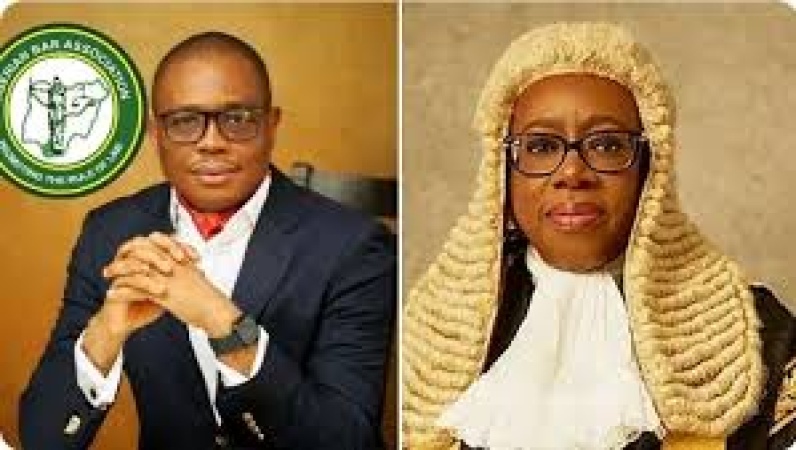
CJN Justice Kudirat Kekere-Ekun and NBA President, Afam Osigwe
As the countdown to the 2027 general elections gathers pace, Nigeria’s courts are bracing for a familiar surge in politically charged litigation.
It is a season many within the legal community wryly describe as the “harvest period” for election disputes.
The season is almost here, when politics-related cases dominate proceedings in the nation’s courts; a period often jocularly referred to as the democratic dividend’s harvesting season for the legal profession.
Since the restoration of democratic governance in the country in 1999, it has become a tradition that shortly before, during and after every election, courts are kept busy with political cases in which parties are always willing to do anything to secure victory.
In this season of stiff contestations, lawyers deploy all forms of tactics, including underhand measures, with the sole intention of outsmarting the adverse party and harvesting the gains; practices that, in most cases, threaten the credibility of the nation’s justice delivery system and democratic foundation.
Some of these practices include engaging in forum shopping with the intention of obtaining favourable decisions; filing frivolous cases and appeals aimed at ensuring delays; and promising clients what lawyers know is impossible, with the sole intention of earning fees, among others.
The need to reverse this trend might have informed the recent interventions by the Chief Justice of Nigeria (CJN), Justice Kudirat Kekere-Ekun, and the President of the Nigerian Bar Association (NBA), who cautioned judges and legal practitioners against engaging in practices that threaten the course of justice and are capable of undermining the nation’s democracy.
CJN: De-emphasise money
Speaking at this year’s edition of the annual conference of the Nigerian Bar Association Section on Legal Practice (NBA-SLP), the CJN advised lawyers to de-emphasise monetary considerations and uphold professionalism at all times.
Justice Kekere-Ekun urged lawyers to see themselves not merely as advocates for clients, but as key actors in the administration of justice.
“While the legal practitioner is unquestionably entitled to fair remuneration for professional services rendered, the acceptance of briefs must ultimately be guided by conscience, professional responsibility, and fidelity to justice,” she said.
Justice Kekere-Ekun expressed concern about instances where lawyers undertake briefs primarily for monetary gain, without sufficient regard to the genuine enforcement of clients’ rights, the advancement of sound legal principles, or the broader development of the nation’s jurisprudence.
She warned that such an approach risks reducing the noble calling of the lawyer to transactional advocacy, rather than principled representation.
The CJN added: “The lawyer occupies a unique position as both an advocate for the client and a minister in the temple of justice.
Your duty, therefore, extends beyond winning cases; it encompasses assisting the court in the attainment of justice, discouraging frivolous litigation, and ensuring that the machinery of the law is not deployed as an instrument of delay, oppression, or abuse of process.
“The long-term credibility of the legal profession depends not merely on professional success, but on ethical courage, intellectual honesty, and an unwavering commitment to the rule of law,” Justice Kekere-Ekun said.
Emphasis on professionalism
In his intervention, the President of the Nigerian Bar Association (NBA), Afam Osigwe (SAN), expressed concern about recent political and legal developments as the nation gradually approaches the 2027 general elections.
Osigwe said the developments, particularly those arising from the interpretation and potential application of provisions of the Electoral Act 2026, raise serious constitutional, democratic, and rule-of-law concerns that require immediate attention.
He reminded lawyers that they are ministers in the temple of justice and not political agents seeking judicial endorsement of partisan objectives.
The NBA president added: “The filing of actions intended to draw courts into internal political party disputes, particularly where jurisdiction is expressly excluded, constitutes an abuse of court process and a violation of professional responsibility.”
He added: “Lawyers must remain officers of the court, not architects of procedural manipulation. Nigeria’s democracy must not be weakened by legal manoeuvring, institutional capture, or the misuse of judicial authority.
The courts must remain arbiters of justice, not instruments of political advantage.”
Osigwe warned that lawyers who deliberately file actions aimed at procuring judicial interference in intra-party affairs, or who seek ex parte or interlocutory orders in clear violation of statutory provisions, risk facing disciplinary proceedings.
Measures to strengthen ethical conduct during 2027 election litigation season.
Electoral Act 2026 to the rescue
In an effort to address these challenges and streamline the number of cases during an election season, the National Assembly has included provisions in the Electoral Act 2026.
Some of such provisions are contained in Section 83, sub-sections 5 and 6, which oust the jurisdiction of courts on cases related to the internal affairs of political parties, demand prompt hearing, and impose fines on lawyers and plaintiffs behind such cases.
Sub-section 5 provides that: “Subject to the provision of sub-section three, no court in Nigeria shall entertain jurisdiction over any suit or matter pertaining to the internal affairs of a political party.”
Sub-section 6(a) states that where such action is brought in negation of this provision, “no interim or interlocutory injunction shall be entertained by the court, but the court shall suspend its ruling and deliver it at the stage of final judgment and shall give accelerated hearing to the matter.”
Sub-section 6(b) provides that “the court shall, at the conclusion of the matter, impose costs of not less than N10 million on the counsel who filed the action and not less than N10 million on the plaintiff/applicant, in addition to payment to the commission (the Independent National Electoral Commission – INEC) of any cost, including solicitors’ fees incurred by it, where joined as a party.”
CJN cautions judges
While speaking at the Federal High Court, Justice Kekere-Ekun cautioned judges to be careful in their handling of election-related cases and advised them to stop granting conflicting decisions, encouraging forum shopping, and abusing ex parte orders, among others.
She said: “As we look ahead to the 2027 general election, the Judiciary will once again be called upon to play a stabilising national role.
“Election-related disputes must be handled with discipline, consistency, and strict adherence to constitutional and statutory timelines.
“The nation looks to the courts for clarity and balance at such critical moments. This court has a crucial role to play in pre-election dispute resolution.
“Conflicting interim orders, forum shopping, and the abuse of ex parte processes undermine the credibility of the entire justice system and weaken public confidence.
“Heads of divisions must, therefore, enforce procedural discipline firmly and fairly. The Judiciary must never be perceived as a theatre for political gamesmanship; it must remain a sanctuary of constitutional order,” she said.
Justice Kekere-Ekun also urged judges to prevent delays and to actively manage cases and guide proceedings, noting that the National Judicial Council (NJC) would continue to strengthen oversight of case progression to support efficiency and institutional discipline.
Osigwe threatens sanctions
Realising the threat that unwholesome practices by legal practitioners pose to the process of justice administration, Osigwe threatened that the NBA will not hesitate to take firm steps where necessary.
He said: “We will not hesitate to present petitions before the Legal Practitioners Disciplinary Committee (LPDC) against any legal practitioner found to be engaging in such conduct.
As it relates to judges who yield their courts to such practices, Osigwe urged the National Judicial Council (NJC) to make regulations that will sanction any judge “who knowingly assumes jurisdiction in matters clearly barred by law, grants orders in respect of intra-party disputes in violation of statutory provisions, or lends the authority of the court to partisan political manoeuvring.”
“The NBA will not shy away from drawing the NJC’s attention to the actions of any judicial officer found to have acted in a manner inconsistent with the judicial oath, constitutional responsibilities, and the preservation of public confidence in the courts.
“The NBA will not hesitate to activate its constitutional responsibility to protect the integrity of the justice system,” Osigwe said.
Other measures
Lawyers, including Akinlolu Kehinde (SAN), Otunba Tunde Falola and a former Chairman of the Lagos branch of the NBA, Olabisi Makanjuola, have also suggested measures to address these challenges.
Kehinde expressed concern that despite existing safeguards in laws, court rules and rules of professional conduct, some lawyers still engage in tactical exploitation of procedural loopholes, especially in politically sensitive cases.
He noted that such practices are encouraged where judges remain reluctant to wield the big stick by imposing minimal or nominal costs, granting frequent or indulgent adjournments, and weakly enforcing disciplinary mechanisms against erring lawyers.
Kehinde recommended measures to curb frivolous litigation and the deployment of dilatory tactics, including the need for courts to impose substantial and realistic costs, payable personally by counsel where frivolous or abusive processes are filed.
This, he said, would serve as a deterrent and promote professional responsibility, insisting that “costs should reflect the actual inconvenience and prejudice caused.”
The senior advocate stressed the need for judges to assert greater control over proceedings by refusing unnecessary adjournments, enforcing strict compliance with procedural timelines and applying sanctions where delay tactics are evident.
He added that, as it relates to election-related disputes, strict adherence to timelines must be non-negotiable.
Kehinde also spoke about the need to strengthen professional discipline and urged the NBA and the LPDC to be more proactive in investigating and sanctioning lawyers who engage in frivolous litigation or abuse of court process.
He suggested that such sanctions should include fines, suspension, or other appropriate disciplinary measures.
According to Kehinde, courts should not hesitate to summarily dismiss manifestly incompetent or abusive actions at preliminary stages.
“The use of preliminary objections and the court’s inherent powers should be encouraged to prevent waste of judicial time.”
He also advocated the deployment of technology and transparency, noting that the adoption of case management systems and transparent tracking of adjournments could help identify patterns of delay and discourage abuse.
Kehinde stated that the persistence of frivolous litigation and dilatory tactics poses a serious threat to the administration of justice, particularly during election periods.
He added: “While the legal framework already provides tools to address these issues, their effectiveness depends largely on robust enforcement.
“The imposition of heavy costs on erring counsel, coupled with firm judicial control of proceedings and strengthened professional discipline, remains the most effective approach.
“A coordinated effort by the Bench and the Bar is essential to restore discipline and uphold the integrity of the judicial process,” the senior advocate said.
Falola, on his part, argued that frivolous filings and dilatory tactics not only undermine public confidence in the legal system, but they also distort democratic outcomes.
According to him, addressing the challenge “requires a combination of regulatory discipline, judicial assertiveness, and ethical reorientation within the legal profession.”
He suggested measures, including the need for courts to adopt a firmer stance through the imposition of punitive costs and sanctions.
Falola argued that “where actions, motions, or appeals are clearly frivolous or constitute an abuse of court process, judges should not hesitate to award substantial costs against counsel personally, not just their clients.
“This will serve as a deterrent against the misuse of legal procedures as tools of delay and oppression.”
He also stressed the need for courts to insist on compliance with timelines, refuse unnecessary adjournments, and summarily dismiss applications that lack merit.
The Abuja-based lawyer added that in election-related cases, where constitutional and statutory timelines are already compressed, any tolerance for delay tactics defeats the very purpose of expeditious adjudication.
Falola spoke about the need for lawyers to certify that they have conducted a thorough review of the facts and law, and that the cases they intend to file have merit, warning that any breach should attract serious sanctions.
Stressing the need for continuous legal education and ethical reorientation, Falola said lawyers must be reminded through seminars, bar conferences, and judicial pronouncements that their primary duty is to the court and the cause of justice, not merely to their clients.
He argued that the weaponisation of legal technicalities for obstructionist purposes must be firmly discouraged, while legislative refinement should be considered, particularly to expressly penalise abuse of court process in election matters and to empower courts with clearer authority to summarily dispose of frivolous claims.
Falola said: “In sum, curbing frivolous litigation and dilatory tactics demands a coordinated response: firm judicial control, active professional discipline, ethical responsibility, and systemic efficiency.
“Only then can the legal system remain a true vehicle for justice rather than a tool for manipulation, especially at a time like this when the credibility of democratic processes is under intense scrutiny.”
Deduct CPD points
Makanjuola suggested that lawyers who file frivolous cases should be made to lose continuing professional development (CPD) points.
He also called for a filtering system to reduce the number of cases filed in court, or that end up on appeal, as a way to decongest the courts, reduce delays, and lessen the workload of judges and justices.
Makanjuola added: “There needs to be a filter on the types of cases that get into our court system. In Nigeria today, there is an automatic right of access to court.
“I can go to court to file a suit against you, asking for a declaration that you are a woman even though I know you are a man, and the court will accept such processes.
“So, until there is a filter, where litigants no longer have an automatic right to access the court, and until lawyers begin to lose CPD points for filing bad cases, the problem will persist.
“When these are done, only cases that have merit will end up in court, and only appeals with merit will be filed at the appellate courts. Those are ways through which we can bring sanity to the system,” Makanjuola said. (The Sun)



