ADAD
ADAD
Updating your news feed...
NEWS EXPRESS is Nigeria’s leading online newspaper. Published by Africa’s international award-winning journalist, Mr. Isaac Umunna, NEWS EXPRESS is Nigeria’s first truly professional online daily newspaper. It is published from Lagos, Nigeria’s economic and media hub, and has a provision for occasional special print editions. Thanks to our vast network of sources and dedicated team of professional journalists and contributors spread across Nigeria and overseas, NEWS EXPRESS has become synonymous with newsbreaks and exclusive stories from around the world.






.webp)


Loading banners
Loading banners...

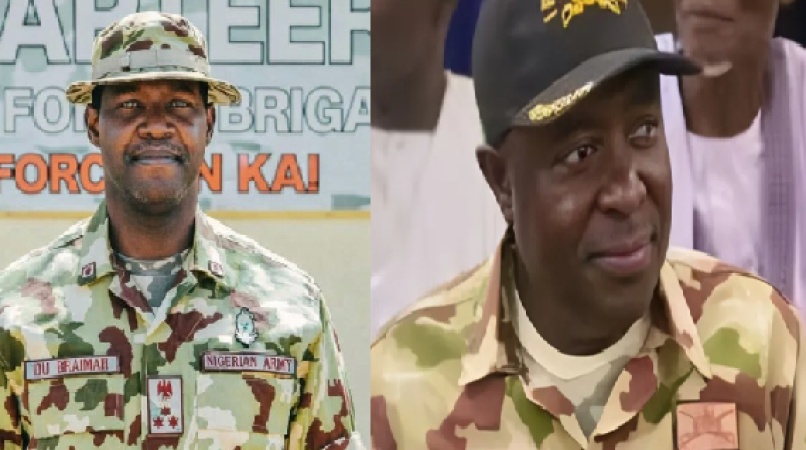
Nigeria's fallen heroes, Brig-Gen Oseni Omoh Braimah and Lt Col IA Mohammed
Fresh insurgent attacks, rising military losses and the fallout from a disputed Borno airstrike have intensified pressure on the Federal Government, heightening public concern over the effectiveness of Nigeria’s security strategy.
Less than a week after Boko Haram insurgents killed several soldiers, including Brigadier-General Oseni Omoh Braimah, the Nigerian Army has suffered fresh casualties.
A Lieutenant Colonel, I.A. Mohammed, and six soldiers were killed on Sunday in an improvised explosive device (IED) attack on troops of the 242 Battalion in Monguno, Borno State, underscoring the escalating security challenges.
Braimah was killed on April 9, 2026, when suspected Boko Haram fighters launched a coordinated attack on a military camp in Benisheikh, Borno State.
Confirming the latest incident in a statement issued in Maiduguri, the Media Information Officer of Operation Hadin Kai, Lt-Col Sani Uba, said the troops came under fire before an Army gun truck ran over a planted IED during the engagement.
“Regrettably, the Commanding Officer, Lt-Col Mohammed, proceeded to the troops’ location to personally assess the situation but encountered another planted IED, which severely damaged his vehicle, leading to his death alongside six other soldiers,” Uba said.
He said the officer’s decision to move towards the troops demonstrated courage, selfless service and commitment to duty.
“His willingness to move towards the troops despite the prevailing danger stood as a testament to his valour and dedication to the welfare and operational effectiveness of his men,” the statement added.
Operation Hadin Kai expressed condolences over the deaths, saying the sacrifice of the officer and soldiers would remain in the memory of the Armed Forces and the nation.
Meanwhile, President Bola Tinubu yesterday convened an emergency security meeting with service chiefs and heads of intelligence agencies at the State House, Abuja, amid mounting concerns over the country’s deteriorating security environment and the fallout from a controversial airstrike in Borno State.
The closed-door session brought together the Chief of Defence Staff, General Olufemi Oluyede; Chief of Army Staff, Lt Gen Waidi Shaibu; Chief of Naval Staff, Vice Admiral Idi Abbas; Chief of Air Staff, Air Marshal Sunday Aneke; Director-General of the Department of State Services (DSS), Oluwatosin Ajayi; Director-General of the National Intelligence Agency (NIA), Ambassador Mohammed Mohammed; and the Inspector-General of Police, Tunji Disu.
Also in attendance was the National Security Adviser, Nuhu Ribadu, alongside other senior security officials.
The high-level meeting comes at a time of heightened anxiety over Nigeria’s security trajectory, following a recent travel advisory issued by the United States Department of State authorising the voluntary departure of non-emergency personnel and their families from its embassy in Abuja.
The advisory, released on April 8, cited a “deteriorating security situation” and placed 23 of Nigeria’s 36 states under a Level 4: Do Not Travel classification, the highest risk category. Newly listed states include Plateau, Jigawa, Kwara, Niger and Taraba.
U.S. authorities pointed to persistent threats ranging from insurgency in the North-East to banditry in the North-West and North-Central, as well as violence in parts of the South and South-East, including oil-producing regions.
In response, the Federal Government dismissed the advisory as a routine precaution based on U.S. internal protocols, maintaining that it does not reflect the broader reality across the country.
The Minister of Information and National Orientation, Mohammed Idris, said while isolated security incidents persist, “there is no general breakdown of law and order, and the vast majority of the country remains stable.”
The emergency meeting also took place against the backdrop of a controversial Nigerian Air Force airstrike in Borno State, which has triggered widespread concern following reports of heavy civilian casualties.
The strike, carried out on Saturday at Jilli Market along the Borno–Yobe border, was reportedly aimed at suspected Boko Haram targets.
However, local sources claimed that more than 100 civilians may have been killed in the incident.
While the Nigerian Air Force confirmed conducting “precision mop-up airstrikes on identified terrorist locations” in the Jilli axis, it has not acknowledged civilian casualties or confirmed that a market was hit.
Presidency defends Borno airstrike, accuses Atiku of politicising military action
The Presidency, however, has defended the operation. Senior Special Assistant to the President on Media and Publicity, Tope Ajayi, said the location had been compromised by insurgents, describing the market as having evolved into “a legitimate military target” after being used as a logistics and trading hub by Boko Haram and ISWAP fighters.
The Presidency also faulted former Vice President Atiku Abubakar’s comments on the airstrike, describing his position as misleading, reckless and capable of undermining national security operations.
The Special Adviser to the President on Media and Communications, Mr Sunday Dare, said in a statement posted on his verified X handle that it was “disappointing” that Atiku had politicised what he described as an intelligence-led military operation targeting terrorist positions.
Dare was reacting to Atiku’s criticism of the Nigerian Air Force airstrikes, which the former vice president claimed targeted civilians.
According to Dare, the operation targeted insurgent positions around the Jilli axis, adding that the location, although still called a market, had long ceased to function as a civilian trading centre.
He said the area had been overtaken by Boko Haram and ISWAP elements and used as a logistics and supply base for their operations.
“Let us be clear: while the location may still be referred to as Jilli Market, it has not functioned as a legitimate civilian marketplace in any meaningful sense. By multiple credible accounts, it has evolved into an operational node within the insurgency’s supply chain,” he said.
The presidential aide warned that portraying the airstrike as an attack on civilians risked distorting public understanding and undermining troop morale.
He said it was inconsistent for Atiku to criticise government inaction on insecurity while also condemning decisive military action.
However, former Senate President, Senator Ahmad Lawan, called for an independent and transparent investigation into the incident, which reportedly claimed several civilian lives.
In a statement, Lawan said he was deeply saddened by reports from Jilli in Geidam Local Government Area of Yobe State, where an airstrike targeting suspected insurgents reportedly led to heavy civilian casualties.
He said eyewitness accounts indicated multiple aircraft were involved in the operation and that a market was hit, resulting in deaths and injuries.
While acknowledging the sacrifices of the Armed Forces in the fight against insurgency, Lawan said the scale of the incident required a thorough investigation.
“The victims deserve answers and justice,” he said.
He urged the Federal Government and military authorities to allow access for investigators, ensure medical care for survivors and provide compensation for affected families, stressing that the fight against terrorism must not erode the protection of innocent lives.
Obi seeks improved defence capacity, decisive action after Borno–Yobe airstrike
Reacting, the presidential candidate of the Labour Party in the 2023 general election, Peter Obi, described the recent airstrike at Jilli Market along the Borno–Yobe border as a wake-up call for Nigeria to strengthen its defence strategy and military capacity.
In a statement, Obi expressed condolences to the families of the victims, as well as the governments and people of Borno and Yobe states, over the reported loss of lives. He prayed for the repose of the dead and comfort for the bereaved.
He said he would refrain from drawing conclusions until full details of the incident, including casualty figures, are established.
Obi noted that such tragedies often arise from operational challenges, coordination gaps, ageing military platforms and equipment limitations. He said similar incidents in the past highlight the need to invest in modern fighter aircraft, upgrade existing platforms, and provide continuous training and retraining for military personnel.
He urged Nigerians to stand in solidarity with the military, noting that personnel risk their lives daily to secure the country. He also stressed the need for the armed forces to be properly equipped and supported to prevent avoidable tragedies.
Obi called on President Bola Ahmed Tinubu to demonstrate decisive leadership by strengthening the country’s security architecture and investing in modern defence capabilities to address the worsening security situation and prevent further loss of innocent lives.
Ndume urges Tinubu, global community to act on insecurity, rescue abductees
Also, the senator representing Borno South, Ali Ndume, appealed to President Bola Tinubu and the international community to intensify efforts to rescue abducted persons and address the worsening insecurity in the northern region.
Speaking on the escalating violence, Ndume urged the Federal Government to take concrete steps to address the crisis, saying citizens continue to face serious threats to their safety and livelihoods.
“We appeal to the President and the international community to get our people rescued. With the declared state of emergency on security, we hope the President will walk the talk,” he said.
The lawmaker said the insurgency, which began as an ideologically driven campaign associated with Boko Haram, has evolved into a complex mix of terrorism and criminality. He explained that criminal elements later infiltrated the movement, transforming its operations into a profit-driven enterprise involving kidnappings, robberies and other violent activities.
Ndume also noted that political interests during the early phase of the crisis contributed to a lack of decisive action, allowing the situation to deteriorate.
Describing the insurgency as a “cancer,” he said the crisis has spread beyond its initial epicentre in Borno, Adamawa and Yobe states to other parts of the country, particularly the North-West, where states such as Sokoto, Zamfara and Katsina are now experiencing similar patterns of violence, including mass killings and abductions.
The senator expressed concern over the continued suffering of residents in Bauchi, Adamawa, Borno and Yobe, stressing the need for urgent and coordinated intervention.
He urged leaders across the country to rise above regional interests and collectively demand accountability and decisive action from government authorities.
“This is no longer a matter of northern elders; it is a matter of Nigerian elders. They should stand up, speak the truth, and the government should do what is necessary because the purpose of government is the security and welfare of the citizens,” he said.
Ndume called for sustainable strategies to curb rising insecurity and restore peace to affected communities.
Army kills four insurgents, rescues three abductees in Borno
Meanwhile, troops of the Nigerian Army killed four Boko Haram fighters during a foiled attack and rescued three kidnapped persons in Askira Uba Local Government Area of Borno State.
Security analyst, Zagazola Makama, disclosed this on his X handle, citing military sources.
According to the report, the incident occurred at about 2:30 a.m. on April 12 after troops received reports of suspicious movement along the Damboa–Chibok axis.
Troops of the 115 Task Force Battalion, deployed in an ambush position at Mussa, engaged the insurgents and neutralised four of them, forcing others to flee.
The insurgents abandoned weapons and other items as they withdrew.
Later, at about 6:15 a.m., troops conducted follow-up operations near Old Hyum, where they rescued three kidnapped persons from a suspected terrorist enclave.
The victims, identified as Fulani from Lagunasa community in Askira Uba Local Government Area, are receiving care, while clearance operations continue in the area. (The Guardian)