Updating your news feed...

NEWS EXPRESS is Nigeria’s leading online newspaper. Published by Africa’s international award-winning journalist, Mr. Isaac Umunna, NEWS EXPRESS is Nigeria’s first truly professional online daily newspaper. It is published from Lagos, Nigeria’s economic and media hub, and has a provision for occasional special print editions. Thanks to our vast network of sources and dedicated team of professional journalists and contributors spread across Nigeria and overseas, NEWS EXPRESS has become synonymous with newsbreaks and exclusive stories from around the world.

























Loading banners
Loading banners...

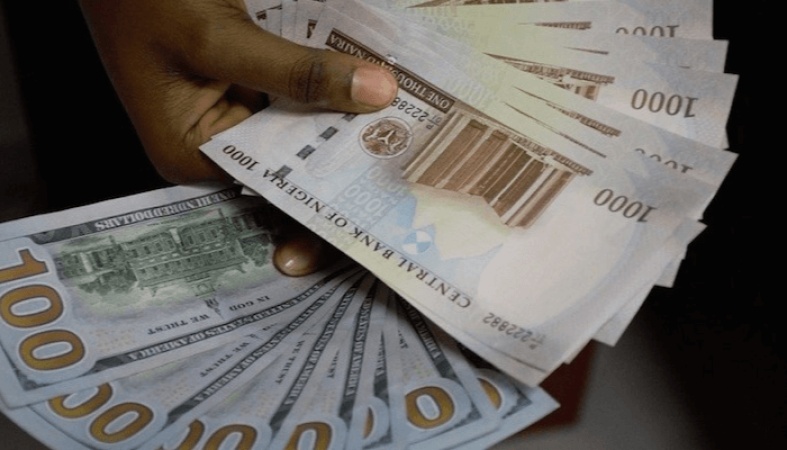
The naira strengthened over the four trading days of the week, supported by aggressive liquidity mop-up through Open Market Operations (OMO) by the Central Bank of Nigeria (CBN), which helped attract foreign inflows and boost demand for the local currency.
Data from the CBN showed that the naira appreciated by N23.90 week-on-week to close at N1,356.89 per dollar on Friday at the Nigerian Foreign Exchange Market (NFEM) window, compared with N1,380.79 quoted before the Easter holiday. This represents a gain of 1.76 percent.
On a day-on-day basis, the currency firmed by N12.43 or 0.92 percent from N1,359.32 on Thursday. Over the four trading sessions, the naira strengthened from N1,386.66 on Tuesday, the first trading day of the week, to N1,356.89 on Friday, translating to a gain of N29.77 or 2.19 percent.
In the parallel market, the naira also appreciated, gaining N10 week-on-week to close at N1,400 per dollar on Friday, compared with N1,410 recorded previously. On a daily basis, it strengthened by N5 from N1,405 quoted on Thursday.
Despite the broad-based appreciation, the spread between the official and parallel market rates widened to N44 per dollar from N30 the previous week.
Market participants attributed the currency’s performance to the Central Bank’s OMO auctions, which saw a total of N2.31 trillion mopped up during the week. The liquidity tightening typically incentivises foreign portfolio investors to bring in dollars to participate in the auctions, supporting the naira.
“Whenever there is an OMO auction, the naira usually appreciates because foreign investors bring dollars into the market to take positions,” an analyst said.
However, the gains in the foreign exchange market came amid continued pressure on Nigeria’s external reserves, which provide a buffer for currency stability. Data from the Central Bank showed that reserves declined by $1.14 billion to $48.88 billion as of April 8, 2026, representing a 2.28 percent drop from $50.02 billion recorded on March 11.
A macroeconomic report by Comercio Partners noted that Nigeria’s foreign exchange market remained relatively stable in March, despite mild depreciation pressures. The naira hovered within a narrow range during the month, opening at N1,376 per dollar and closing at N1,387, reflecting a depreciation of 0.79 percent with limited volatility.
According to the report, the marginal weakening was driven by external debt service obligations and sustained interventions by the Central Bank to manage liquidity and support the currency. Average exchange rates for the period reflected ongoing demand for foreign exchange for imports and other obligations, partly offset by official dollar sales.
The report also highlighted that global factors, including oil price fluctuations and demand for foreign exchange for invisibles, contributed to pressure on the currency, although the Central Bank’s active participation helped prevent sharp swings.
Analysts at Comercio Partners expect the naira to face mild to moderate depreciation pressures in April, with the market likely to remain in a consolidation phase under the current willing-buyer, willing-seller framework. However, risks persist, particularly from potential oil price volatility and sustained import demand.
Comercio Partners also pointed to a recent policy shift allowing international oil companies to fully repatriate export proceeds, which, while aimed at improving transparency and attracting investment, has contributed to short-term foreign exchange outflows and added pressure on reserves.
Looking ahead, the firm expects external reserves to stabilise or recover modestly, supported by elevated crude oil prices, although production constraints remain a limiting factor for Nigeria’s foreign exchange inflows. (Business Day)